Important Documents resources
Plain-English explanations, worked math, and what it means for you.
You can start with the basics.
Learn the words, follow the numbers, and understand what a choice could mean for your life. Start with the first action. Open examples and explanations when you need them, then continue in the related tool.
Your first useful action
Identify the receiving organization and ask for its exact document requirements before gathering copies. Make a list of document types and where originals are kept.
A worked example
An office may ask for proof of address dated within a specific period. Write its accepted documents and date range rather than assuming any envelope will work.
What people often mix up
A copy, a certified copy, and an original are different. A planning template does not replace an official form when one is required.
What to ask when you are stuck
“Which versions are accepted, how recent must they be, and what alternatives are allowed if I do not have that document?”
Ask the organization or person responsible for the decision. Write down the answer, date, and any next action. If their answer uses an unfamiliar word, find it in Words explained below.
How to know this first action is finished
Your list matches the receiving office’s instructions and you know how to submit each item securely.
Locate a record without exposing its number
- Name one document and write the secure location of its original and any permitted copy.
- Check the receiving office’s accepted version and submission method.
- For a missing item, use the issuer’s official replacement process and record a confirmation.
Check your result: You can retrieve the required version without storing sensitive numbers in a shared worksheet.
If something changes
If the office requests a certified or newer copy, follow that requirement rather than resending the same rejected copy.
Practical how-to guides
Start with one useful skill. Clear instructions and a checklist help you through it.
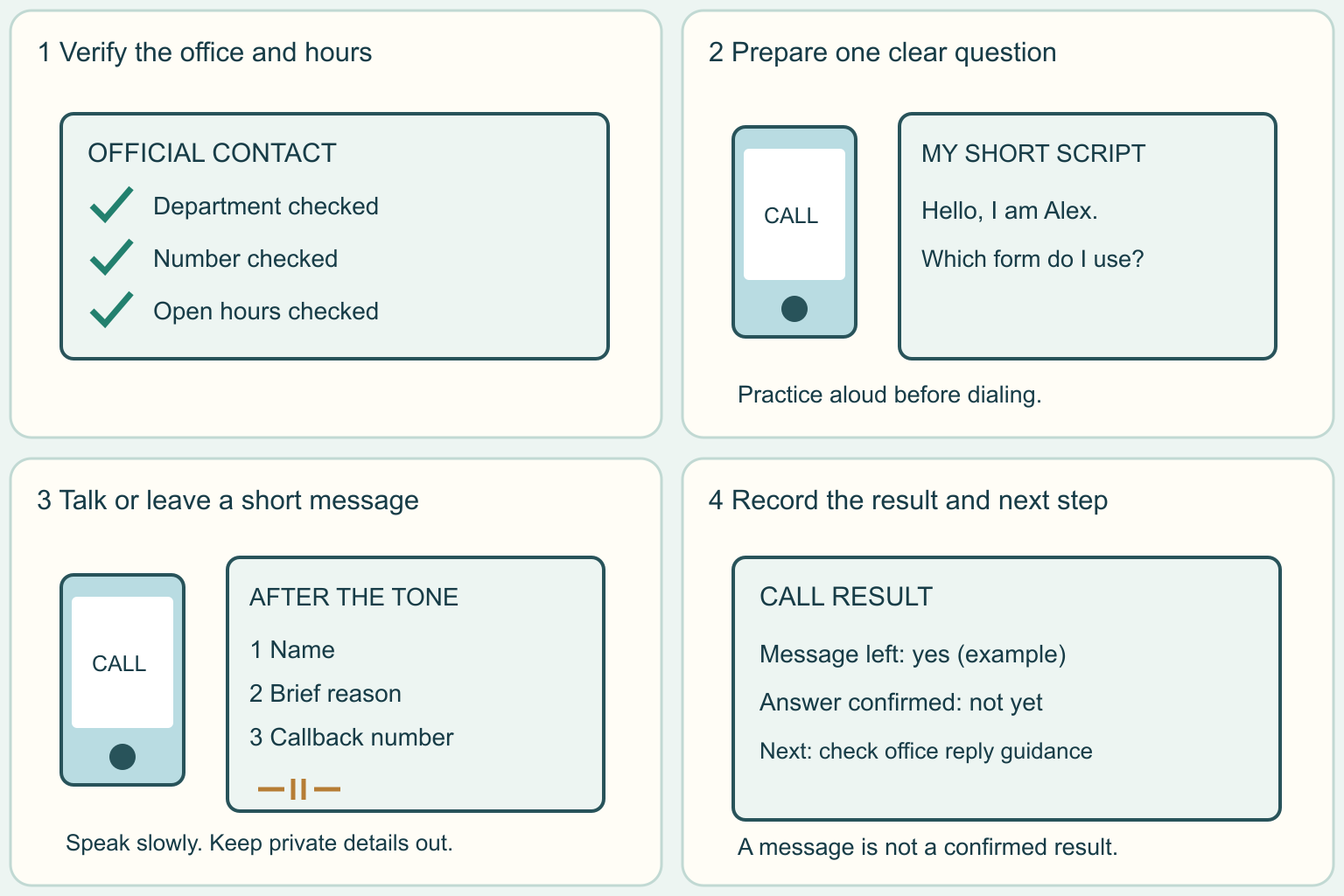
Make a routine office call and leave a clear voicemail
Prepare one simple question, call a verified office number, and know what to say if a person or voicemail answers.
4 clear steps · checklist & download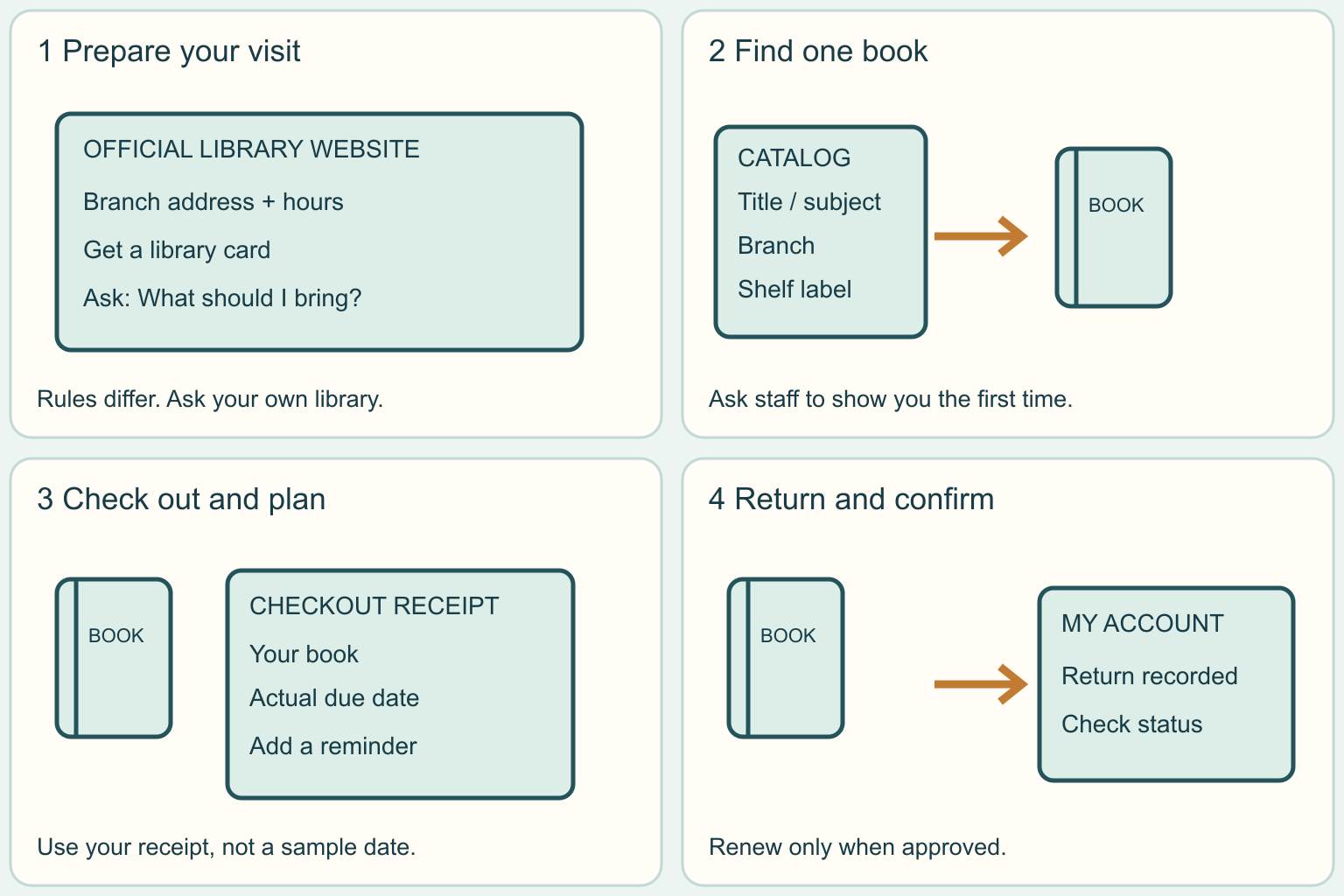
Borrow and return your first library book
Find a library, ask for help, check out one book, and bring it back on time. The examples use U.S. public libraries; your own library sets its rules.
4 clear steps · checklist & download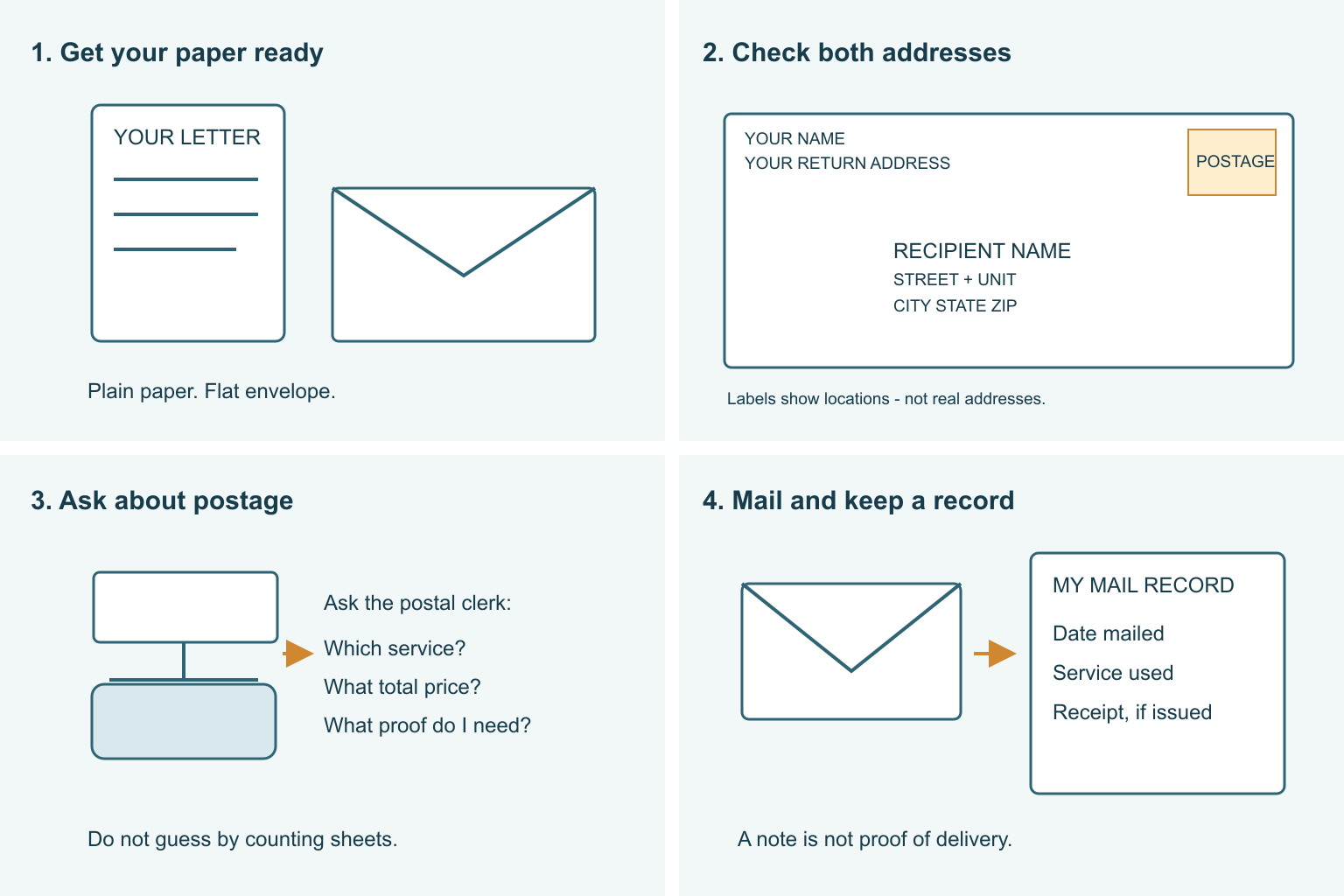
Address and mail a plain paper letter
Learn which address goes where, what postage means, and where to take a simple letter. This guide uses U.S. Postal Service rules; other countries have their own postal instructions.
4 clear steps · checklist & download · YouTube companionPrepare to replace a lost official document
Use the issuing office’s current process and avoid unnecessary disclosure.
4 clear steps · checklist & downloadWhat to bring
Choose the document you need first. Each issuing office sets its own evidence rules; you do not need every item for every visit.
Prepare the items that apply to your task. For an appointment or application, confirm the receiving organization’s exact requirements. “Ready” means you have reviewed and prepared the item.
Accepted identification
Why you may need it
Shows who you are. The accepted list depends on the service.
Where to get it
Use a current document you already have, or apply through the state ID agency or other issuing office.
Check before you go
Ask for the exact ID list. A school card, membership card, expired ID, or phone photo may not count.
Proof of your home address
Why you may need it
Shows where you live. It is a separate check from identity.
Where to get it
Download an eligible bill or statement from the provider, obtain your lease, or ask about an approved residency letter.
Check before you go
Confirm document type, how recent it must be, whose name must appear, physical address, and whether a printed copy is needed.
Name-change or relationship evidence, if needed
Why you may need it
Connects records that show different names or proves a required relationship.
Where to get it
Request certified marriage, court, adoption, or birth records from the correct issuing office.
Check before you go
Ask which chain of documents is needed and whether certified copies are required. A social-media name is not legal evidence.
Existing record or certified vital-record copy
Why you may need it
May support a new ID, passport, or replacement request.
Where to get it
Use the issuing state vital-records office, court, SSA, DMV, or State Department as appropriate.
Check before you go
A photocopy, notarized copy, and certified copy are different. Ask what counts and whether originals are returned.
Application, compliant photo, and appointment confirmation when required
Why you may need it
Supports the specific application.
Where to get it
Get the current form and photo rules from the issuing agency.
Check before you go
Passport applicants of different ages have different attendance/consent rules. Do not sign a form early if instructed to wait.
Accepted payment method and fee amount
Why you may need it
Pays the required application, service, or appointment fee.
Where to get it
Check the official fee page or call the office; ask whether it accepts a card, check, money order, or cash.
Check before you go
Verify the total and who it is payable to. Government offices and different fees may use different payment rules.
0 of 6 reviewed and prepared. These ticks save in this browser only.
A question you can read aloud
“I need this specific document. What evidence do you accept if I do not already have a photo ID, and which records must be certified?”
Keep actual documents in a secure place. Do not put Social Security numbers, full account or ID numbers, passwords, or document images into My Vault notes.
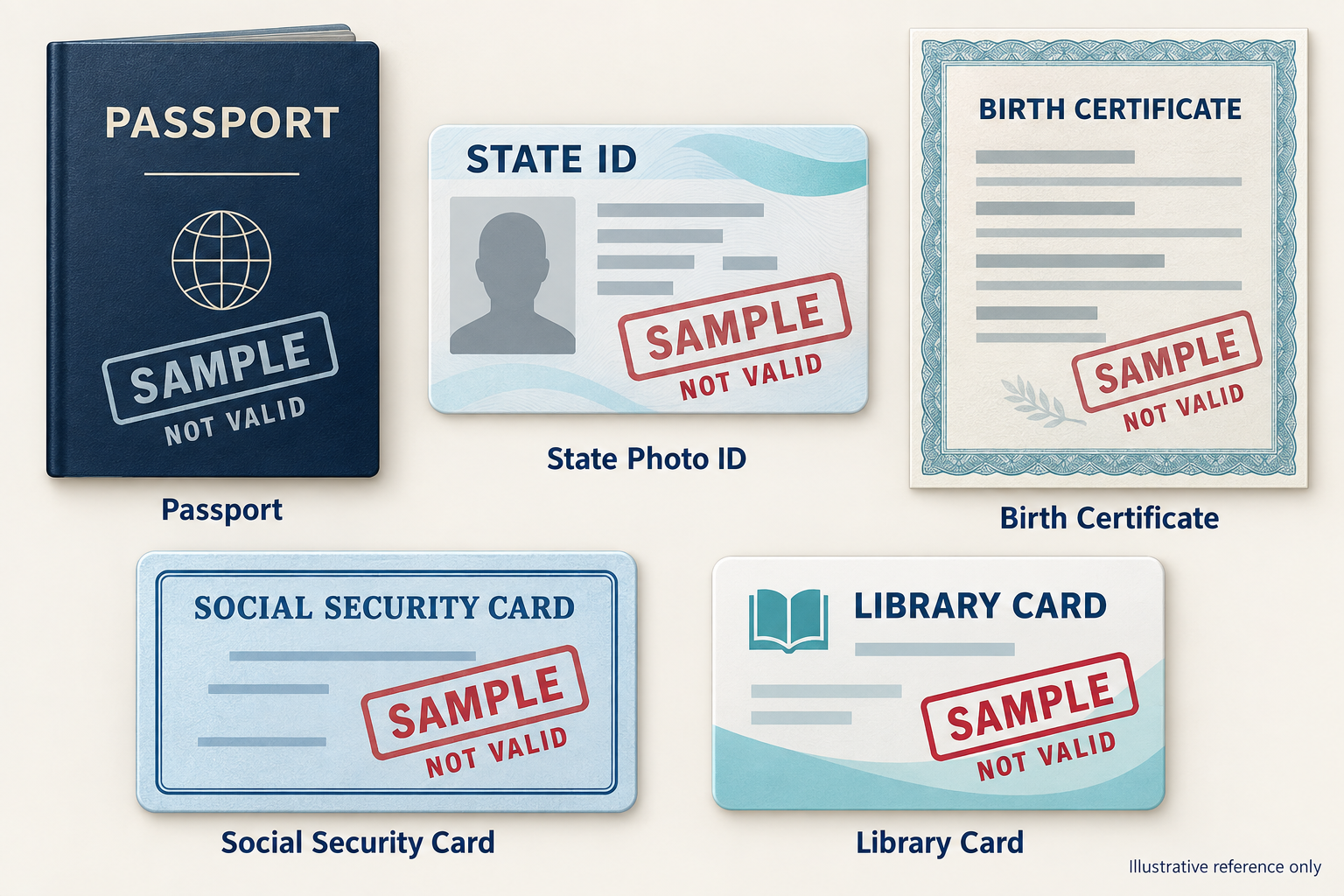
See how DMV and Post Office address rules differ →Picture guideSee labeled examples of the things you are learning about.
Words, in plain English
24 terms in Important Documents · Open any word to learn more.
BeneficiaryThe person or organization named to receive money or another benefit under an account or policy.
How it works
For example, a life-insurance policy owner may name who receives a covered death benefit. This is different from an emergency contact. The owner or other authorized person follows the provider’s signing rules; some changes require additional consent. A beneficiary does not automatically control the policy or sign for the owner. Ask about primary and backup choices, minors, and any special rules.
A small example
You name Jordan as a primary beneficiary and Casey as a backup under the provider’s rules. You later marry; check the record because marriage does not automatically update every designation.
Start here, one step at a time
- Review the current beneficiary with the account or policy provider.
- Use its official change form and ask when the change becomes effective.
Try explaining this word yourself
Before looking back, explain “Beneficiary” in your own words. Which part of the example shows it?
Then compare your explanation with “The person or organization named to receive money or another benefit under an account or policy.” and the example above. If it is still unclear, use the question below with the relevant office or provider.
A question you can ask
“How do I update this designation, and when does it become effective?”
NAIC: find your state insurance department (opens a new tab)Birth certificateA government record of a birth, usually listing when and where a person was born and their parents.
How it works
For a U.S. birth, the birth is registered with the responsible vital-records office. A certified copy comes from the state or territory where the birth occurred, sometimes through a local office. A hospital souvenir is not the same thing.
A small example
If you were born in Ohio and now live elsewhere, start with Ohio’s vital-records instructions.
Start here, one step at a time
- Use USAGov’s birth-certificate page to find the correct issuing office.
- Check who may order, accepted ID, fee, and delivery time.
- For a birth abroad, use the separate consular-record or foreign-record route that fits your birth.
Try explaining this word yourself
Before looking back, explain “Birth certificate” in your own words. Which part of the example shows it?
Then compare your explanation with “A government record of a birth, usually listing when and where a person was born and their parents.” and the example above. If it is still unclear, use the question below with the relevant office or provider.
A question you can ask
“How do I prove I may request this record, and is this the certified version I need?”
USAGov: get a certified birth certificate (opens a new tab)See a labeled picture
Certified copyAn official copy verified by the issuing authority.
How it works
Ask the organization requesting the document what form it accepts. A photocopy, notarized copy, and certified government copy are not interchangeable.
A small example
A phone picture may help you remember details but may not be accepted for an official application.
Start here, one step at a time
- Ask the receiving organization which version it needs.
- Order the certified copy from the issuing authority when that is required.
Try explaining this word yourself
Before looking back, explain “Certified copy” in your own words. Which part of the example shows it?
Then compare your explanation with “An official copy verified by the issuing authority.” and the example above. If it is still unclear, use the question below with the relevant office or provider.
A question you can ask
“Do you need the original, a certified copy, or a plain copy?”
USAGov: official document replacements (opens a new tab)Driver’s license and license numberA state document that allows you to drive certain vehicles under its rules.
How it works
The card usually has a number labeled “DL,” “DLN,” “License No.,” or something similar. That is different from a vehicle’s VIN. Restrictions and expiration still matter.
A small example
An insurer asks for your license number to identify the driver and your VIN to identify the car.
Start here, one step at a time
- Read the front and back of your card. Look for the license-number label.
- If unclear, use your state agency’s sample card or call its official number.
- Share the number only with a verified organization that needs it.
Try explaining this word yourself
Before looking back, explain “Driver’s license and license number” in your own words. Which part of the example shows it?
Then compare your explanation with “A state document that allows you to drive certain vehicles under its rules.” and the example above. If it is still unclear, use the question below with the relevant office or provider.
A question you can ask
“Where is the license number on my state’s card, and which restrictions apply to me?”
USAGov: state motor-vehicle services (opens a new tab)See a labeled picture
Emergency contactA person an organization should try to reach if you need urgent help.
How it works
Choose someone who agrees to be contacted and can usually answer. Give the requested name, relationship, and phone number. Schools, employers, and clinics keep separate records. This does not by itself make the person a legal guardian, medical decision-maker, co-signer, or beneficiary.
A small example
You list your aunt at college with her permission. If the school needs to reach someone about an emergency, it can call her. That does not let her sign a loan for you.
Start here, one step at a time
- Ask someone dependable whether you may list them.
- Confirm their number, enter it separately at school and work, and update it when it changes.
Try explaining this word yourself
Before looking back, explain “Emergency contact” in your own words. Which part of the example shows it?
Then compare your explanation with “A person an organization should try to reach if you need urgent help.” and the example above. If it is still unclear, use the question below with the relevant office or provider.
A question you can ask
“Who should be contacted first, and what should they know?”
Ready.gov: household preparation (opens a new tab)Expiration and renewalExpiration is when a document or agreement stops being valid under its terms; renewal extends or replaces it.
How it works
Record deadlines and check the issuing agency’s requirements early. A reminder email is helpful but may not be guaranteed.
A small example
A renewal application may need processing time before a card expires.
Start here, one step at a time
- Check the date printed on the current record.
- Use the issuer’s renewal instructions early enough for processing and delivery.
Try explaining this word yourself
Before looking back, explain “Expiration and renewal” in your own words. Which part of the example shows it?
Then compare your explanation with “Expiration is when a document or agreement stops being valid under its terms; renewal extends or replaces it.” and the example above. If it is still unclear, use the question below with the relevant office or provider.
A question you can ask
“How early can I renew, and what proof remains valid while I wait?”
USAGov: official document replacements (opens a new tab)Government photo IDA card or document from a government that has your name and picture.
How it works
Examples include a state ID, driver’s license, or passport. The place checking your identity decides which documents it accepts. An expired card or a phone photo may not qualify.
A small example
A library may accept a school ID under its rules. An airport uses a different list.
Start here, one step at a time
- Find the office’s official list for the service you need.
- Compare your document’s name and expiration date with that list.
- Bring the required physical document; ask before relying on a phone copy.
Try explaining this word yourself
Before looking back, explain “Government photo ID” in your own words. Which part of the example shows it?
Then compare your explanation with “A card or document from a government that has your name and picture.” and the example above. If it is still unclear, use the question below with the relevant office or provider.
A question you can ask
“Which exact IDs do you accept for this service, and must they be unexpired?”
USAGov: official document replacements (opens a new tab)See a labeled picture
Insurance card and declarations pageAn insurance card is a short proof of coverage. A declarations page summarizes a policy’s people, property, dates, limits, and deductibles.
How it works
Neither is the complete policy. Read the full terms and check the state’s required proof format. Do not assume that a saved old card proves coverage is still active.
A small example
A registration appointment may require current insurance information matching your vehicle.
Start here, one step at a time
- Get the current documents from your insurer’s official app, website, or agent.
- Check names, VIN, dates, and coverage details.
- Use the state insurance department and motor-vehicle agency for your state’s requirements.
Try explaining this word yourself
Before looking back, explain “Insurance card and declarations page” in your own words. Which part of the example shows it?
Then compare your explanation with “An insurance card is a short proof of coverage. A declarations page summarizes a policy’s people, property, dates, limits, and deductibles.” and the example above. If it is still unclear, use the question below with the relevant office or provider.
A question you can ask
“Is my policy active, who and what is covered, and what proof format does my state accept?”
NAIC: find your state insurance department (opens a new tab)See a labeled picture
Learner’s permitPermission to practice driving under specific limits. It is not an unrestricted license.
How it works
Your state sets age, testing, supervision, practice, and driving-hour rules. Passing a written test does not mean you can drive alone.
A small example
A permit holder may need a qualified licensed adult in the front seat. Check your state’s exact rule.
Start here, one step at a time
- Open your state’s page for a first permit for your age.
- Read its study handbook and application-document list.
- Arrange required tests and practice with a person who meets the rules.
Try explaining this word yourself
Before looking back, explain “Learner’s permit” in your own words. Which part of the example shows it?
Then compare your explanation with “Permission to practice driving under specific limits. It is not an unrestricted license.” and the example above. If it is still unclear, use the question below with the relevant office or provider.
A question you can ask
“Who may supervise me, when may I drive, and what comes next?”
USAGov: state motor-vehicle services (opens a new tab)See a labeled picture
Library cardA card or account that lets you use a particular library’s services.
How it works
It may let you borrow books, use computers, or download materials. Public libraries set their own residency, age, and proof rules. It is not a general substitute for an accepted government photo ID.
A small example
A free library card may give you access to e-books. Some services or late/lost-item charges depend on the library.
Start here, one step at a time
- Find your local library through its official website.
- Open “Get a library card” or call the desk.
- Bring the listed documents and ask staff to show you one service you want to use.
Try explaining this word yourself
Before looking back, explain “Library card” in your own words. Which part of the example shows it?
Then compare your explanation with “A card or account that lets you use a particular library’s services.” and the example above. If it is still unclear, use the question below with the relevant office or provider.
A question you can ask
“What do I need to join, which services are free, and does a minor need an adult?”
USAGov: find your public library (opens a new tab)See a labeled picture
Marriage license and certificateA license authorizes marriage under local rules; a certificate records the marriage after the required process.
How it works
Contact the actual state or local issuing office for timing, identification, fees, and filing. Ordering a certificate is not the same as applying for a license.
A small example
You might need a certified certificate later for an account or name-change process.
Start here, one step at a time
- Find the real county/state marriage-license office.
- Ask who attends, brings ID, signs, returns the license, and orders the certified certificate.
Try explaining this word yourself
Before looking back, explain “Marriage license and certificate” in your own words. Which part of the example shows it?
Then compare your explanation with “A license authorizes marriage under local rules; a certificate records the marriage after the required process.” and the example above. If it is still unclear, use the question below with the relevant office or provider.
A question you can ask
“Which office issues the license, who returns it, and how do we order certified copies?”
USAGov: marriage licenses and certificates (opens a new tab)Membership cardProof that you have an account with a club, store, gym, or other service.
How it works
Costco, Sam’s Club, and Planet Fitness memberships give access under that business’s rules. These cards are not government IDs. A picture on a card does not make it a government ID.
A small example
A gym card may open the gym door but not satisfy a passport application’s identity requirement.
Start here, one step at a time
- Check the business’s official membership terms and age rules.
- Ask what is included and whether charges repeat.
- Keep the agreement and cancellation instructions with your bill reminders.
Try explaining this word yourself
Before looking back, explain “Membership card” in your own words. Which part of the example shows it?
Then compare your explanation with “Proof that you have an account with a club, store, gym, or other service.” and the example above. If it is still unclear, use the question below with the relevant office or provider.
A question you can ask
“What is the total fee, what ID is needed to join, and how do I cancel?”
FTC: subscriptions and cancellation (opens a new tab)See a labeled picture
Notary publicA person authorized to perform certain acts involving signatures, identity, and sometimes oaths.
How it works
A notary does not make a document’s promises true or give it automatic legal approval. The document’s instructions and state rules decide the act, ID, witnesses, and signer requirements.
A small example
A notary may verify that you acknowledged your signature. That does not mean the notary wrote or approved your contract.
Start here, one step at a time
- Ask the receiving office exactly what needs notarizing.
- Call your bank, a local notary, or a participating UPS Store; confirm appointment, ID, witnesses, and fees.
- Bring the complete document and follow the notary’s instructions about signing. FedEx Office advertises an online service, not a notary at every store.
Try explaining this word yourself
Before looking back, explain “Notary public” in your own words. Which part of the example shows it?
Then compare your explanation with “A person authorized to perform certain acts involving signatures, identity, and sometimes oaths.” and the example above. If it is still unclear, use the question below with the relevant office or provider.
A question you can ask
“Which notarial act and witnesses are required, and what is the full fee?”
The UPS Store: participating notary locations (opens a new tab)See a labeled picture
Passport book and passport cardA U.S. passport proves U.S. citizenship and identity for specified travel uses.
How it works
The book is used for international air travel. The card has limited land and sea uses and cannot replace the book for international flights. A passport does not replace a required visa or guarantee entry.
A small example
For a flight abroad, check passport-book and destination entry rules before buying nonrefundable travel.
Start here, one step at a time
- Open the State Department’s passport site and select your age and situation.
- Follow the correct application or renewal route, photo rules, evidence list, and fee instructions.
- Allow processing plus mailing time; check the current timeline before setting travel dates.
Try explaining this word yourself
Before looking back, explain “Passport book and passport card” in your own words. Which part of the example shows it?
Then compare your explanation with “A U.S. passport proves U.S. citizenship and identity for specified travel uses.” and the example above. If it is still unclear, use the question below with the relevant office or provider.
A question you can ask
“Which passport type and validity period does my trip require?”
U.S. State Department: passport applications (opens a new tab)See a labeled picture
Pay stubThe itemized explanation of a paycheck.
How it works
Compare hours, rate, gross earnings, deductions, and take-home pay. Report a mismatch to payroll with your own time record.
A small example
$300 gross minus $40 of example deductions leaves $260 net pay. Actual deductions vary.
Start here, one step at a time
- Compare your own time record with paid hours and rate.
- Ask payroll about unfamiliar deductions or missing hours promptly.
Try explaining this word yourself
Before looking back, explain “Pay stub” in your own words. Which part of the example shows it?
Then compare your explanation with “The itemized explanation of a paycheck.” and the example above. If it is still unclear, use the question below with the relevant office or provider.
A question you can ask
“Can you explain each deduction and correct these hours if they are wrong?”
U.S. Department of Labor: youth employment (opens a new tab)Proof of address / proof of residencyEvidence that you live at the address you give an organization.
How it works
It is different from proving who you are. Accepted documents, dates, names, and formats vary by service. An envelope with your name on it is not automatically enough.
A small example
A DMV may accept a utility bill that is not on the USPS PO Box identification list.
Start here, one step at a time
- Find the specific office’s current document list.
- Match the name, physical address, date, and format requirements.
- If you live with someone else or have no fixed address, ask for its approved alternative process.
Try explaining this word yourself
Before looking back, explain “Proof of address / proof of residency” in your own words. Which part of the example shows it?
Then compare your explanation with “Evidence that you live at the address you give an organization.” and the example above. If it is still unclear, use the question below with the relevant office or provider.
A question you can ask
“Which documents count for this exact service, how recent, and how many do you need?”
USPS: ID accepted for each postal service (opens a new tab)See a labeled picture
REAL IDA standard that some state IDs and driver’s licenses meet for certain federal identification uses.
How it works
REAL ID is not a separate driving skill or proof of U.S. citizenship. Adults flying within the U.S. need a TSA-accepted ID; a passport is one alternative. A standard license can still be valid for driving.
A small example
You may choose a REAL ID state card even if you do not drive. A REAL ID is not a passport for international air travel.
Start here, one step at a time
- Check TSA’s current accepted-ID list for your trip.
- If applying for REAL ID, open your state’s REAL ID checklist.
- Gather the required identity, name-change, Social Security, and address evidence that applies to you.
Try explaining this word yourself
Before looking back, explain “REAL ID” in your own words. Which part of the example shows it?
Then compare your explanation with “A standard that some state IDs and driver’s licenses meet for certain federal identification uses.” and the example above. If it is still unclear, use the question below with the relevant office or provider.
A question you can ask
“Do I need a REAL ID for my plans, or do I already have another accepted document?”
TSA: accepted identification (opens a new tab)See a labeled picture
Social Security number and cardA Social Security number identifies your Social Security record. The card shows that number and your name.
How it works
It is not a photo ID. A replacement card is free through the Social Security Administration. You often need the number, not the physical card; ask what the process actually requires.
A small example
A replacement card normally keeps the same number. Do not enter that number in this website’s notes.
Start here, one step at a time
- Start at SSA.gov using the official replacement-card process.
- Answer the eligibility questions to learn whether you can finish online or must visit.
- Follow its evidence rules; keep the card secure instead of carrying it every day.
Try explaining this word yourself
Before looking back, explain “Social Security number and card” in your own words. Which part of the example shows it?
Then compare your explanation with “A Social Security number identifies your Social Security record. The card shows that number and your name.” and the example above. If it is still unclear, use the question below with the relevant office or provider.
A question you can ask
“Do you need the number, the physical card, or another accepted document?”
USAGov: get or replace a Social Security card (opens a new tab)See a labeled picture
State ID cardA state-issued card used to show who you are. It does not give permission to drive.
How it works
Apply through your state’s motor-vehicle agency or other issuing office. It may offer a standard card and a REAL ID version with different document requirements.
A small example
Someone who rides the bus can get a state ID without taking a driving test.
Start here, one step at a time
- Choose your state in the official motor-vehicle directory.
- Find “identification card,” not “driver license renewal.”
- Use its checklist, gather documents, and make the required appointment.
Try explaining this word yourself
Before looking back, explain “State ID card” in your own words. Which part of the example shows it?
Then compare your explanation with “A state-issued card used to show who you are. It does not give permission to drive.” and the example above. If it is still unclear, use the question below with the relevant office or provider.
A question you can ask
“What documents, fee, appointment, and parent or guardian involvement apply to my age?”
USAGov: state motor-vehicle services (opens a new tab)See a labeled picture
State safety inspection and emissions testChecks some states or local areas require for certain vehicles.
How it works
Safety inspections and emissions tests are different. Requirements can depend on the state, county, vehicle age, fuel type, and registration situation. An EV exemption from emissions does not mean exemption from all inspections.
A small example
A car moving to another state may need different checks before registration.
Start here, one step at a time
- Open your state motor-vehicle agency from the official directory.
- Find registration renewal and inspection requirements for your vehicle and county.
- Use its approved-station list and keep the required proof or electronic confirmation.
Try explaining this word yourself
Before looking back, explain “State safety inspection and emissions test” in your own words. Which part of the example shows it?
Then compare your explanation with “Checks some states or local areas require for certain vehicles.” and the example above. If it is still unclear, use the question below with the relevant office or provider.
A question you can ask
“For my ZIP code, vehicle, and renewal year, which checks are required and where are approved stations?”
USAGov: state motor-vehicle services (opens a new tab)See a labeled picture
TranscriptAn official record of courses and grades from a school.
How it works
Request it through the school’s registrar, counseling office, or approved portal. A screenshot may not meet an official-transcript requirement.
A small example
A college may require your high school to send the final transcript after graduation.
Start here, one step at a time
- Contact your school’s counselor or registrar.
- Give the exact recipient and deadline; check that the official record arrived.
Try explaining this word yourself
Before looking back, explain “Transcript” in your own words. Which part of the example shows it?
Then compare your explanation with “An official record of courses and grades from a school.” and the example above. If it is still unclear, use the question below with the relevant office or provider.
A question you can ask
“Who must send it, where should it go, and what is the deadline?”
Vehicle title and registrationA title records vehicle ownership; registration authorizes vehicle use under your state’s rules.
How it works
Follow the state motor-vehicle office’s transfer, registration, insurance, and renewal steps. Paying a seller does not finish all the paperwork.
A small example
A used-car purchase may require a title transfer plus registration and other state requirements.
Start here, one step at a time
- Find your state’s page for your exact purchase, transfer, or renewal.
- Gather the listed ownership, identity, insurance, inspection, and payment items before going.
Try explaining this word yourself
Before looking back, explain “Vehicle title and registration” in your own words. Which part of the example shows it?
Then compare your explanation with “A title records vehicle ownership; registration authorizes vehicle use under your state’s rules.” and the example above. If it is still unclear, use the question below with the relevant office or provider.
A question you can ask
“Which forms, fees, inspections, and deadlines apply to this purchase?”
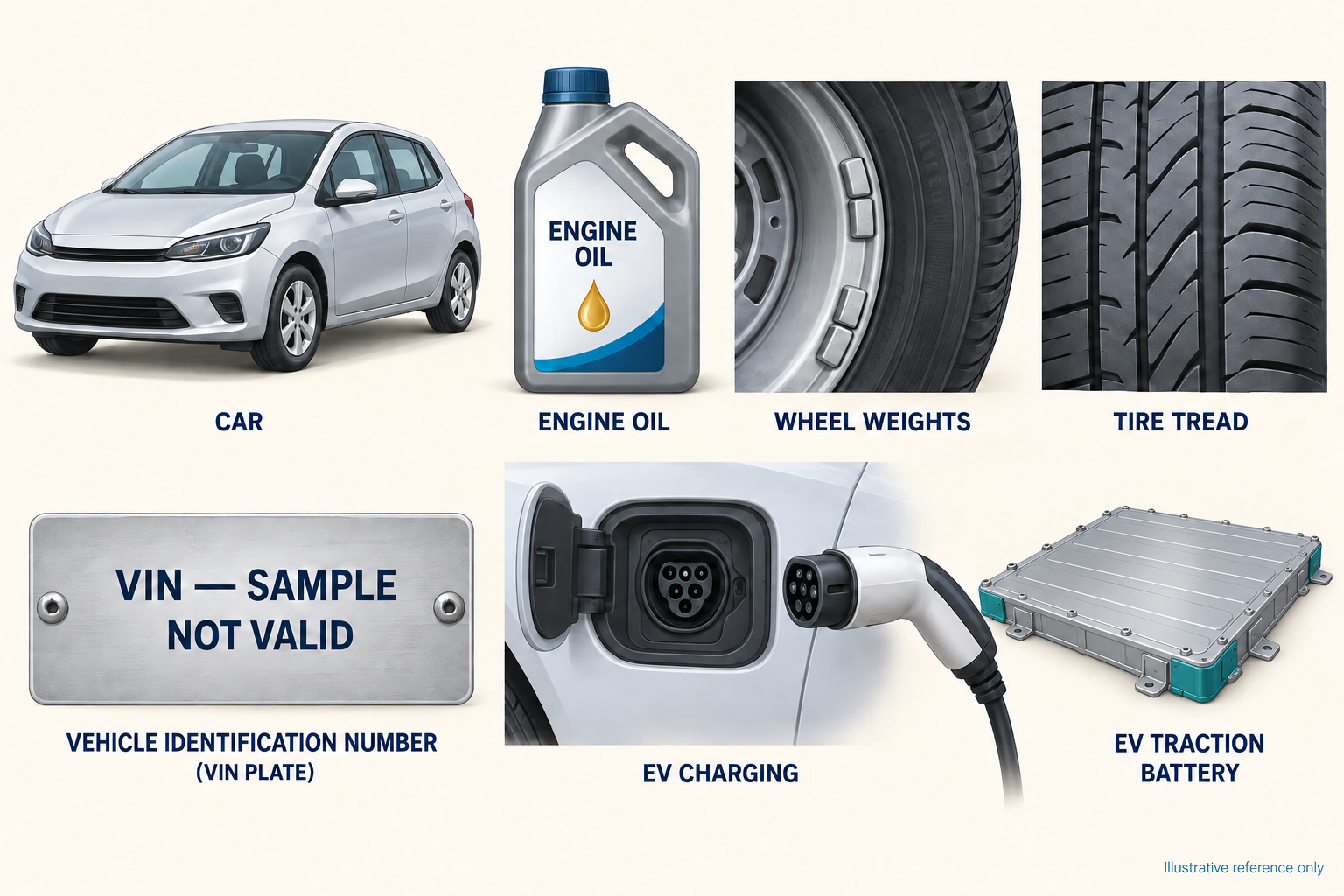
USAGov: state motor-vehicle services (opens a new tab)VIN — vehicle identification numberThe identifying number for a particular vehicle, like its own serial number.
How it works
For most modern cars it has 17 characters. You can often see it through the windshield on the driver’s side of the dashboard or on a driver-door label. Registration and insurance records also list it.
A small example
Two cars of the same model have different VINs. Your driver’s license number identifies you, not the car.
Start here, one step at a time
- Park safely and look through the windshield from outside.
- Compare with the door label and registration without removing any parts.
- Use the exact characters when requesting insurance or checking recalls.
Try explaining this word yourself
Before looking back, explain “VIN — vehicle identification number” in your own words. Which part of the example shows it?
Then compare your explanation with “The identifying number for a particular vehicle, like its own serial number.” and the example above. If it is still unclear, use the question below with the relevant office or provider.
A question you can ask
“Do these VINs match on the vehicle and the paperwork?”
NHTSA: vehicle identification numbers (opens a new tab)See a labeled picture
Voter registration and voter cardVoter registration adds an eligible person to the voter list. A voter card may confirm that record.
How it works
Eligibility, registration deadlines, and accepted voting IDs depend on your state. A voter card usually is not a general-purpose photo ID. Registering is not the same as voting.
A small example
After a move, check both your registration address and where or how you may vote.
Start here, one step at a time
- Use Vote.gov to reach your state’s official election instructions.
- Check eligibility and deadlines before applying or updating.
- Use the state’s status tool and voting-ID list before election day.
Try explaining this word yourself
Before looking back, explain “Voter registration and voter card” in your own words. Which part of the example shows it?
Then compare your explanation with “Voter registration adds an eligible person to the voter list. A voter card may confirm that record.” and the example above. If it is still unclear, use the question below with the relevant office or provider.
A question you can ask
“Am I eligible, is my record current, and what must I bring to vote here?”
USAGov: state voter-ID rules (opens a new tab)See a labeled picture
What this means for you
Correct documents can be necessary to enroll, work, travel, or complete other applications.
What can make it harder
An expired document, a name mismatch, or the wrong kind of copy can delay a process and sometimes add rush costs.
What can help
Keeping originals secure and knowing where to request accepted copies makes future tasks easier.
One next stepAsk the receiving organization exactly what it accepts and when it needs it. Then use the official issuing office.
Plan the cost of document copies
Fees vary by issuing office. These are made-up prices to show how to budget.
Confirm the kind of copy first
Ask whether the recipient needs a certified copy or a regular photocopy before buying anything.
Multiply the unit price
If certified copies are $15 each and you need two: 2 × $15 = $30.
Add separate charges
$30 copies + $5 shipping = $35 total in this example.
Compare urgency
If optional faster processing adds $20, the new total is $55. Check whether ordinary processing meets your actual deadline.
What the answer tells youUse the official office’s current fee and processing information. A paid shortcut may be unnecessary if you start early.
Requesting the right kind of document copy
The recipient’s requirements determine whether a regular or certified copy works.
What can make it harder
Paying for the wrong format wastes time and can delay an appointment.
What can help
Ask the receiving office for its exact accepted evidence before ordering.
One next stepConfirm one document’s required format with the recipient.
Count backward from an appointment
A document appointment is 35 days away and a listed service estimate is 21 days.
- 1
Find the nominal margin
35 − 21 = 14 days.
- 2
Include shipping
If shipping adds 5 days, 14 − 5 = 9 days left.
- 3
Avoid treating estimates as guarantees
Nine days is a planning margin, not a promised delivery date.
What the answer tells youAsk the issuer whether processing and shipping use calendar or business days.
Go a little deeper
Open a lesson when you need the full explanation. You can return to it at any time.
Prove where you live: DMV, Post Office, and no bills in your nameA bill accepted in one place may be refused somewhere else. Start with the exact service.
1. Name the job before gathering papers
Say what you are doing: “I am applying for my first state ID,” “I want a REAL ID,” “I need a PO Box,” or “I am forwarding mail.” These are different services with different lists. Identity means who you are. Residency means where you live. A passport may prove identity without proving your current street address.
2. For a license or state ID, use your state’s list
Open the official state motor-vehicle site using the directory below. Choose the exact service and your age. Look for “documents,” “residency,” or “proof of address.” Common categories on some state lists include utility bills, leases, bank statements, and government mail. No category is accepted everywhere.
California REAL ID is one example: its checklist calls for two different residency documents and lists several categories, including certain bills and financial records. California’s rule is an example, not a rule for every state. Read the current list for names, dates, address, and printed-document requirements.
A standard ID application may have different rules.
3. At the Post Office, use the postal service’s list
For a PO Box, USPS Form 1093 calls for two acceptable current IDs: one photo identification and one qualifying non-photo address document. The non-photo examples on that form include a lease, mortgage or deed of trust, voter or vehicle registration, and home or vehicle insurance.
Utility bills are not on that PO Box form’s accepted-ID list. A Social Security card, birth certificate, or credit card is not a substitute for the listed postal IDs. For a different service, such as collecting mail or identity verification, check USPS’s service-specific rules instead of reusing the DMV list.
4. If you are moving, forwarding is only one step
Start on USPS.com, choose the real change-of-address service, and follow its identity-verification instructions. If directed to visit a Post Office, bring the barcode or instructions and the exact IDs requested. An extra address document may be needed when your primary ID does not show the required address.
Forwarding eligible mail does not update your driver’s license, bank, school, voter record, or insurance automatically. Update those organizations separately through their own official processes.
5. If no bills show your name, ask about the approved alternative
Do not put your name on someone else’s bill yourself. Ask: “I live with my parent/relative/roommate and have no bills in my name. What is your approved residency process?” A state or organization may allow a relationship record, signed residency form, school/housing letter, or other evidence. Some offer a separate route for people without fixed housing.
Acceptance is specific to that service.
Before leaving home, check: correct name, physical address, required date range, enough different documents, and the right format. Ask whether a downloaded statement must be printed, whether originals are needed, and how any name difference is handled. Save the official list with your appointment details.
Prepare for the exact office
Write the name of the receiving office and the specific transaction, such as renewing an ID or opening a PO Box. Read that office’s current list and note acceptable document types, required dates, whose name must appear, and whether a physical address is required. A mailing address and a residence address may serve different purposes.
If a bill is in someone else’s name, explain that situation before the visit and ask which alternatives the office accepts. Do not alter a bill or assume a handwritten note qualifies. Keep the official answer with the appointment information.
Check the whole packet before leaving
Compare your documents against the list one by one. Make sure names, dates, and addresses are readable and that the required originals or copies are available. If you plan to use a digital statement, confirm whether the office needs a printed version.
If a document is rejected, ask which requirement it failed and what would satisfy it. Record that explanation rather than ordering several replacements at random. This turns a frustrating return visit into a specific correction and helps avoid paying for an unnecessary certified copy.
Check your understanding
- Explain the main idea of “Prove where you live: DMV, Post Office, and no bills in your name” without looking back.
- Choose one example above and identify its assumptions or requirements.
- Write the next question you would ask about your own situation.
Official sources & next places to go
USAGov: state motor-vehicle services (opens a new tab)California DMV: example of a state document checklist (opens a new tab)USPS: PO Box application and ID list (PDF) (opens a new tab)USPS: ID accepted for each postal service (opens a new tab)USPS: mail forwarding and identity checks (opens a new tab)USPS: find a Post Office and its services (opens a new tab)Get or replace a passport, birth certificate, or Social Security cardGo to the office that issues the record. Each replacement follows its own steps.
1. Start with what is missing
Write the document name and why you need it. Ask the place requesting it whether it needs a certified copy, original, or another accepted form. Do not order every possible record. Use official government routes instead of paying an unnecessary middleman.
2. Birth certificate
For a U.S. birth, use the vital-records office for the state or territory where you were born. It explains who can order, identity evidence, fees, and delivery. The government keeps the birth record; it issues certified copies from that record. A hospital’s decorative keepsake is different.
If you do not have the usual photo ID, call the records office for its alternative evidence process. For a birth abroad, the process depends on the record: a Consular Report of Birth Abroad and a foreign birth certificate have different issuing authorities. If a copy is lost, request a replacement certified copy.
If it was stolen, ask the issuing office about any relevant reporting steps and use IdentityTheft.gov if you suspect misuse.
3. Social Security card
Go to SSA.gov and choose “Replace card.” Replacement is free. Its questions tell you whether your request can finish online or needs an office visit. Follow the current evidence instructions; do not assume photocopies or notarized copies satisfy SSA. You may not need a physical replacement if knowing your number is enough for the service you need.
A replacement does not normally give you a new number. If you suspect identity theft, follow IdentityTheft.gov’s recovery steps and consider the official credit-freeze guidance. Keep your card secure rather than carrying it for everyday shopping.
4. First passport or replacement application
On Travel.State.gov, choose your age and application situation. First-time adult applicants commonly use the in-person DS-11 route. Follow that route’s list for citizenship evidence, photo identification, required copies, a compliant photo, and separate fees. Do not sign until the instructions tell you to.
Children under 16 and ages 16–17 have additional rules about attendance and parent/guardian involvement.
As reviewed September 17, 2026, the State Department lists routine processing at 4–6 weeks and expedited processing at 2–3 weeks. Mailing time is additional; allow for time in both directions. These are published estimates, not delivery promises. Recheck the linked processing page and urgent-travel instructions before booking.
5. Lost or stolen valid passport
Use the State Department’s official reporting process promptly. Once reported lost or stolen, the passport cannot be used for international travel even if found later. Reporting and replacing are separate tasks; follow the site’s DS-11 replacement instructions and any reporting form it requests.
Abroad, contact the nearest U.S. embassy or consulate for the applicable help.
Keep application or report confirmations securely. Do not put scans, Social Security numbers, or passport numbers in Life’s Checklists notes.
Work backward from the missing record
Start with the issuing agency and the exact record you need. List what evidence you already have and what the official application requires. If one missing document is needed to obtain another, ask the agency which alternative evidence or sequence applies to your situation. Do not assume every replacement starts with the same identity papers.
Keep a simple tracker with the agency, submission date, confirmation, quoted processing range, and next follow-up date. Store sensitive copies separately in protected storage. The tracker should help you find a request without exposing the underlying identity information.
Avoid paying for the wrong service
Check whether a website is the actual issuer or a third-party service charging to forward a request. Read the official fee schedule and what that fee includes before paying. A fee for faster shipping is different from faster processing, and neither automatically guarantees arrival before an appointment.
After receiving a replacement, check the name and relevant details immediately and follow the issuer’s correction process for any error. Update your secure document locator so you know where the original is kept. Do not upload a full identity document into ordinary checklist notes.
Check your understanding
- Explain the main idea of “Get or replace a passport, birth certificate, or Social Security card” without looking back.
- Choose one example above and identify its assumptions or requirements.
- Write the next question you would ask about your own situation.
Official sources & next places to go
USAGov: get a certified birth certificate (opens a new tab)USAGov: get or replace a Social Security card (opens a new tab)Social Security Administration: free replacement card (opens a new tab)Social Security Administration: required evidence (opens a new tab)U.S. State Department: passport applications (opens a new tab)U.S. State Department: current passport times (opens a new tab)U.S. State Department: lost or stolen passports (opens a new tab)FTC: identity-theft recovery steps (opens a new tab)Which ID works—and who signs a document?A card’s purpose matters more than whether it has a picture.
1. Match the ID to the purpose
A driver’s license gives driving permission under state rules. A state ID shows identity without driving permission. A learner’s permit allows limited practice. A passport serves specified identity, citizenship, and travel uses. REAL ID is a standard available on certain state cards; it does not turn them into passports.
School, library, voter, store, and gym cards have narrower purposes. They may be valid for their own service and sometimes appear on a specific accepted list, but are not interchangeable with government photo ID. A public library may be a government service; its card still is not general-purpose photo identification. Ask the receiving office what it accepts.
2. Read each signature line
A signature is your agreement or certification for the words attached to it. Read the label: applicant, borrower, co-signer, owner, witness, or notary. Each role is different. A beneficiary receives a benefit; an emergency contact gets a call. Neither label automatically allows that person to sign your contracts.
Ask the organization who must sign and whether a guardian, other owner, spouse’s consent, or legally authorized representative is needed. Do not sign another person’s name or assume a parent can sign every adult child’s document. Keep a copy of the completed agreement.
3. Arrange a notary when one is actually required
Ask the receiving organization what notarial act it needs and whether witnesses are separate. Contact your bank, a local notary, or a participating UPS Store. Ask about total price, appointment, accepted current ID, document type, and witness availability. No store chain is always the cheapest.
FedEx Office advertises an online notarization service using your own compatible device; do not assume a notary is inside every FedEx store. Confirm remote notarization is accepted for your document and location. Bring the complete document and required people, and follow the notary’s signing instructions.
The notary verifies a specified act, not whether your deal is wise.
Ask two separate questions
First ask what evidence establishes identity for this transaction. Then ask who has authority to sign. A person can have acceptable identification without being authorized to sign for somebody else. Being a spouse, parent of an adult, emergency contact, or helpful friend does not answer every signing question.
Before an appointment, describe the actual situation to the office and request its current instructions. If an authorized representative is involved, ask what evidence of that authority is required and who must attend. Avoid filling a signature field merely because another person is unavailable.
Check the form’s sequence
Read whether a signature must be witnessed, notarized, or made in front of the receiving official. Some forms must remain unsigned until that step. Bring the correct version of the form and required identification, with questions marked on a separate sheet.
If you make a mistake, ask how to correct it rather than hiding or overwriting information. Keep a copy of the completed record when permitted. A clear signing process protects the purpose of the document and prevents a preparatory checklist from being confused with permission to act for someone else.
Check your understanding
- Explain the main idea of “Which ID works—and who signs a document?” without looking back.
- Choose one example above and identify its assumptions or requirements.
- Write the next question you would ask about your own situation.
Official sources & next places to go
USAGov: official document replacements (opens a new tab)USAGov: state motor-vehicle services (opens a new tab)TSA: accepted identification (opens a new tab)USAGov: find your public library (opens a new tab)USAGov: state voter-ID rules (opens a new tab)The UPS Store: participating notary locations (opens a new tab)FedEx Office: remote online notary service (opens a new tab)USCIS: Form I-9 instructions and document choices (PDF) (opens a new tab)Useful places to start
- Find official replacement-document offices (USAGov) (opens a new tab)
Select the missing document and follow the link to its actual issuer.
- Find your state motor-vehicle agency (opens a new tab)
Use your state’s official site for state ID or driver-license instructions.
Ready for one small action?
Go back to your path. Each stage has instructions, questions to ask, and a checklist.
U.S. starting points · Foundation references reviewed September 17, 2026; expanded content added September 19, 2026. Examples use invented amounts unless stated otherwise. Requirements, rates, and policies vary; use the linked official sources and the terms that apply to you.
Use notes for plans and reminders. Keep passwords, account numbers, and sensitive documents in a secure storage service.