Wedding / Newlywed resources
Plain-English explanations, worked math, and what it means for you.
You can start with the basics.
Learn the words, follow the numbers, and understand what a choice could mean for your life. Start with the first action. Open examples and explanations when you need them, then continue in the related tool.
Your first useful action
Agree on the total spending limit and what matters most before committing to vendors. List guests and the costs affected by guest count.
A worked example
A $1,000 quoted service plus $150 delivery and $100 setup requires $1,250 before any other charges. Record the deposit paid and the unpaid balance separately.
What people often mix up
A deposit is not the full price. A verbal promise may not match the written contract, and cancellation terms differ between vendors.
What to ask when you are stuck
“What exactly is included, what remains payable, when is it due, and what happens if the date changes?”
Ask the organization or person responsible for the decision. Write down the answer, date, and any next action. If their answer uses an unfamiliar word, find it in Words explained below.
How to know this first action is finished
You have a written scope, total price, payment dates, and a record of any unresolved terms.
Agree on one shared decision
- Each person writes what matters most for one decision, such as the guest count or a shared household expense.
- Compare the total cost, timing and responsibility rather than only the preferred option.
- Record the agreed next action and what must be checked before paying or booking.
Check your result: Both people can explain the decision, budget and next responsibility.
If something changes
If a quote or contribution changes, review the agreement together before treating the earlier budget as current.
Practical how-to guides
Start with one useful skill. Clear instructions and a checklist help you through it.
Coordinate newlywed household administration
Choose which changes you want and assign one clear next action.
4 clear steps · checklist & downloadChildcare search & arrangements: prepare and follow through
Compare practical care needs, review your state’s licensing resources and prepare a provider conversation.
4 clear steps · checklist & downloadEldercare & caregiver coordination: prepare and follow through
Find local aging services and agree on the help the older adult wants, with clear contacts and follow-up.
4 clear steps · checklist & download
Handle a stuck ring without forcing it
A ring may get tight when a finger swells. First check the finger. A ring that affects blood flow needs prompt medical help.
4 clear steps · checklist & download · YouTube companionWhat to bring
A marriage-license appointment is a government process. Venue and vendor bookings have separate contracts.
Prepare the items that apply to your task. For an appointment or application, confirm the receiving organization’s exact requirements. “Ready” means you have reviewed and prepared the item.
Accepted identification
Why you may need it
Shows who you are. The accepted list depends on the service.
Where to get it
Use a current document you already have, or apply through the state ID agency or other issuing office.
Check before you go
Ask for the exact ID list. A school card, membership card, expired ID, or phone photo may not count.
Name-change or relationship evidence, if needed
Why you may need it
Connects records that show different names or proves a required relationship.
Where to get it
Request certified marriage, court, adoption, or birth records from the correct issuing office.
Check before you go
Ask which chain of documents is needed and whether certified copies are required. A social-media name is not legal evidence.
Prior-marriage ending records, if applicable
Why you may need it
May establish that a previous marriage ended.
Where to get it
Request the needed divorce decree or death certificate from the issuing court or records office.
Check before you go
The marriage-license office decides what is required and which copies count.
Marriage-license application and appointment details
Why you may need it
Starts the legal marriage process under local rules.
Where to get it
Use the actual county/state issuing office’s site.
Check before you go
Confirm age rules, both applicants’ attendance, waiting period, expiration, witnesses, officiant, and who returns the completed license.
Application, agreement, and appointment confirmation
Why you may need it
Shows which service you requested and what was agreed.
Where to get it
Save the official form, confirmation number, written quote, and signed agreement from the provider.
Check before you go
Check the correct version and date. Leave signature fields blank when instructions require signing in front of someone.
Accepted payment method and fee amount
Why you may need it
Pays the required application, service, or appointment fee.
Where to get it
Check the official fee page or call the office; ask whether it accepts a card, check, money order, or cash.
Check before you go
Verify the total and who it is payable to. Government offices and different fees may use different payment rules.
Certified marriage certificate after filing
Why you may need it
Provides official evidence of the recorded marriage.
Where to get it
Order through the office that keeps the marriage record after the required filing.
Check before you go
A decorative ceremony certificate may not work for changing official records. Marriage does not automatically change every account name.
0 of 7 reviewed and prepared. These ticks save in this browser only.
A question you can read aloud
“What must each person bring, who must attend and sign, and how do we receive certified copies afterward?”
Keep actual documents in a secure place. Do not put Social Security numbers, full account or ID numbers, passwords, or document images into My Vault notes.
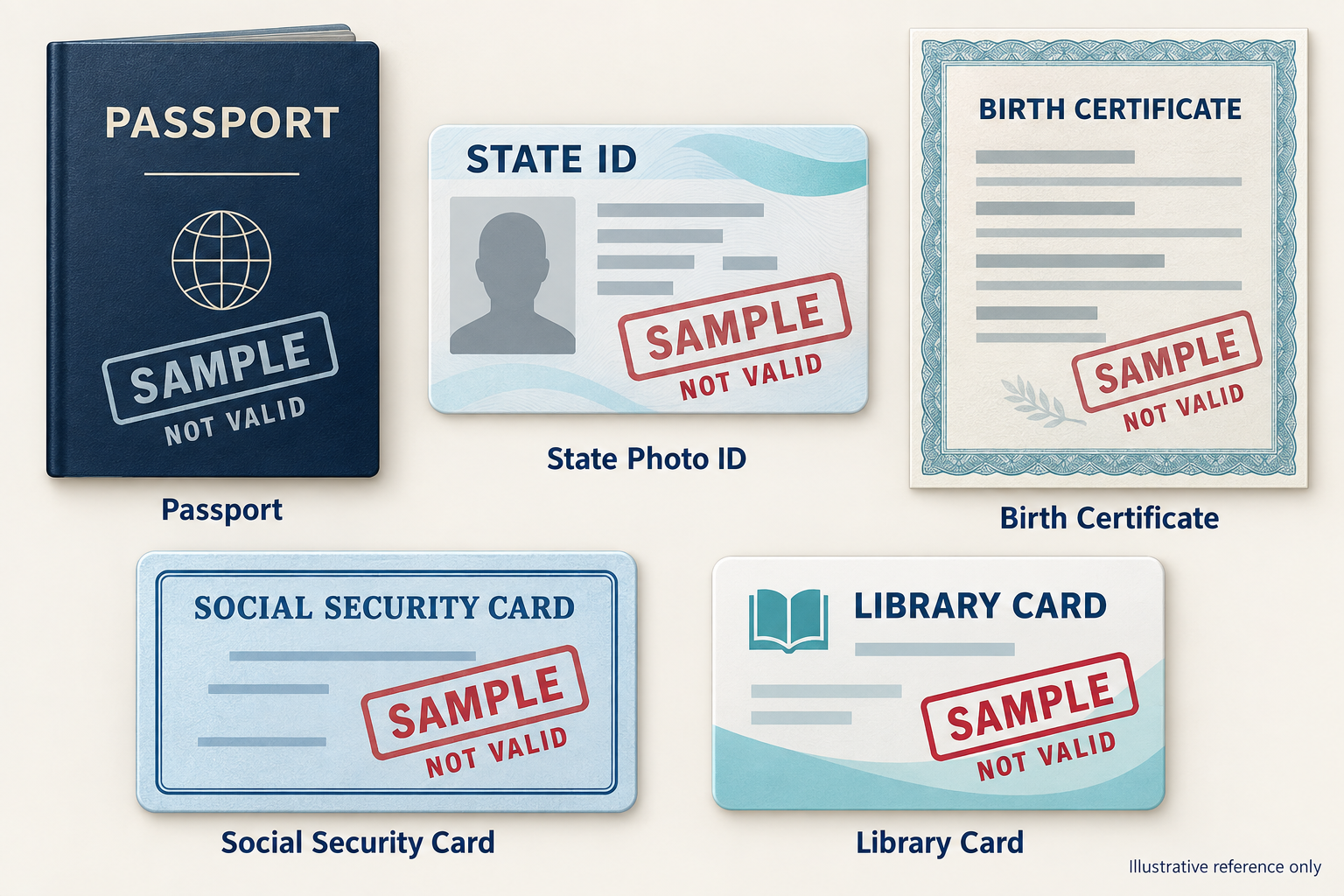
See how DMV and Post Office address rules differ →Picture guideSee labeled examples of the things you are learning about.
Words, in plain English
8 terms in Wedding / Newlywed · Open any word to learn more.
BeneficiaryThe person or organization named to receive money or another benefit under an account or policy.
How it works
For example, a life-insurance policy owner may name who receives a covered death benefit. This is different from an emergency contact. The owner or other authorized person follows the provider’s signing rules; some changes require additional consent. A beneficiary does not automatically control the policy or sign for the owner. Ask about primary and backup choices, minors, and any special rules.
A small example
You name Jordan as a primary beneficiary and Casey as a backup under the provider’s rules. You later marry; check the record because marriage does not automatically update every designation.
Start here, one step at a time
- Review the current beneficiary with the account or policy provider.
- Use its official change form and ask when the change becomes effective.
Try explaining this word yourself
Before looking back, explain “Beneficiary” in your own words. Which part of the example shows it?
Then compare your explanation with “The person or organization named to receive money or another benefit under an account or policy.” and the example above. If it is still unclear, use the question below with the relevant office or provider.
A question you can ask
“How do I update this designation, and when does it become effective?”
NAIC: find your state insurance department (opens a new tab)Birth certificateA government record of a birth, usually listing when and where a person was born and their parents.
How it works
For a U.S. birth, the birth is registered with the responsible vital-records office. A certified copy comes from the state or territory where the birth occurred, sometimes through a local office. A hospital souvenir is not the same thing.
A small example
If you were born in Ohio and now live elsewhere, start with Ohio’s vital-records instructions.
Start here, one step at a time
- Use USAGov’s birth-certificate page to find the correct issuing office.
- Check who may order, accepted ID, fee, and delivery time.
- For a birth abroad, use the separate consular-record or foreign-record route that fits your birth.
Try explaining this word yourself
Before looking back, explain “Birth certificate” in your own words. Which part of the example shows it?
Then compare your explanation with “A government record of a birth, usually listing when and where a person was born and their parents.” and the example above. If it is still unclear, use the question below with the relevant office or provider.
A question you can ask
“How do I prove I may request this record, and is this the certified version I need?”
USAGov: get a certified birth certificate (opens a new tab)See a labeled picture
BudgetA plan that gives your expected money specific jobs.
How it works
Add the money you expect to receive, subtract planned costs, then check the dates. A positive monthly total does not guarantee enough cash on an earlier bill date.
A small example
Income $1,000 minus costs $850 leaves $150 to assign or keep available.
Start here, one step at a time
- Write the money you can count on receiving, with dates.
- List bills, food, transport, savings, and due dates. Subtract costs and adjust until the plan fits.
Try explaining this word yourself
Before looking back, explain “Budget” in your own words. Which part of the example shows it?
Then compare your explanation with “A plan that gives your expected money specific jobs.” and the example above. If it is still unclear, use the question below with the relevant office or provider.
A question you can ask
“Are these numbers confirmed, estimated, or just hoped for?”
Certified copyAn official copy verified by the issuing authority.
How it works
Ask the organization requesting the document what form it accepts. A photocopy, notarized copy, and certified government copy are not interchangeable.
A small example
A phone picture may help you remember details but may not be accepted for an official application.
Start here, one step at a time
- Ask the receiving organization which version it needs.
- Order the certified copy from the issuing authority when that is required.
Try explaining this word yourself
Before looking back, explain “Certified copy” in your own words. Which part of the example shows it?
Then compare your explanation with “An official copy verified by the issuing authority.” and the example above. If it is still unclear, use the question below with the relevant office or provider.
A question you can ask
“Do you need the original, a certified copy, or a plain copy?”
USAGov: official document replacements (opens a new tab)Estimate and quoteA written price proposal whose commitments depend on its wording and applicable rules.
How it works
Ask what is included, what can change, and whether the price is binding. Compare the same work, quantity, and time period.
A small example
A mover’s hourly rate can apply to a whole crew or each worker; those totals differ.
Start here, one step at a time
- Ask for the same written scope from each provider.
- Clarify what can increase the price and require your approval for changes.
Try explaining this word yourself
Before looking back, explain “Estimate and quote” in your own words. Which part of the example shows it?
Then compare your explanation with “A written price proposal whose commitments depend on its wording and applicable rules.” and the example above. If it is still unclear, use the question below with the relevant office or provider.
A question you can ask
“Is this a binding price, and which situations would increase it?”
FMCSA: protect your interstate move (opens a new tab)Marriage license and certificateA license authorizes marriage under local rules; a certificate records the marriage after the required process.
How it works
Contact the actual state or local issuing office for timing, identification, fees, and filing. Ordering a certificate is not the same as applying for a license.
A small example
You might need a certified certificate later for an account or name-change process.
Start here, one step at a time
- Find the real county/state marriage-license office.
- Ask who attends, brings ID, signs, returns the license, and orders the certified certificate.
Try explaining this word yourself
Before looking back, explain “Marriage license and certificate” in your own words. Which part of the example shows it?
Then compare your explanation with “A license authorizes marriage under local rules; a certificate records the marriage after the required process.” and the example above. If it is still unclear, use the question below with the relevant office or provider.
A question you can ask
“Which office issues the license, who returns it, and how do we order certified copies?”
USAGov: marriage licenses and certificates (opens a new tab)Notary publicA person authorized to perform certain acts involving signatures, identity, and sometimes oaths.
How it works
A notary does not make a document’s promises true or give it automatic legal approval. The document’s instructions and state rules decide the act, ID, witnesses, and signer requirements.
A small example
A notary may verify that you acknowledged your signature. That does not mean the notary wrote or approved your contract.
Start here, one step at a time
- Ask the receiving office exactly what needs notarizing.
- Call your bank, a local notary, or a participating UPS Store; confirm appointment, ID, witnesses, and fees.
- Bring the complete document and follow the notary’s instructions about signing. FedEx Office advertises an online service, not a notary at every store.
Try explaining this word yourself
Before looking back, explain “Notary public” in your own words. Which part of the example shows it?
Then compare your explanation with “A person authorized to perform certain acts involving signatures, identity, and sometimes oaths.” and the example above. If it is still unclear, use the question below with the relevant office or provider.
A question you can ask
“Which notarial act and witnesses are required, and what is the full fee?”
The UPS Store: participating notary locations (opens a new tab)See a labeled picture
Vendor contractThe written agreement for a service, such as food, photography, or a venue.
How it works
Check exactly what is included, dates, headcount, payment schedule, cancellation, and extra charges. Do not assume a deposit can be refunded.
A small example
A $500 deposit applied to a $2,000 price leaves $1,500, unless additional agreed charges apply.
Start here, one step at a time
- Get dates, services, people, total price, and cancellation rules in writing.
- Keep the signed contract and payment receipts together.
Try explaining this word yourself
Before looking back, explain “Vendor contract” in your own words. Which part of the example shows it?
Then compare your explanation with “The written agreement for a service, such as food, photography, or a venue.” and the example above. If it is still unclear, use the question below with the relevant office or provider.
A question you can ask
“What would we owe if we changed the date or canceled?”
What this means for you
Contracts and shared money decisions can affect your finances long after the celebration.
What can make it harder
Adding guests or assuming a deposit is refundable can create unexpected costs. Unclear responsibilities can cause missed payments.
What can help
A shared spending limit, itemized contracts, and clear payment responsibilities make decisions easier.
One next stepAgree on the total you can fund, then review each quote against that limit before paying a deposit.
Count guests before signing a food contract
Use a small made-up celebration to see how a guest count affects the price.
Calculate the food line
40 people × $30 per person = $1,200. Ask whether the count includes vendors or children.
Add fixed costs
$1,200 food + $500 space + $300 other agreed items = $2,000 before any unlisted charges.
Ask about additions
If an example 10% service charge applies only to food, $1,200 × 0.10 = $120. The subtotal becomes $2,120. A service charge is not automatically a tip; ask.
Subtract a credited deposit
$2,120 − $500 already paid toward the price = $1,620 remaining, before any taxes or other charges not included in this example.
What the answer tells youAsk what every percentage applies to. Get the final itemized total, payment dates, and cancellation terms in writing.
Agreeing before a household purchase
A purchase affects shared space and sometimes shared money.
What can make it harder
Different assumptions about who pays or owns an item can create conflict.
What can help
Discuss cost, use, ownership, and what happens if plans change.
One next stepAgree on the next shared purchase in writing before paying.
See what ten more guests change
Assume $35 per guest plus $400 fixed costs, with no other charges in this example.
- 1
Price forty guests
40 × $35 + $400 = $1,800.
- 2
Price fifty guests
50 × $35 + $400 = $2,150.
- 3
Find the difference
$2,150 − $1,800 = $350 additional cost.
What the answer tells youAsk whether a larger group also changes room, staffing, or rental charges.
Go a little deeper
Open a lesson when you need the full explanation. You can return to it at any time.
Which ID works—and who signs a document?A card’s purpose matters more than whether it has a picture.
1. Match the ID to the purpose
A driver’s license gives driving permission under state rules. A state ID shows identity without driving permission. A learner’s permit allows limited practice. A passport serves specified identity, citizenship, and travel uses. REAL ID is a standard available on certain state cards; it does not turn them into passports.
School, library, voter, store, and gym cards have narrower purposes. They may be valid for their own service and sometimes appear on a specific accepted list, but are not interchangeable with government photo ID. A public library may be a government service; its card still is not general-purpose photo identification. Ask the receiving office what it accepts.
2. Read each signature line
A signature is your agreement or certification for the words attached to it. Read the label: applicant, borrower, co-signer, owner, witness, or notary. Each role is different. A beneficiary receives a benefit; an emergency contact gets a call. Neither label automatically allows that person to sign your contracts.
Ask the organization who must sign and whether a guardian, other owner, spouse’s consent, or legally authorized representative is needed. Do not sign another person’s name or assume a parent can sign every adult child’s document. Keep a copy of the completed agreement.
3. Arrange a notary when one is actually required
Ask the receiving organization what notarial act it needs and whether witnesses are separate. Contact your bank, a local notary, or a participating UPS Store. Ask about total price, appointment, accepted current ID, document type, and witness availability. No store chain is always the cheapest.
FedEx Office advertises an online notarization service using your own compatible device; do not assume a notary is inside every FedEx store. Confirm remote notarization is accepted for your document and location. Bring the complete document and required people, and follow the notary’s signing instructions.
The notary verifies a specified act, not whether your deal is wise.
Ask two separate questions
First ask what evidence establishes identity for this transaction. Then ask who has authority to sign. A person can have acceptable identification without being authorized to sign for somebody else. Being a spouse, parent of an adult, emergency contact, or helpful friend does not answer every signing question.
Before an appointment, describe the actual situation to the office and request its current instructions. If an authorized representative is involved, ask what evidence of that authority is required and who must attend. Avoid filling a signature field merely because another person is unavailable.
Check the form’s sequence
Read whether a signature must be witnessed, notarized, or made in front of the receiving official. Some forms must remain unsigned until that step. Bring the correct version of the form and required identification, with questions marked on a separate sheet.
If you make a mistake, ask how to correct it rather than hiding or overwriting information. Keep a copy of the completed record when permitted. A clear signing process protects the purpose of the document and prevents a preparatory checklist from being confused with permission to act for someone else.
Check your understanding
- Explain the main idea of “Which ID works—and who signs a document?” without looking back.
- Choose one example above and identify its assumptions or requirements.
- Write the next question you would ask about your own situation.
Official sources & next places to go
USAGov: official document replacements (opens a new tab)USAGov: state motor-vehicle services (opens a new tab)TSA: accepted identification (opens a new tab)USAGov: find your public library (opens a new tab)USAGov: state voter-ID rules (opens a new tab)The UPS Store: participating notary locations (opens a new tab)FedEx Office: remote online notary service (opens a new tab)USCIS: Form I-9 instructions and document choices (PDF) (opens a new tab)Useful places to start
- Marriage licenses and certificates (USAGov) (opens a new tab)
Learn which local office to contact and how license and certificate requests differ.
- Make a shared money plan (opens a new tab)
Use real income and costs to agree on a household and celebration budget.
Ready for one small action?
Go back to your path. Each stage has instructions, questions to ask, and a checklist.
U.S. starting points · Foundation references reviewed September 17, 2026; expanded content added September 19, 2026. Examples use invented amounts unless stated otherwise. Requirements, rates, and policies vary; use the linked official sources and the terms that apply to you.
Use notes for plans and reminders. Keep passwords, account numbers, and sensitive documents in a secure storage service.