Home Maintenance resources
Plain-English explanations, worked math, and what it means for you.
You can start with the basics.
Learn the words, follow the numbers, and understand what a choice could mean for your life. Start with the first action. Open examples and explanations when you need them, then continue in the related tool.
Your first useful action
Identify the exact item and model, read its instructions, and decide whether the task is safe for you. Choose one small routine job.
A worked example
A filter record can include the correct size, airflow direction from the system instructions, last check date, and a reminder to inspect it again.
What people often mix up
A general illustration may look different from your equipment. Cleaning, inspection, and repair are different jobs; unsafe faults need qualified help.
What to ask when you are stuck
“Is this a routine user-maintenance task for my model, and what conditions mean I should stop?”
Ask the organization or person responsible for the decision. Write down the answer, date, and any next action. If their answer uses an unfamiliar word, find it in Words explained below.
How to know this first action is finished
The item is safely usable or the fault is clearly recorded with an appropriate next contact.
Decide whether a job is routine care
- Identify the exact item and read the user-maintenance section of its instructions.
- Check the guide’s supplies and stop conditions before starting.
- If the task is outside user care, describe the symptom for the landlord or qualified service contact.
Check your result: You have either an approved small job or a clear service request, rather than an improvised repair.
If something changes
An unexpected symptom is a reason to stop and reassess, even if an earlier step seemed normal.
Practical how-to guides
Start with one useful skill. Clear instructions and a checklist help you through it.
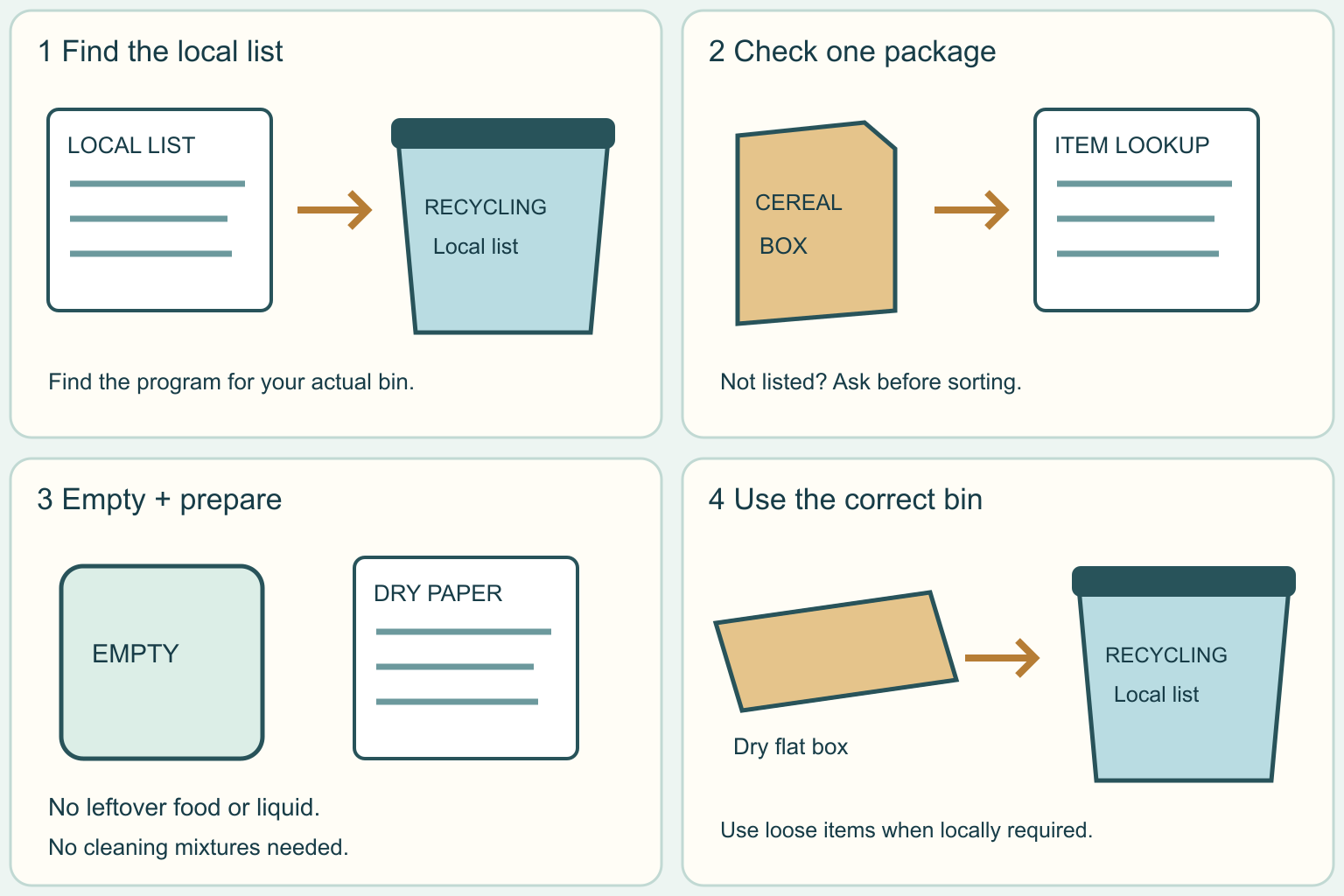
Sort everyday recycling using your local rules
Start with a few ordinary empty packages. Find the right local list, prepare accepted items, and use the correct collection bin.
4 clear steps · checklist & downloadBuild a seasonal maintenance plan from real instructions
Choose safe, applicable tasks instead of a generic required schedule.
4 clear steps · checklist & downloadRead a cleaning product label before using it
Match one product to one surface, then follow its directions.
4 clear steps · checklist & download · YouTube companionPlan a small room-cleaning reset
Pick one area, separate clutter from dirt, and leave a clear next step.
4 clear steps · checklist & download · YouTube companionWhat to bring
Looking up a filter or asking about a repair usually does not need government ID. Gather information about the home and the problem instead.
Prepare the items that apply to your task. For an appointment or application, confirm the receiving organization’s exact requirements. “Ready” means you have reviewed and prepared the item.
Model number, manual, and photos of the problem
Why you may need it
Identifies the appliance, correct parts, and symptoms.
Where to get it
Look for an accessible label and the manufacturer’s manual; take pictures without opening unsafe equipment.
Check before you go
Do not post photos showing account numbers, door codes, or private information.
Lease/owner approval, warranty, and service records
Why you may need it
Shows who may authorize work and what may already be covered.
Where to get it
Ask the landlord or read the purchase/warranty documents.
Check before you go
Renters should use the approved repair process. A warranty may require authorization before work.
Written estimate, contractor license details, and proof of insurance
Why you may need it
Records the agreed job and supports checking the business.
Where to get it
Get them from the contractor and verify licensing through the state/local agency where applicable.
Check before you go
Agree on scope, total, schedule, payment stages, cleanup, and how changes will be approved.
0 of 3 reviewed and prepared. These ticks save in this browser only.
A question you can read aloud
“What can I safely check myself, who is allowed to authorize repairs, and what written records should I keep?”
Keep actual documents in a secure place. Do not put Social Security numbers, full account or ID numbers, passwords, or document images into My Vault notes.
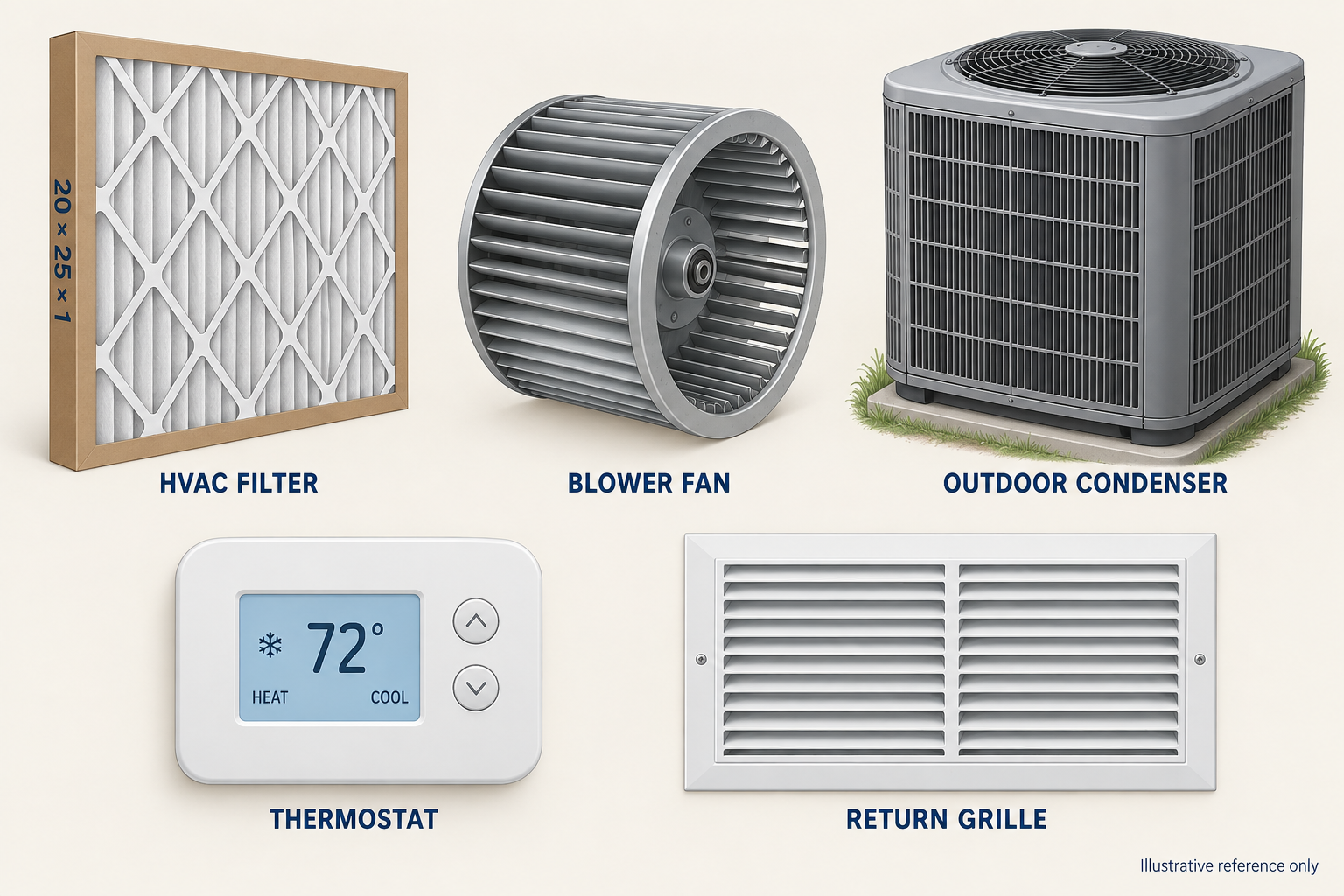
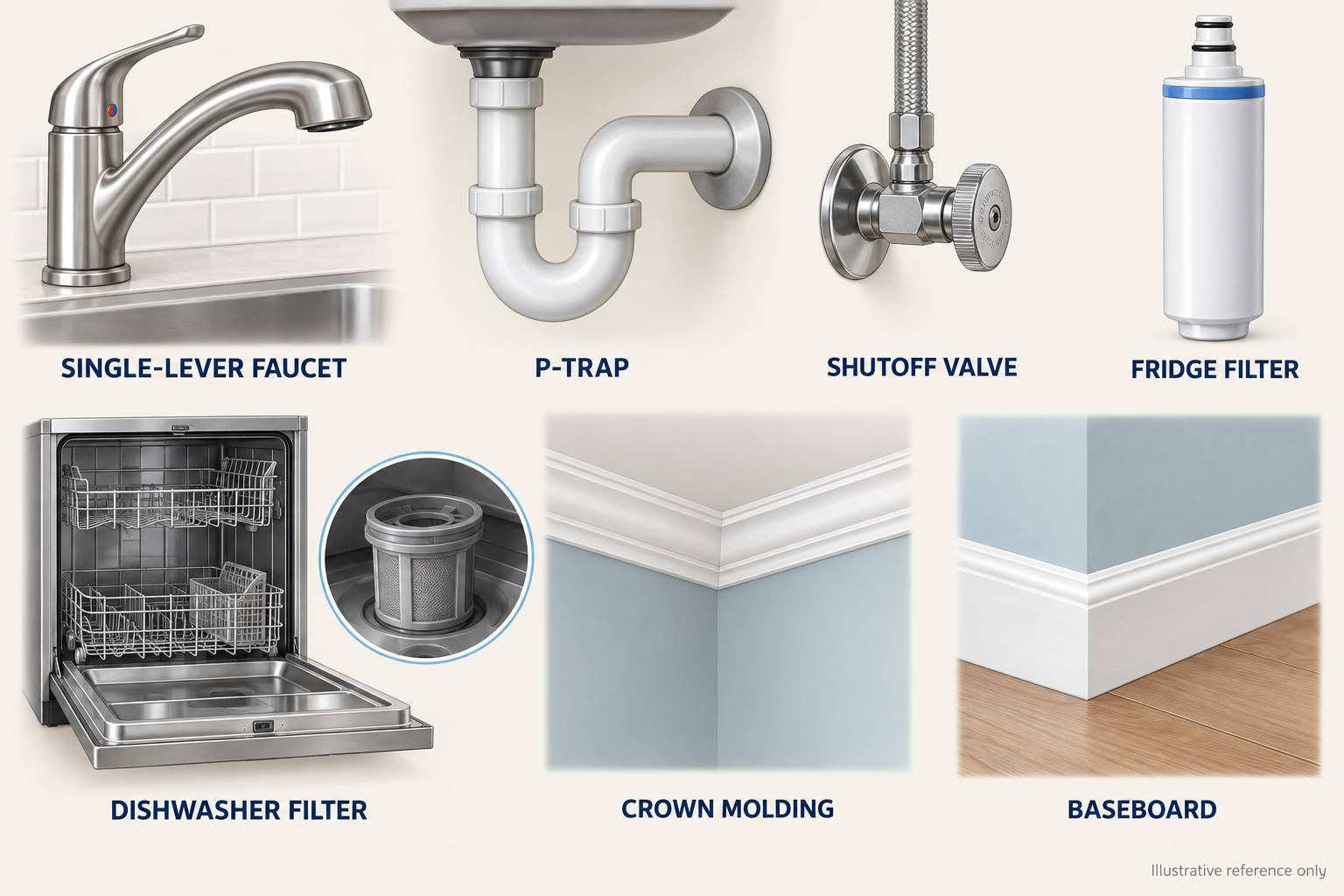
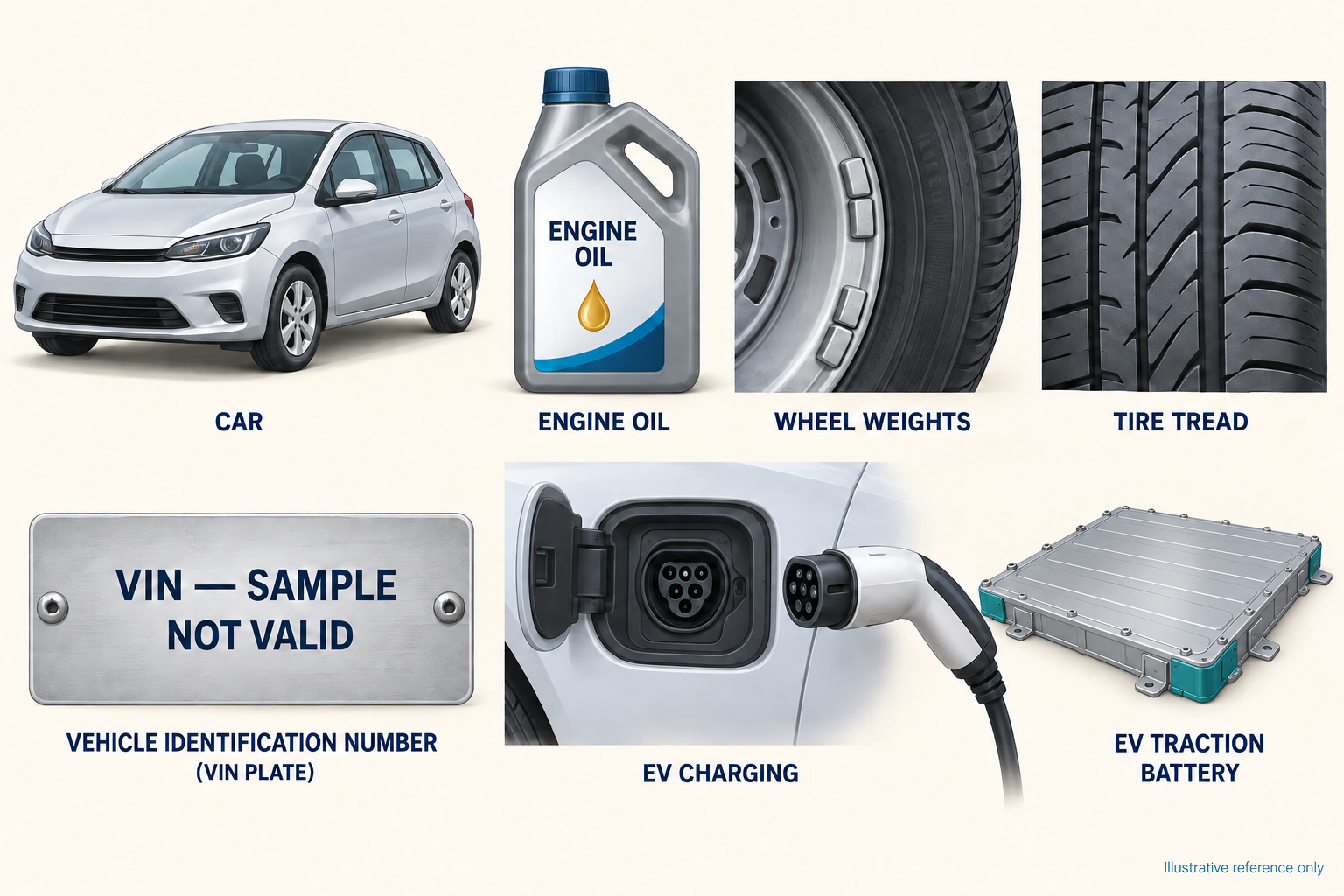
See how DMV and Post Office address rules differ →Picture guideSee labeled examples of the things you are learning about.
Words, in plain English
19 terms in Home Maintenance · Open any word to learn more.
Air filter and filter sizeA removable part that catches particles as air passes through it.
How it works
A home HVAC filter may be at a return grille or inside a user-accessible slot. Its printed size is often a rounded size, such as 20 × 25 × 1 inches. Actual measurements may differ.
A small example
The example size means roughly 20 inches long, 25 wide, and 1 thick. Your system may need a different size or filter type.
Start here, one step at a time
- Turn the system off at its normal control before using the manual’s filter-access steps.
- Read and photograph the old filter’s size and airflow arrow. Check the manual; do not assume a wrong old filter is correct.
- Get the specified replacement, install with the arrow pointing in the required airflow direction, close the access, and record the date. Stop if access is unsafe.
Try explaining this word yourself
Before looking back, explain “Air filter and filter size” in your own words. Which part of the example shows it?
Then compare your explanation with “A removable part that catches particles as air passes through it.” and the example above. If it is still unclear, use the question below with the relevant office or provider.
A question you can ask
“Which exact size, type, airflow direction, and replacement schedule does this system require?”
Department of Energy: home energy checklist (opens a new tab)See a labeled picture
BlowerThe fan that pushes air through parts of a heating or cooling system.
How it works
It is often inside the indoor equipment. It moves air; the outdoor condenser does a different job. Filters protect airflow and equipment.
A small example
If air is weak, a dirty filter is one possible cause—not proof that the blower is broken.
Start here, one step at a time
- Locate the equipment from outside its closed case.
- Check only the user-accessible items described in your manual.
- Ask a qualified HVAC technician to handle internal parts or electrical work.
Try explaining this word yourself
Before looking back, explain “Blower” in your own words. Which part of the example shows it?
Then compare your explanation with “The fan that pushes air through parts of a heating or cooling system.” and the example above. If it is still unclear, use the question below with the relevant office or provider.
A question you can ask
“Which filter serves this blower, and who should check unusual sounds?”
Department of Energy: home cooling explained (PDF) (opens a new tab)See a labeled picture
Condenser and condensationA condenser is a part of a cooling system that releases heat. Condensation is water formed when moist air meets a cold surface.
How it works
In a common split air conditioner, the outdoor unit releases heat. Indoors, moisture can collect on the cold coil and flow through a drain. A heat pump can reverse the heat flow.
A small example
Water from a cold glass is condensation. The outdoor metal AC unit is not called a “condensation unit.”
Start here, one step at a time
- Use the picture to recognize the outdoor unit without touching its parts.
- Keep normal access clear as your manual directs.
- Report damaged wires, persistent leaks, or unusual sounds; do not open the cabinet.
Try explaining this word yourself
Before looking back, explain “Condenser and condensation” in your own words. Which part of the example shows it?
Then compare your explanation with “A condenser is a part of a cooling system that releases heat. Condensation is water formed when moist air meets a cold surface.” and the example above. If it is still unclear, use the question below with the relevant office or provider.
A question you can ask
“Is this a normal drain, a leak, or a problem needing an HVAC technician?”
Department of Energy: home cooling explained (PDF) (opens a new tab)See a labeled picture
Crown molding and baseboardDecorative trim covers or finishes edges in a room. Crown molding is near the ceiling; baseboard is near the floor.
How it works
These parts are different from the main wall. Materials vary. Swelling, soft areas, or stains may be clues to a moisture problem.
A small example
A strip where the wall meets the ceiling is crown molding. A strip along the floor is baseboard.
Start here, one step at a time
- Use the picture to name the part when reporting a problem.
- Photograph damage and note whether it is spreading or damp.
- Ask the owner before painting or removing trim; older coatings and hidden wiring need care.
Try explaining this word yourself
Before looking back, explain “Crown molding and baseboard” in your own words. Which part of the example shows it?
Then compare your explanation with “Decorative trim covers or finishes edges in a room. Crown molding is near the ceiling; baseboard is near the floor.” and the example above. If it is still unclear, use the question below with the relevant office or provider.
A question you can ask
“Is this just surface damage, or should someone check for a leak?”
FTC: check a home-repair contractor (opens a new tab)See a labeled picture
Dishwasher filter and drainingA dishwasher pumps used water out. Some models have a removable filter that catches food.
How it works
A little water in a filter well can be normal. Water standing across the tub after a finished cycle needs checking. Controls and user-cleanable filters vary.
A small example
“Cancel/Drain” may run a drain cycle on one model; another uses a different button sequence.
Start here, one step at a time
- Read the manual and try only its normal cancel/drain instructions. Stop if it leaks or smells electrical.
- Before removing a user-cleanable filter, switch off power as the manual instructs. Do not reach blindly into debris or broken glass.
- Clean and refit only approved parts. For persistent water, call maintenance or an appliance technician; do not disconnect hoses or pour in drain cleaner.
Try explaining this word yourself
Before looking back, explain “Dishwasher filter and draining” in your own words. Which part of the example shows it?
Then compare your explanation with “A dishwasher pumps used water out. Some models have a removable filter that catches food.” and the example above. If it is still unclear, use the question below with the relevant office or provider.
A question you can ask
“Which draining and filter-cleaning steps are approved for this model?”
Whirlpool: water remaining after a cycle (opens a new tab)See a labeled picture
Emergency savings and planned-cost savingsEmergency savings is money for unexpected needs. Planned-cost savings is money set aside for a known future bill.
How it works
Keep an annual renewal or predictable service on the plan instead of treating it as a surprise. Choose amounts that fit your circumstances.
A small example
A $240 yearly bill can be planned as $20 a month for 12 months if you start in time.
Start here, one step at a time
- Write the amount and date of the next known big bill.
- Divide by the number of saving periods left; keep unexpected-emergency savings separate if possible.
Try explaining this word yourself
Before looking back, explain “Emergency savings and planned-cost savings” in your own words. Which part of the example shows it?
Then compare your explanation with “Emergency savings is money for unexpected needs. Planned-cost savings is money set aside for a known future bill.” and the example above. If it is still unclear, use the question below with the relevant office or provider.
A question you can ask
“How much time is actually left before this bill is due?”
Estimate and quoteA written price proposal whose commitments depend on its wording and applicable rules.
How it works
Ask what is included, what can change, and whether the price is binding. Compare the same work, quantity, and time period.
A small example
A mover’s hourly rate can apply to a whole crew or each worker; those totals differ.
Start here, one step at a time
- Ask for the same written scope from each provider.
- Clarify what can increase the price and require your approval for changes.
Try explaining this word yourself
Before looking back, explain “Estimate and quote” in your own words. Which part of the example shows it?
Then compare your explanation with “A written price proposal whose commitments depend on its wording and applicable rules.” and the example above. If it is still unclear, use the question below with the relevant office or provider.
A question you can ask
“Is this a binding price, and which situations would increase it?”
FMCSA: protect your interstate move (opens a new tab)Faucet / tapThe fixture you use to let water flow into a sink, tub, or other place.
How it works
Handles differ. A single lever may lift for flow and move sideways for temperature. Two-handle taps often turn separately. Red often means hot and blue cold; do not rely only on color.
A small example
Start with a little cool water. Add hot water slowly so you do not get burned.
Start here, one step at a time
- Make sure the basin can drain and no electrical items are in it.
- Move the handle gently a small amount. If it resists, do not force it.
- Adjust slowly, then close gently and check that water stops. Ask the owner about drips or unusual controls.
Try explaining this word yourself
Before looking back, explain “Faucet / tap” in your own words. Which part of the example shows it?
Then compare your explanation with “The fixture you use to let water flow into a sink, tub, or other place.” and the example above. If it is still unclear, use the question below with the relevant office or provider.
A question you can ask
“Can you show me how this handle works and which direction is cold?”
FTC: check a home-repair contractor (opens a new tab)See a labeled picture
HVACShort for heating, ventilation, and air conditioning: systems that heat, move, and cool air.
How it works
A thermostat asks the system to heat or cool. A fan moves air. Some homes use ducts; other systems work differently. Identify your system before buying parts.
A small example
A heat pump can provide both cooling and heating; an outdoor unit is not always cooling-only.
Start here, one step at a time
- Ask the owner or technician to name the system.
- Photograph the accessible model label without opening equipment.
- Use the manufacturer’s manual for that exact model.
Try explaining this word yourself
Before looking back, explain “HVAC” in your own words. Which part of the example shows it?
Then compare your explanation with “Short for heating, ventilation, and air conditioning: systems that heat, move, and cool air.” and the example above. If it is still unclear, use the question below with the relevant office or provider.
A question you can ask
“What kind of system is this, and where is its model number and manual?”
Department of Energy: home cooling explained (PDF) (opens a new tab)See a labeled picture
Oil changeA service that replaces used engine oil, usually with a new oil filter too.
How it works
Oil helps lubricate moving parts in an engine. The correct oil type, amount, and schedule come from the vehicle manual. Gas and many hybrid vehicles need this; battery-only EVs do not have engine oil changes.
A small example
An oil-change reminder is not the same as an oil-pressure warning. A pressure warning can require stopping safely and shutting the engine off.
Start here, one step at a time
- Find your year, model, engine, mileage, and maintenance schedule.
- Ask a service shop for a written price for the specified oil and filter, including fees.
- Keep the receipt and next-due mileage or date. Ask before approving extra work.
Try explaining this word yourself
Before looking back, explain “Oil change” in your own words. Which part of the example shows it?
Then compare your explanation with “A service that replaces used engine oil, usually with a new oil filter too.” and the example above. If it is still unclear, use the question below with the relevant office or provider.
A question you can ask
“What oil specification and interval does my exact engine require?”
FTC: understand vehicle service and estimates (opens a new tab)See a labeled picture
Plumber, electrician, and HVAC technicianA plumber works on water and drain systems. An electrician works on electrical systems. An HVAC technician works on heating and cooling.
How it works
Find candidates through the property manager, trusted local referrals, and official license searches where licensing applies. Reviews alone do not prove a license or insurance.
A small example
A broken outlet calls for an electrician; a leaking sink pipe usually calls for a plumber.
Start here, one step at a time
- If renting, contact your landlord’s repair service first unless an emergency requires immediate help.
- For owned property, check your state or local licensing agency and ask about insurance and relevant experience.
- Compare written scope, fees, timing, and payment terms. Agree before work begins; do not open electrical panels yourself.
Try explaining this word yourself
Before looking back, explain “Plumber, electrician, and HVAC technician” in your own words. Which part of the example shows it?
Then compare your explanation with “A plumber works on water and drain systems. An electrician works on electrical systems. An HVAC technician works on heating and cooling.” and the example above. If it is still unclear, use the question below with the relevant office or provider.
A question you can ask
“Are you qualified and insured for this exact job, and can I have a written estimate?”
FTC: check a home-repair contractor (opens a new tab)See a labeled picture
Plumbing and P-trapPlumbing brings water in and carries used water away. A P-trap is the curved drain pipe under many sinks.
How it works
The curve holds water that helps block sewer gases. Supply pipes and drains do different jobs. A leak may come from either side.
A small example
The curved pipe under a sink is a drain part, not the handle that turns water off.
Start here, one step at a time
- Look from a safe, dry position and note where water appears.
- Report leaks early with a photo and location.
- Do not take pipes apart or mix drain chemicals; ask a plumber when unsure.
Try explaining this word yourself
Before looking back, explain “Plumbing and P-trap” in your own words. Which part of the example shows it?
Then compare your explanation with “Plumbing brings water in and carries used water away. A P-trap is the curved drain pipe under many sinks.” and the example above. If it is still unclear, use the question below with the relevant office or provider.
A question you can ask
“Is the leak on the clean-water supply or the drain, and who handles repairs?”
FTC: check a home-repair contractor (opens a new tab)See a labeled picture
Preventive maintenanceRoutine care done before something fails.
How it works
Use the actual product manual or professional service instructions. Record dates and reminders. If you do not know how to do a task safely, get qualified help.
A small example
Changing a filter on the maker’s schedule is planned care; fixing a failed system is a repair.
Start here, one step at a time
- Find the exact product or vehicle manual.
- Record required tasks, dates, parts, and who can do them safely.
Try explaining this word yourself
Before looking back, explain “Preventive maintenance” in your own words. Which part of the example shows it?
Then compare your explanation with “Routine care done before something fails.” and the example above. If it is still unclear, use the question below with the relevant office or provider.
A question you can ask
“What maintenance does this model require, and who should perform it?”
Refrigerator water filterA replaceable part that filters water sent to some refrigerators’ dispensers or ice makers.
How it works
Not every refrigerator has one. Location, part number, release method, flushing, and replacement timing depend on the model. A water filter is different from an air or odor filter.
A small example
A filter that looks similar may still be the wrong part. Match the model and approved part number.
Start here, one step at a time
- Find the model label and official manual. Locate the user-serviceable filter if there is one.
- Follow its water shutoff and removal directions with a towel ready; never force the fitting.
- Fit the correct part, run the specified flushing amount, inspect for leaks, and reset the indicator if instructed.
Try explaining this word yourself
Before looking back, explain “Refrigerator water filter” in your own words. Which part of the example shows it?
Then compare your explanation with “A replaceable part that filters water sent to some refrigerators’ dispensers or ice makers.” and the example above. If it is still unclear, use the question below with the relevant office or provider.
A question you can ask
“Does this model have a water filter, and what replacement and flush steps does it require?”
Whirlpool: model-specific water-filter instructions (opens a new tab)See a labeled picture
Shutoff and breakerControls that stop a utility supply or an electrical circuit.
How it works
Ask a qualified person to identify and label them. Knowing the location does not mean it is safe to operate every control during an emergency. Follow utility and emergency-service instructions.
A small example
You can keep the utility emergency number with a labeled photo of a shutoff location.
Start here, one step at a time
- Have the owner or qualified professional show you the controls before an emergency.
- Record safe instructions and emergency contacts; leave dangerous conditions to trained help.
Try explaining this word yourself
Before looking back, explain “Shutoff and breaker” in your own words. Which part of the example shows it?
Then compare your explanation with “Controls that stop a utility supply or an electrical circuit.” and the example above. If it is still unclear, use the question below with the relevant office or provider.
A question you can ask
“Which controls may I safely use, and when should I leave and call for help?”
Ready.gov: household preparation (opens a new tab)Thermostat and return grilleA thermostat controls the heating or cooling request. A return grille is an opening through which air goes back to the system.
How it works
Supply vents send conditioned air into a room; returns bring air back. Keep furniture from blocking airflow. A return may hold a filter, but not every grille does.
A small example
Setting cooling to 60°F does not usually cool the house faster than setting the temperature you actually want.
Start here, one step at a time
- Find the thermostat and identify heat, cool, off, and fan settings using its manual.
- Ask the owner which openings are returns and which are supply vents.
- Avoid opening unknown equipment or covering vents.
Try explaining this word yourself
Before looking back, explain “Thermostat and return grille” in your own words. Which part of the example shows it?
Then compare your explanation with “A thermostat controls the heating or cooling request. A return grille is an opening through which air goes back to the system.” and the example above. If it is still unclear, use the question below with the relevant office or provider.
A question you can ask
“Which controls and filter locations belong to my system?”
Department of Energy: home cooling explained (PDF) (opens a new tab)See a labeled picture
Tire balance, rotation, and alignmentBalancing corrects uneven wheel-and-tire weight. Rotation moves tires to different positions. Alignment adjusts wheel angles.
How it works
These are different services. Balancing often uses small weights. Rotation patterns depend on the vehicle and tire setup. Alignment may be checked for pulling or uneven wear; a technician should diagnose the cause.
A small example
Buying a rotation does not automatically mean you also bought balancing and alignment.
Start here, one step at a time
- Write down the symptom and when it happens.
- Check the manual’s care schedule and ask a qualified shop to inspect.
- Request separate prices and approval before additional work.
Try explaining this word yourself
Before looking back, explain “Tire balance, rotation, and alignment” in your own words. Which part of the example shows it?
Then compare your explanation with “Balancing corrects uneven wheel-and-tire weight. Rotation moves tires to different positions. Alignment adjusts wheel angles.” and the example above. If it is still unclear, use the question below with the relevant office or provider.
A question you can ask
“Which service is needed, what evidence shows that, and what is included in the price?”
NHTSA: tire safety (opens a new tab)See a labeled picture
Tire pressure and treadPressure is how much air is in a tire. Tread is the grooved rubber that touches the road.
How it works
Use the vehicle’s cold-tire pressure label or manual, not the maximum number on the tire sidewall. Correct pressure and sufficient tread help the tire work properly.
A small example
A dashboard pressure light calls for checking the tires; it does not tell you that every tire is otherwise safe.
Start here, one step at a time
- Find the pressure label, often at the driver’s door opening.
- Use a gauge when tires are cold as the manual directs.
- Have a shop inspect cuts, bulges, recurring air loss, or worn tread; do not drive on an obviously damaged tire.
Try explaining this word yourself
Before looking back, explain “Tire pressure and tread” in your own words. Which part of the example shows it?
Then compare your explanation with “Pressure is how much air is in a tire. Tread is the grooved rubber that touches the road.” and the example above. If it is still unclear, use the question below with the relevant office or provider.
A question you can ask
“What pressure and tire size does this vehicle require, and is there damage or unsafe wear?”
NHTSA: tire safety (opens a new tab)See a labeled picture
Water shutoff valveA control that stops water flowing to a fixture or part of a home.
How it works
A sink or toilet may have a nearby valve. A main shutoff controls more of the home. Designs differ; some turn a quarter turn and others take several turns.
A small example
Knowing the correct sink valve can limit a small leak while help is arranged.
Start here, one step at a time
- Have the owner or plumber identify and label the correct valve before a problem.
- Keep the route clear and the emergency plumber number handy.
- Never force a stuck valve. If water is near electricity, stay clear and call for help.
Try explaining this word yourself
Before looking back, explain “Water shutoff valve” in your own words. Which part of the example shows it?
Then compare your explanation with “A control that stops water flowing to a fixture or part of a home.” and the example above. If it is still unclear, use the question below with the relevant office or provider.
A question you can ask
“Which valve is mine to use, and can you show me safely?”
FTC: check a home-repair contractor (opens a new tab)See a labeled picture
What this means for you
Routine care helps you notice problems and plan costs before they disrupt daily life.
What can make it harder
Ignoring a small leak or an overdue service can allow a problem to grow. Attempting unfamiliar electrical or gas work can create danger.
What can help
Using manuals, reminders, and qualified help supports safe upkeep and more predictable spending.
One next stepChoose one routine task, find the correct instructions, and record who will handle it and when. Ask the landlord about responsibilities if you rent.
Save gradually for a known maintenance bill
Imagine a planned $240 service in six months. Use an actual estimate and the manufacturer’s schedule for your own home.
Identify the amount and deadline
Write “$240 needed in six months” so the goal has both a price and a date.
Divide by the time available
$240 ÷ 6 = $40 per month.
Account for money already saved
If you already have $60: ($240 − $60) ÷ 6 = $30 more per month.
Keep surprises separate
This goal covers the planned service only. It is not a guarantee that other repairs will not happen.
What the answer tells youSmall regular savings can make a known bill easier to handle. For unfamiliar work, budget for qualified help rather than assuming it is a safe do-it-yourself task.
Using the right product on the right surface
A product can work well on one material and damage another.
What can make it harder
Assuming every tile, stone, or wood finish is alike can produce permanent marks.
What can help
Identify the material, follow its care directions, and test when instructed.
One next stepConfirm the floor type before the next wet cleaning.
Compare identical approved filters
Two packages contain the same compatible filter: one for $12 or three for $30.
- 1
Price the multipack per filter
$30 ÷ 3 = $10.
- 2
Find per-filter difference
$12 − $10 = $2.
- 3
Compare three purchases
3 × $12 − $30 = $6 saved if all three are needed and stored correctly.
What the answer tells youCompatibility and condition matter more than the unit-price saving.
Go a little deeper
Open a lesson when you need the full explanation. You can return to it at any time.
Find the right filter and handle simple home-care tasksIdentify the item and its manual first. Renting? Ask which jobs the landlord handles.
1. Start a home information list
Write the appliance or system name, accessible model number, manual link, filter part number, and repair contact. The model number identifies the design; the serial number identifies one unit. Use the manufacturer’s website and search that model. Do not open an electrical cabinet to find a label.
Use the pictures to tell a blower from an outdoor condenser, or a water filter from an air filter. The pictures identify examples, not instructions for taking your equipment apart.
2. Replace a user-accessible air filter
Ask where the filter is and read the manual’s instructions. Turn the system off at its normal control. Photograph the current filter size and direction before removal. Verify the required type, thickness, and size with the manual; the old filter might be wrong.
Fit the correct replacement with its airflow arrow pointing as the system requires, close the access, and record the date. Do not bend a filter to make it fit or assume the strongest filter is suitable. Ask the owner or technician for a replacement schedule based on the system and home.
3. Check for a refrigerator water filter
A refrigerator without filtered water or ice may have no water filter. Find your model’s manual and the listed location and part number. Some filters twist out, others use a release; follow that model’s water-supply and removal instructions.
Install the correct part without force, flush exactly as the manufacturer directs, check for leaks, and reset the reminder if instructed. A reset light does not physically replace or clean a filter.
4. Use a faucet and check a dishwasher calmly
For an unfamiliar faucet, start with a small flow of cool water and adjust gently. Ask the owner to demonstrate unusual handles. Do not force a stuck handle or valve. For leaks, know whom to contact and which water shutoff you have been shown to use safely.
For a dishwasher that did not drain, check the manual’s normal cancel/drain control. A little water in the filter well can be normal; standing water across the tub is different. Switch off power as instructed before cleaning any user-serviceable filter. Avoid sharp debris, drain chemicals, and hose disassembly.
Call maintenance for persistent problems, leaks, or electrical smells.
5. Know when to call a professional
Describe the room, part, symptom, and when it began. A plumber handles water/drains; an electrician handles electrical systems; an HVAC technician handles heating/cooling. Your landlord may require its own repair team.
For work you authorize, verify licensing where required, ask about insurance, and get scope and price in writing. Never open live electrical equipment or refrigerant systems. Gas smell, smoke, or water near electricity calls for leaving the danger area and following emergency or utility instructions.
Match the object, tool, and action
Identify the exact part before collecting supplies. A return-air filter, refrigerator water cartridge, and dishwasher filter have different jobs and removal methods. Write the model and part number from accessible labels and compare them with the manual. A picture of a similar appliance is useful for recognition but does not establish compatibility.
For cleaning, identify the material and finish as well as the object. A soft cloth on a permitted surface is different from an abrasive pad on a delicate coating. Keep floor tools separate from dishwashing tools and do not assume a household chemical is safe on every nearby surface.
Finish by checking the result
After an allowed task, confirm that covers, filters, and removable parts are seated correctly and the area is dry where required. Restore normal operation only as instructed. Watch for leaks, unusual sounds, or error indicators without opening electrical or mechanical compartments.
If the result is unclear, stop and describe what changed to maintenance or the appropriate professional. Keep a simple record of the model, symptom, date, and safe observations. A task is complete when the intended condition is verified, not merely when the checklist boxes have been ticked.
Check your understanding
- Explain the main idea of “Find the right filter and handle simple home-care tasks” without looking back.
- Choose one example above and identify its assumptions or requirements.
- Write the next question you would ask about your own situation.
Official sources & next places to go
Department of Energy: home cooling explained (PDF) (opens a new tab)Department of Energy: home energy checklist (opens a new tab)Whirlpool: model-specific water-filter instructions (opens a new tab)Whirlpool: dishwasher draining and basic troubleshooting (opens a new tab)Whirlpool: water remaining after a cycle (opens a new tab)FTC: check a home-repair contractor (opens a new tab)Book vehicle service, renew registration, and plan EV careUse the exact vehicle and state requirements; there is no one schedule for every car.
1. Make a small vehicle information sheet
Write the year, make, model, fuel type, mileage, and manual link. Find the VIN at the driver-side windshield or door label and compare it with registration. Keep your license and current insurance details secure. Do not publish these numbers in notes or photos.
2. Book the right service
Read the manual’s maintenance schedule. Ask the shop: “For my exact model and mileage, what service is due, which oil or parts meet the specification, and what is the total price?” A dealership, independent mechanic, or quick-lube location may be an option depending on the work.
Get the scope and price before approving. Ask to be contacted before extras. A rotation, balancing, and alignment are separate services; an oil change is not a promise that every system was inspected. Keep the receipt with date and mileage. Independent maintenance does not automatically void a warranty, but damage from improper work can affect coverage.
3. Renew registration through your state
Use the official state motor-vehicle directory and choose renewal or transfer, whichever applies. Check the expiration, fees, address, insurance evidence, and any county/vehicle-specific inspection rules. A reminder is helpful, but do not rely on receiving one.
For insurance requirements, use the state insurance department and motor-vehicle office. Ask whether the proof may be electronic and when coverage must be active. Do not assume another state’s minimums or an EV emissions exemption applies to all your requirements. Save the renewal receipt and follow instructions while waiting for new documents.
4. For an EV, plan charging and maintenance
A battery-only EV does not need engine oil changes. Plug-in and ordinary hybrids still have engines. All need the care listed in their own manuals. Tires, brakes, filters, and specified fluids still matter. Leave high-voltage batteries and orange cables to qualified technicians.
Confirm the connector, charger compatibility, charging price, parking/idle fees, and how to start/stop a session. For home installation, ask the property owner and a qualified electrician about permission and electrical capacity. Use approved equipment, not improvised cords. Plan a backup charging option before a long trip.
Translate a symptom into a useful service request
Write the vehicle year, model, fuel type, mileage, symptom, and when it occurs. Distinguish a scheduled maintenance item from a new fault. “Noise when turning left at low speed” gives a shop more useful information than “car sounds bad.” Do not drive an unsafe vehicle simply to gather more observations.
Ask for the diagnostic process, charges, and approval boundary before leaving the vehicle. A written estimate should identify proposed work and any assumptions. Tell the shop to contact you before adding work beyond the agreed scope, and keep the response with the service record.
Check the handoff and next due item
At collection, compare the invoice with the authorized work and ask about anything unfamiliar. Record the date, mileage, parts or specification information provided, and any recommended follow-up. A suggestion for future service is different from work already completed.
For an EV, keep charging arrangements and high-voltage work separate from ordinary owner checks. For every vehicle, use the exact manual and current local renewal instructions. Put the next confirmed due date or mileage in your organizer and keep receipts securely for later maintenance and warranty questions.
Check your understanding
- Explain the main idea of “Book vehicle service, renew registration, and plan EV care” without looking back.
- Choose one example above and identify its assumptions or requirements.
- Write the next question you would ask about your own situation.
Official sources & next places to go
NHTSA: vehicle identification numbers (opens a new tab)FTC: understand vehicle service and estimates (opens a new tab)FTC: dealer and independent maintenance (opens a new tab)NHTSA: tire safety (opens a new tab)USAGov: state motor-vehicle services (opens a new tab)NAIC: find your state insurance department (opens a new tab)Department of Energy: electric-vehicle types (opens a new tab)Department of Energy: EV maintenance and safety (opens a new tab)Useful places to start
- Smoke alarm basics (U.S. Fire Administration) (opens a new tab)
Read the testing guidance and use your own alarm’s instructions.
- Tenant help by state (USAGov) (opens a new tab)
Find local help when you cannot resolve a rental responsibility or repair question.
Ready for one small action?
Go back to your path. Each stage has instructions, questions to ask, and a checklist.
U.S. starting points · Foundation references reviewed September 17, 2026; expanded content added September 19, 2026. Examples use invented amounts unless stated otherwise. Requirements, rates, and policies vary; use the linked official sources and the terms that apply to you.
Use notes for plans and reminders. Keep passwords, account numbers, and sensitive documents in a secure storage service.