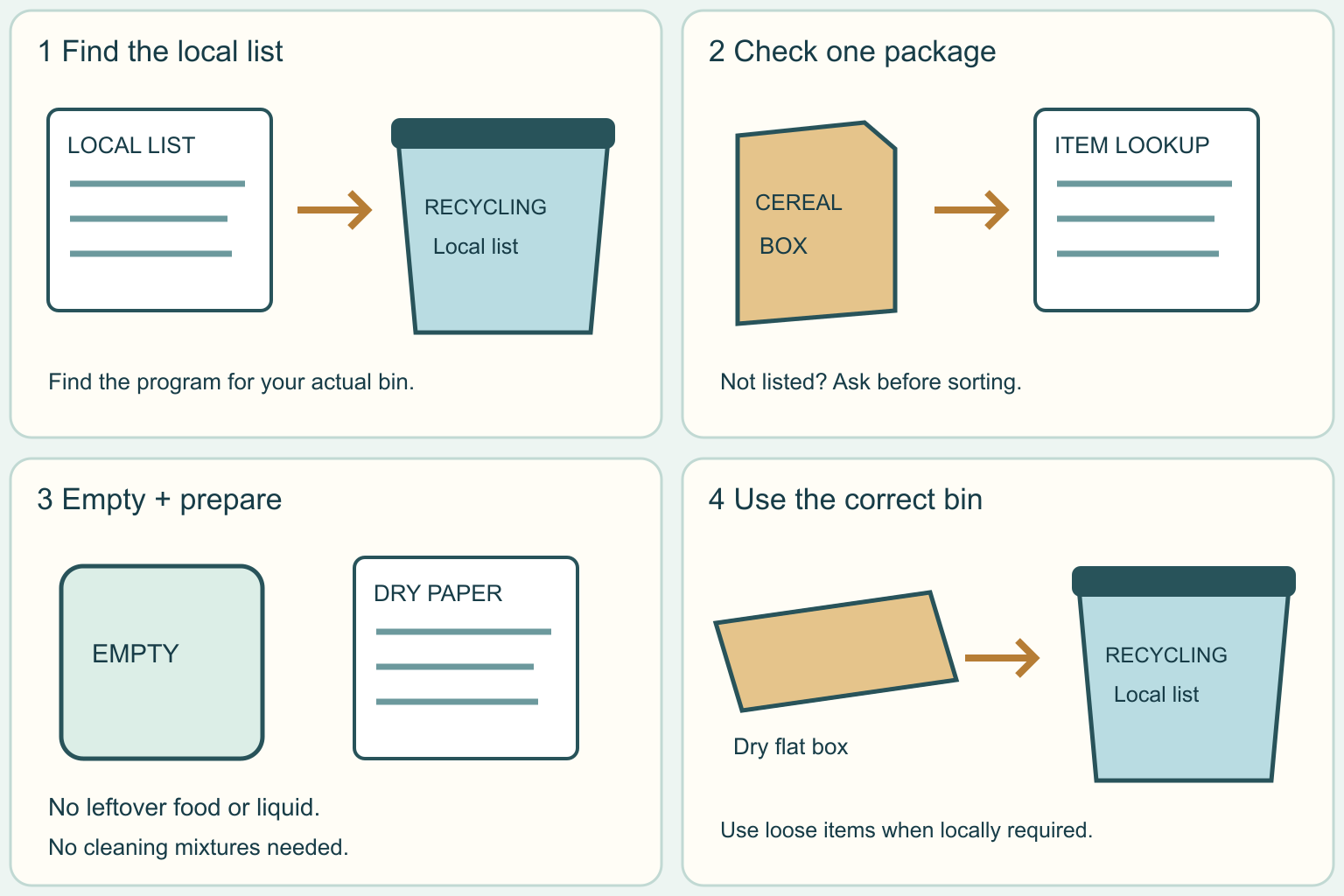
Start with a few ordinary empty packages. Find the right local list, prepare accepted items, and use the correct collection bin.
Why it matters: Careful sorting helps keep food, plastic bags and other unwanted items from spoiling a batch of recycling.
Written guidance reviewed: 2026-10-26 · Sources and equipment assumptions are below.
Take this guide to another device
Steps, notes, supplies, setup choices, results and check dates save on this browser as you work. Plus can also keep an account copy. Account copies update only when you choose Save; loading one replaces the browser draft shown here.
Review all saved work. Saved account check dates appear in My Day. Clear the date and save again to finish a follow-up. Email settings stay separate; existing opted-in agenda or deadline emails can include these dated actions.
Understand the job before starting
Careful sorting helps keep food, plastic bags and other unwanted items from spoiling a batch of recycling.
A common mistake to avoid
Putting a doubtful item into recycling just in case can cause problems for sorting equipment and other materials. Ask first rather than assuming a recycle symbol is permission. Compostable does not automatically mean accepted in a local compost or recycling program. If a bin is full, do not leave loose items where they can blow away or block access; ask the collector or building manager for the approved next step.
Words used in this guide
Rent
The amount paid to use someone else’s property for an agreed time. Read the example
Use what you already have. Check each item when it is ready.
Before you begin
Do not sort through unknown waste or handle broken glass, needles, leaking containers, chemicals, batteries or damaged electronics for this practice. Keep these out of ordinary mixed recycling and ask the local waste authority about the correct separate service. Do not mix leftover cleaners or pour unknown contents down a drain. Ask building staff for help with inaccessible bins or heavy carts.
0 of 4 steps checked0%
Guide progress and notes save on this browser; choose Save account copy above to carry them to another device with Plus. Downloads contain the complete blank checklist; print to include your current checks and notes.
Do it with me
Your step position saves on this browser. Use the picture when available, then check the written result.
STEP 1 OF 4
Find the rules for your actual bin
Start here: Save the accepted-items list for your building or address.
Illustration: Find the rules for your actual bin. Read the steps for your exact task.
Read-aloud is available in supported browsers; the written steps always remain available.
Recycling means collecting certain used materials so they can be made into new products.
Search your city or county plus recycling accepted items.
A waste hauler is the company that collects bins.
If you rent or live in a dorm, ask the manager which program serves your building.
Save its current list and collection instructions.
Bin colors and rules differ.
A triangle or number on plastic identifies the material; it does not prove your local program accepts that package.
Before moving to the next step
Check this specific result: I found the program for my actual bin and saved its accepted-items list.
If that result is not true yet, leave the box unchecked. Write what is missing in your notes; use the official instructions below when the equipment or situation differs.
STEP 1 OF 4
Find the rules for your actual bin
Start here: Save the accepted-items list for your building or address.
Illustration: Find the rules for your actual bin. Read the steps for your exact task.
Recycling means collecting certain used materials so they can be made into new products.
Search your city or county plus recycling accepted items.
A waste hauler is the company that collects bins.
If you rent or live in a dorm, ask the manager which program serves your building.
Save its current list and collection instructions.
Bin colors and rules differ.
A triangle or number on plastic identifies the material; it does not prove your local program accepts that package.
Before moving to the next step
Check this specific result: I found the program for my actual bin and saved its accepted-items list.
If that result is not true yet, leave the box unchecked. Write what is missing in your notes; use the official instructions below when the equipment or situation differs.
STEP 2 OF 4
Check one item at a time
Start here: Match the exact kind of package to the local list.
Illustration: Check one item at a time. Read the steps for your exact task.
Choose one safe empty package, such as a cereal box.
Look up its item type, not just the word paper or plastic.
A bottle, a plastic bag and a foam tray can need different routes.
Check rules for lids, caps, labels and flattening too.
If the item is not clearly listed, use the official lookup tool or ask the provider.
Keep only safe, dry practice items aside briefly while asking; do not create a pile of unknown or hazardous waste.
Before moving to the next step
Check this specific result: Each practice item has a confirmed accepted route, or I know whom to ask before sorting it.
If that result is not true yet, leave the box unchecked. Write what is missing in your notes; use the official instructions below when the equipment or situation differs.
STEP 3 OF 4
Empty and prepare accepted items
Start here: Remove food and liquid, then follow the program preparation rules.
Illustration: Empty and prepare accepted items. Read the steps for your exact task.
For an accepted ordinary food container, empty leftovers into the appropriate food-waste or trash stream under local rules.
Scrape or briefly rinse remaining food if instructed, and let excess water drain away.
Keep paper and cardboard dry.
Contamination means unwanted material mixed into recycling, such as food or a plastic bag where it is not accepted.
Do not put packages into a plastic bag for the ordinary mixed-recycling bin; bags can tangle sorting machines.
Follow any special local collection method instead of guessing.
No cleaning-chemical mixture is needed.
Before moving to the next step
Check this specific result: Accepted items are prepared as instructed, without food or liquid spoiling dry paper.
If that result is not true yet, leave the box unchecked. Write what is missing in your notes; use the official instructions below when the equipment or situation differs.
STEP 4 OF 4
Use the right bin and plan collection
Start here: Read the bin label and confirm the collection instructions.
Illustration: Use the right bin and plan collection. Read the steps for your exact task.
Place only confirmed accepted items in the designated recycling bin, loose when the program requires that.
A recycling label is more useful than relying on bin color.
Flatten boxes only as locally instructed and keep the lid closed where required.
Check your collection calendar, holiday changes, or the building collection area rules.
A special drop-off is a separate location for items the regular bin cannot take; confirm its accepted items and hours before traveling.
Record one useful reminder, then wash your hands after handling the packages.
Before moving to the next step
Check this specific result: I used the correct labeled bin and know the next collection or confirmed drop-off plan.
If that result is not true yet, leave the box unchecked. Write what is missing in your notes; use the official instructions below when the equipment or situation differs.
Pictures for this guide
Picture 1 of 4 · Find the rules for your actual bin
A local accepted-items list sits beside a bin labeled for the actual program.
For: Find the rules for your actual bin
Illustrations show examples of the actions above. Follow your equipment’s instructions.
Notes about these pictures
Recycling means collecting certain used materials so they can be made into new products. Search your city or county plus recycling accepted items. A waste hauler is the company that collects bins. If you rent or live in a dorm, ask the manager which program serves your building. Save its current list and collection instructions. Bin colors and rules differ. A triangle or number on plastic identifies the material; it does not prove your local program accepts that package.
Do not sort through unknown waste or handle broken glass, needles, leaking containers, chemicals, batteries or damaged electronics for this practice. Keep these out of ordinary mixed recycling and ask the local waste authority about the correct separate service. Do not mix leftover cleaners or pour unknown contents down a drain. Ask building staff for help with inaccessible bins or heavy carts.
Was this step clear?
Flag “Find the rules for your actual bin” for review. We save the guide and step identifiers with your account to limit duplicates, not your private notes.
A specific companion has not been selected for this new guide yet. You can search for related demonstrations; search results have not been reviewed by Life’s Checklists.
These YouTube videos belong to their respective creators. Life’s Checklists does not own them and is not affiliated with the creators. Links open on YouTube, where the videos are available independently of our membership.
How to use the video with this guide
Read “Before you begin” first. Watch the relevant part, pause, then return to the written step and its completion check. Use captions and playback speed if they help. A demonstration may cover only part of the task or show different equipment.
Your model’s instructions and current official guidance take priority. For urgent problems, follow the stop instructions without waiting to watch a video.
Finish the job and know what to do next.
For this guide, the final result is: I used the correct labeled bin and know the next collection or confirmed drop-off plan.
A concrete way to approach this task
Fictional example: Morgan checks the building list and finds that ordinary empty cereal boxes are accepted and must be flattened. Morgan removes the inner bag, keeps it out of mixed recycling, flattens the dry box, and places it loose in the labeled bin. Your program may give different preparation instructions.
What if I cannot complete a step?
Putting a doubtful item into recycling just in case can cause problems for sorting equipment and other materials. Ask first rather than assuming a recycle symbol is permission. Compostable does not automatically mean accepted in a local compost or recycling program. If a bin is full, do not leave loose items where they can blow away or block access; ask the collector or building manager for the approved next step.
Identify the exact step: “Find the rules for your actual bin.” Record what you tried, what happened, and which item or model you used. Ask for help with that specific problem rather than repeating an unsafe or unsuccessful action.
Do not sort through unknown waste or handle broken glass, needles, leaking containers, chemicals, batteries or damaged electronics for this practice. Keep these out of ordinary mixed recycling and ask the local waste authority about the correct separate service. Do not mix leftover cleaners or pour unknown contents down a drain. Ask building staff for help with inaccessible bins or heavy carts.
Connect this skill to everyday life
Write down the total move-in cash and monthly costs before applying. Ask which charges are required and which are optional.
Advertised rent is not necessarily the whole monthly cost. A refundable deposit still needs cash now. An application does not mean you have a signed lease.
A useful record for this task: Record the result of “Use the right bin and plan collection”: I used the correct labeled bin and know the next collection or confirmed drop-off plan.
When finished, record the result and any next check or follow-up date. Your original step checks and notes remain on this browser.
Keep the result of your work
Finish and check every step before recording completion. You can write a draft below now.
Result: Not recorded · Next check: Not chosen
Choose a date from your own manual or situation. No email is enabled by saving this record.