Vehicle & Transportation resources
Plain-English explanations, worked math, and what it means for you.
You can start with the basics.
Learn the words, follow the numbers, and understand what a choice could mean for your life. Start with the first action. Open examples and explanations when you need them, then continue in the related tool.
Your first useful action
Set a total purchase and running budget before shopping. Arrange an independent inspection and collect written terms for the specific vehicle.
A worked example
A $300 monthly payment plus $120 insurance, $100 fuel, and a $50 maintenance allowance is $570/month before other charges. Figures are fictional; use your own quotes.
What people often mix up
A low monthly payment can come with a longer term or higher total cost. A vehicle history report is not a substitute for inspecting its current condition.
What to ask when you are stuck
“What is the total amount payable, which fees are included, and may I arrange an independent inspection?”
Ask the organization or person responsible for the decision. Write down the answer, date, and any next action. If their answer uses an unfamiliar word, find it in Words explained below.
How to know this first action is finished
You have written cost assumptions, inspection findings, and answers to the questions that affect your decision.
Compare the whole transport cost
- List payment or fare, insurance, fuel or charging, parking and maintenance assumptions.
- Use the same time period for each option and include a realistic backup journey.
- For a vehicle purchase, keep written terms and independent inspection findings separate.
Check your result: A cheaper payment is not being mistaken for a lower total running cost.
If something changes
If your commute changes, recalculate travel time and the costs that depend on distance or availability.
Practical how-to guides
Start with one useful skill. Clear instructions and a checklist help you through it.
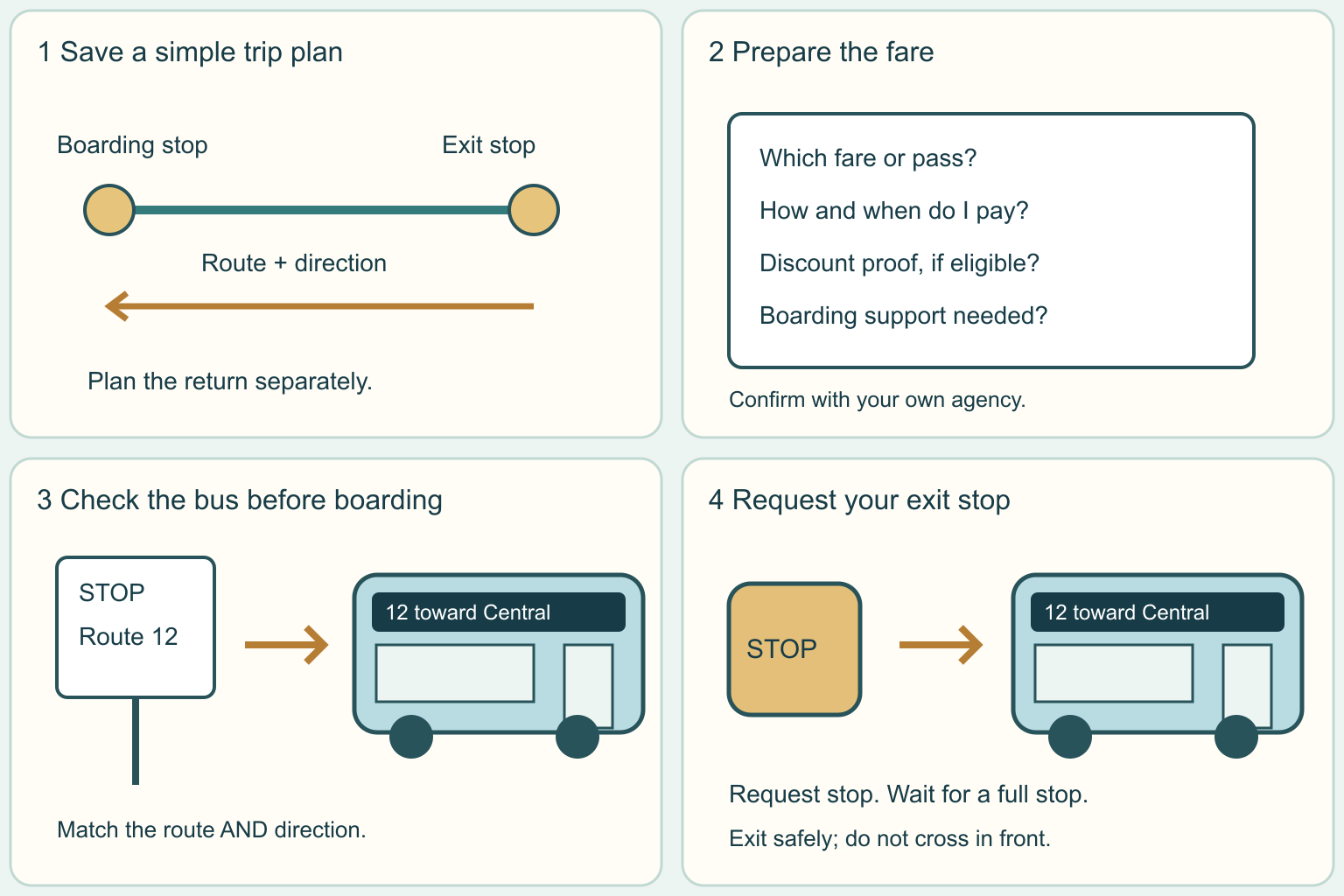
Plan and take your first local bus ride
Find the right stop, check the fare, board the right bus, and get off at your planned stop.
4 clear steps · checklist & downloadCompare written vehicle repair estimates
Understand the work proposed before approving a repair.
4 clear steps · checklist & downloadCheck tire pressure while the tires are cold
Read the vehicle’s pressure label, measure each tire, and adjust only to the specified value.
4 clear steps · checklist & download · YouTube companionReplace wiper blades that fit your vehicle
Identify the correct blades and connector, replace one at a time, and test on a wet windshield.
4 clear steps · checklist & download · YouTube companionWhat to bring
Buying, registering, renewing, insuring, and servicing a vehicle are separate jobs. Use your state’s list for your vehicle and county.
Prepare the items that apply to your task. For an appointment or application, confirm the receiving organization’s exact requirements. “Ready” means you have reviewed and prepared the item.
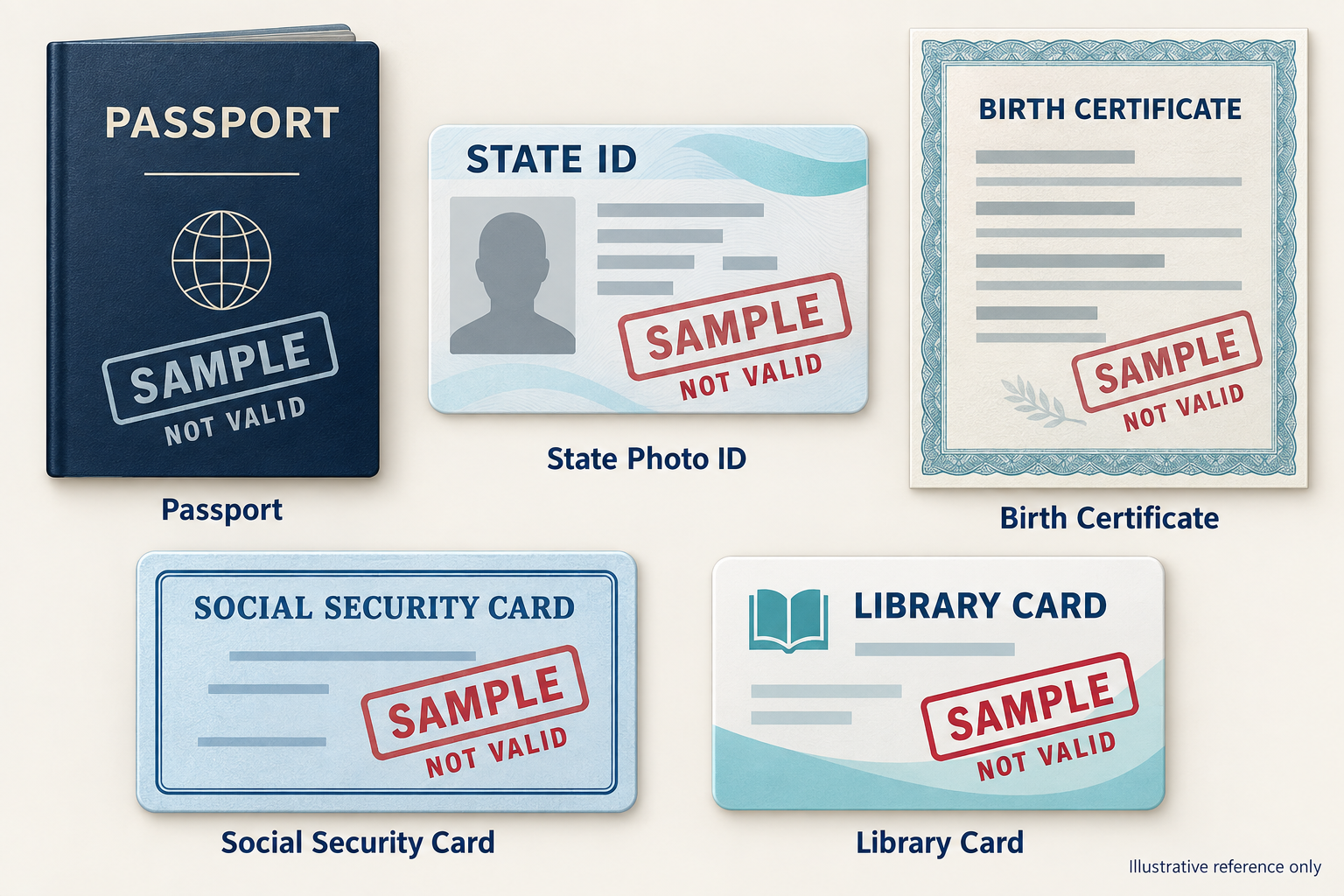
Accepted identification
Why you may need it
Shows who you are. The accepted list depends on the service.
Where to get it
Use a current document you already have, or apply through the state ID agency or other issuing office.
Check before you go
Ask for the exact ID list. A school card, membership card, expired ID, or phone photo may not count.
Vehicle records: VIN, registration, and title when required
Why you may need it
Identifies the vehicle and shows registration or ownership.
Where to get it
Find the VIN on the car and existing records. Request missing title or registration through your state motor-vehicle office.
Check before you go
A title, registration, and insurance card do different jobs. Bring the specific ones listed for purchase, transfer, renewal, or insurance.
Insurance card or policy details
Why you may need it
Shows coverage details and helps locate your account.
Where to get it
Get current documents from the insurer’s verified app, website, or agent.
Check before you go
Check effective dates and the correct person, address, or vehicle. Ask whether electronic proof is accepted.
Proof of your home address
Why you may need it
Shows where you live. It is a separate check from identity.
Where to get it
Download an eligible bill or statement from the provider, obtain your lease, or ask about an approved residency letter.
Check before you go
Confirm document type, how recent it must be, whose name must appear, physical address, and whether a printed copy is needed.
Purchase/transfer records and lien information, if applicable
Why you may need it
Documents how ownership changes and whether a lender has a claim on the vehicle.
Where to get it
Get the signed title and required sale documents from the seller or lender; use the state’s official transfer forms.
Check before you go
Verify names, VIN, signatures, odometer entries, and any required release before paying or filing.
Inspection or emissions result, when required
Why you may need it
Shows completion of the applicable state/local check.
Where to get it
Use an approved station from the official state list.
Check before you go
Check whether your fuel type, model year, and county need the test and whether results transmit electronically.
Accepted payment method and fee amount
Why you may need it
Pays the required application, service, or appointment fee.
Where to get it
Check the official fee page or call the office; ask whether it accepts a card, check, money order, or cash.
Check before you go
Verify the total and who it is payable to. Government offices and different fees may use different payment rules.
Service history and exact vehicle details for repairs
Why you may need it
Helps a shop choose the correct service and parts.
Where to get it
Bring the mileage, year/model, manual schedule, prior receipts, and description of symptoms.
Check before you go
Ask for a written estimate and your approval before extra work.
0 of 8 reviewed and prepared. These ticks save in this browser only.
A question you can read aloud
“For this exact transaction, what documents, signatures, fees, inspections, and insurance proof does my state require?”
Keep actual documents in a secure place. Do not put Social Security numbers, full account or ID numbers, passwords, or document images into My Vault notes.
See how DMV and Post Office address rules differ →Picture guideSee labeled examples of the things you are learning about.
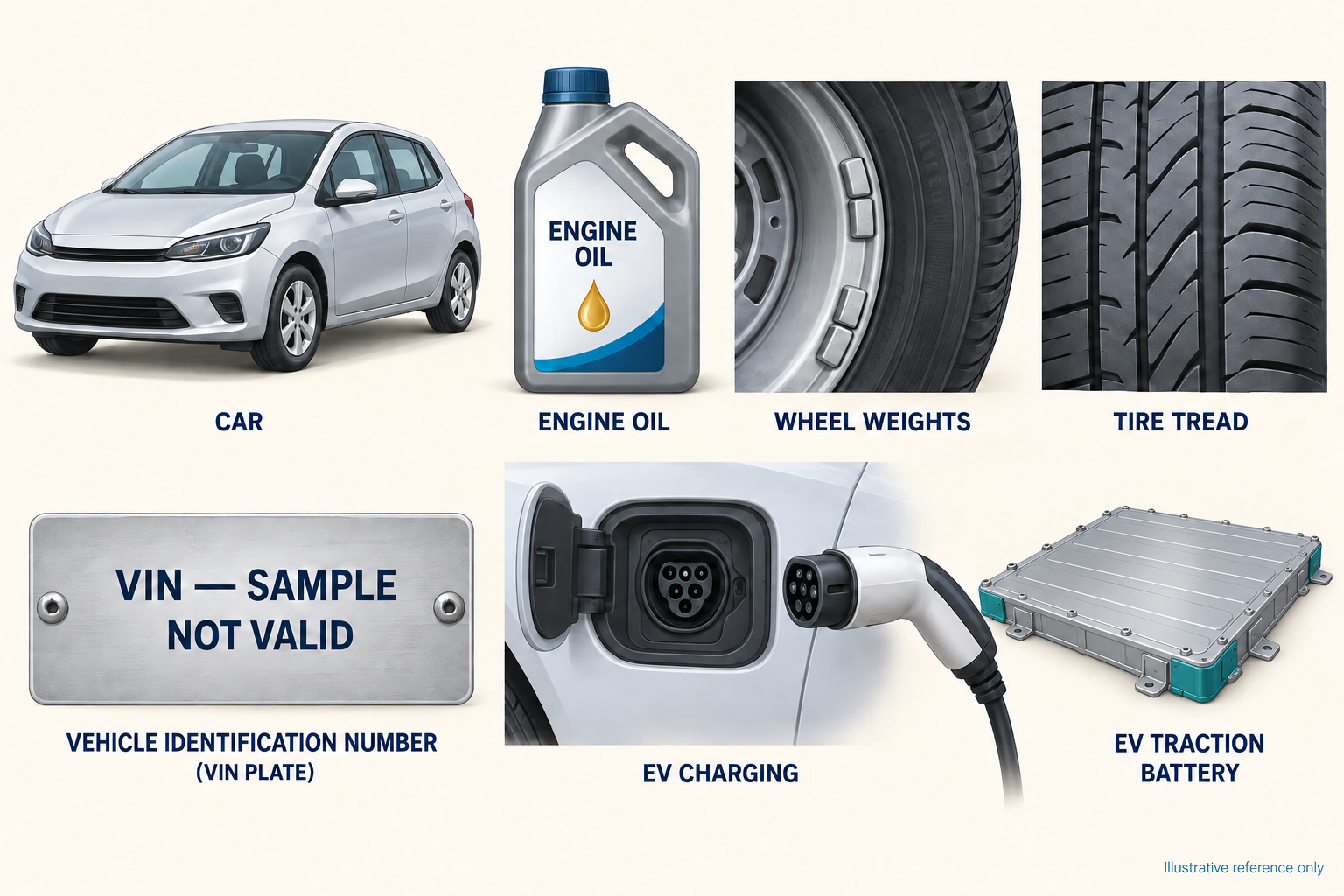
Words, in plain English
49 terms in Vehicle & Transportation · Open any word to learn more.
Accrued interest and capitalizationAccrued interest is interest that has built up. Capitalization means adding unpaid interest to the loan’s principal when the rules allow it.
How it works
After capitalization, interest may be calculated on a larger principal balance. Not every loan adds interest the same way or at the same time.
A small example
A $1,000 principal plus $40 capitalized interest becomes $1,040 principal. Future interest can then be based on $1,040.
Start here, one step at a time
- Read the interest section for your exact loan type.
- Ask for an example covering school, pauses, and repayment.
- Do not assume no payment due means no interest.
Try explaining this word yourself
Before looking back, explain “Accrued interest and capitalization” in your own words. Which part of the example shows it?
Then compare your explanation with “Accrued interest is interest that has built up. Capitalization means adding unpaid interest to the loan’s principal when the rules allow it.” and the example above. If it is still unclear, use the question below with the relevant office or provider.
A question you can ask
“When does interest build up, and when could it be added to principal?”
Federal Student Aid: subsidized and unsubsidized loans (opens a new tab)See a labeled picture
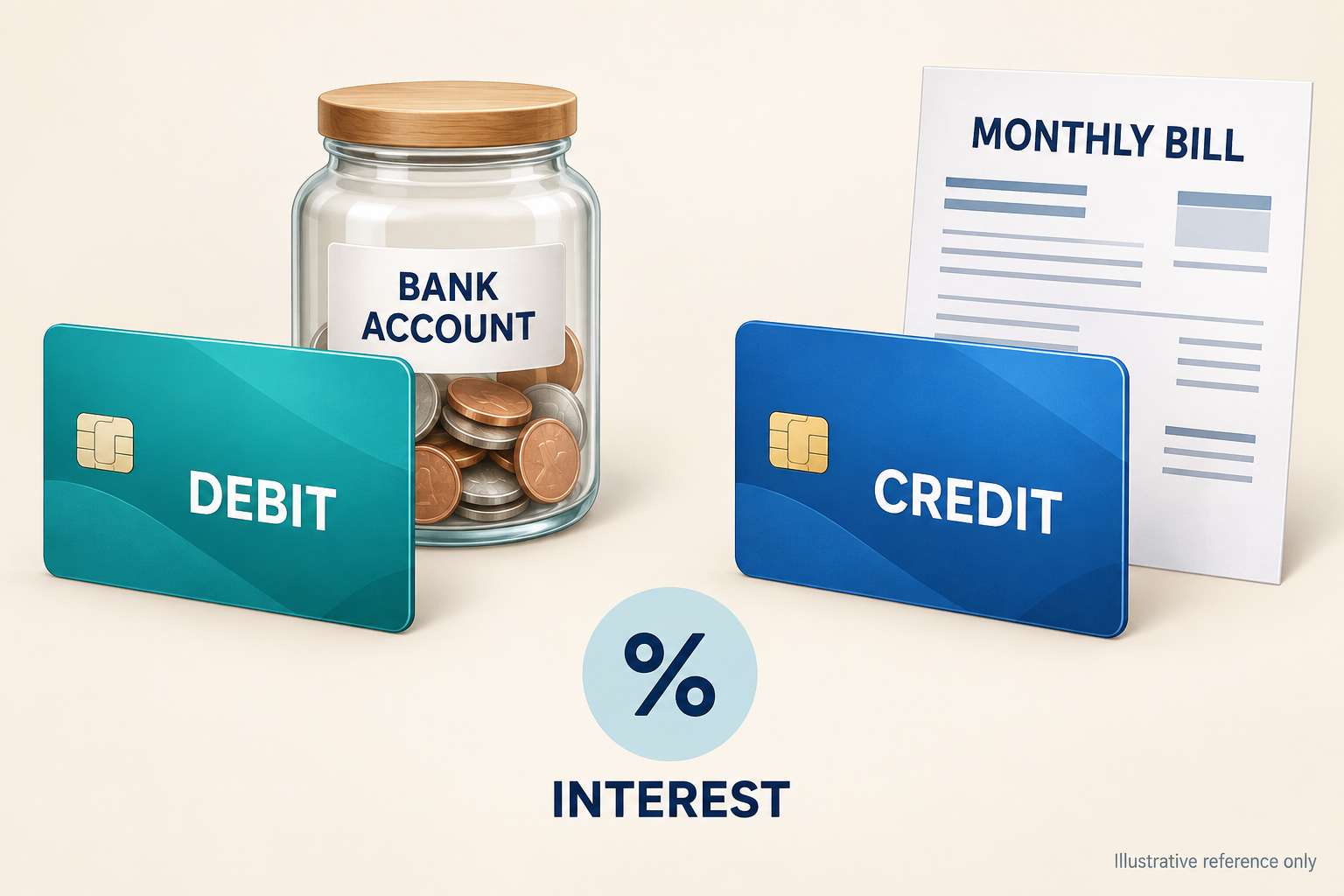
APR — annual percentage rateAPR means annual percentage rate. It helps describe the yearly cost of borrowing.
How it works
Annual means “for one year.” A percentage is a part out of 100. For a mortgage, APR includes interest and certain loan charges. For a credit card, APR usually describes an interest rate, while some fees are separate. There can be different APRs for purchases, cash advances, and late-payment situations. Compare the same kind of borrowing and read all fees.
A small example
A loan with a lower advertised interest rate can still cost more after fees. Compare the actual disclosures.
Start here, one step at a time
- Find the APR and the interest rate in the written offer.
- Compare offers for the same amount and length, including fees and total payments.
Try explaining this word yourself
Before looking back, explain “APR — annual percentage rate” in your own words. Which part of the example shows it?
Then compare your explanation with “APR means annual percentage rate. It helps describe the yearly cost of borrowing.” and the example above. If it is still unclear, use the question below with the relevant office or provider.
A question you can ask
“Which fees are included in this APR, and which costs are separate?”
CFPB: mortgage interest rate and APR (opens a new tab)Authorized user vs. co-signerAn authorized user has permission to use a card account. A co-signer promises to repay a debt with the borrower.
How it works
An authorized user is generally not legally responsible for the primary cardholder’s debt merely because they are a user. The account owner is responsible; account reporting may help or hurt a user’s credit. A co-signer is legally responsible for the loan if the borrower does not pay, even if the co-signer never uses the money or car. A joint owner is another role. Read the agreement and ask the lender to explain your exact responsibility.
A small example
A parent lets Alex use a card for groceries: that may be an authorized-user arrangement. The same parent co-signing Alex’s car loan is promising repayment. If Alex misses payments, the parent can owe money and both credit records can be affected.
Start here, one step at a time
- Name the exact role being proposed: card user, joint owner, borrower, or co-signer.
- Ask the issuer who legally owes the debt and how each person’s credit may be affected.
Try explaining this word yourself
Before looking back, explain “Authorized user vs. co-signer” in your own words. Which part of the example shows it?
Then compare your explanation with “An authorized user has permission to use a card account. A co-signer promises to repay a debt with the borrower.” and the example above. If it is still unclear, use the question below with the relevant office or provider.
A question you can ask
“What am I legally responsible for, and how will this affect my credit record?”
CFPB: sharing credit (PDF) (opens a new tab)Borrower and lenderThe borrower takes a loan. The lender gives the loan and expects repayment.
How it works
A loan servicer may be a different company that sends bills and handles payments. An adviser or salesperson is not automatically the lender.
A small example
If a bank lends you $500, you are the borrower and the bank is the lender.
Start here, one step at a time
- Find both names on the agreement.
- Use verified contact details on official statements.
- Keep any notice of a servicer change.
Try explaining this word yourself
Before looking back, explain “Borrower and lender” in your own words. Which part of the example shows it?
Then compare your explanation with “The borrower takes a loan. The lender gives the loan and expects repayment.” and the example above. If it is still unclear, use the question below with the relevant office or provider.
A question you can ask
“Who lends the money, who sends the bill, and who do I contact about a problem?”
FTC: understanding your credit (opens a new tab)See a labeled picture
Collateral and secured loanCollateral is property a lender can claim through the applicable process if the borrower does not repay a secured loan.
How it works
A car can secure an auto loan. A home can secure a mortgage. An unsecured loan has no named collateral but is still a debt you must repay.
A small example
Missing payments on a car loan can put the car at risk. It is not just a late-fee issue.
Start here, one step at a time
- Look for “security interest” or “collateral” in the agreement.
- Ask what happens after a missed payment.
- Do not pledge property you do not understand you are risking.
Try explaining this word yourself
Before looking back, explain “Collateral and secured loan” in your own words. Which part of the example shows it?
Then compare your explanation with “Collateral is property a lender can claim through the applicable process if the borrower does not repay a secured loan.” and the example above. If it is still unclear, use the question below with the relevant office or provider.
A question you can ask
“Which property secures this loan, and what can happen if I miss payments?”
FTC: understanding your credit (opens a new tab)See a labeled picture
CommuteThe regular trip between where you live and school or work.
How it works
Compare travel time, reliability, fares, parking, and fuel. Visit or check the route during the hours you would actually travel.
A small example
An apartment $80 cheaper but requiring $140 more transportation costs $60 more overall.
Start here, one step at a time
- Map the trip at the time you would actually travel.
- Check return trips, weekend service, parking, and the full monthly cost.
Try explaining this word yourself
Before looking back, explain “Commute” in your own words. Which part of the example shows it?
Then compare your explanation with “The regular trip between where you live and school or work.” and the example above. If it is still unclear, use the question below with the relevant office or provider.
A question you can ask
“What would this trip cost each month, and can I get home after a late shift?”
Coverage limit and exclusionA limit caps a benefit; an exclusion describes something the policy does not cover.
How it works
A low premium alone does not tell you what protection you have. Read the declarations and coverage wording, and ask about special limits.
A small example
A covered item worth $2,000 may not receive $2,000 if a smaller special limit applies.
Start here, one step at a time
- Read the policy summary and full coverage wording.
- Ask about your actual items and situations, including special limits and exclusions.
Try explaining this word yourself
Before looking back, explain “Coverage limit and exclusion” in your own words. Which part of the example shows it?
Then compare your explanation with “A limit caps a benefit; an exclusion describes something the policy does not cover.” and the example above. If it is still unclear, use the question below with the relevant office or provider.
A question you can ask
“Is this situation covered, and what limit or exclusion applies?”
NAIC: understand a home or renters policy (opens a new tab)CreditAn agreement to borrow money or receive something now and pay later.
How it works
Credit is not extra income. A credit limit is permission to borrow up to an amount, subject to terms. Your borrowing and repayment history can be recorded and used by businesses evaluating applications.
A small example
A $1,000 card limit does not add $1,000 to your earnings. A $100 purchase creates a repayment obligation.
Start here, one step at a time
- List anything you borrow and must repay.
- Before borrowing more, write the due dates, costs, and money available to pay.
Try explaining this word yourself
Before looking back, explain “Credit” in your own words. Which part of the example shows it?
Then compare your explanation with “An agreement to borrow money or receive something now and pay later.” and the example above. If it is still unclear, use the question below with the relevant office or provider.
A question you can ask
“What must I repay, when, and with which fees or interest?”
FTC: understanding your credit (opens a new tab)Credit bureauA company that collects and supplies credit-report information.
How it works
The three major U.S. nationwide bureaus are Equifax, Experian, and TransUnion. Reports may differ because not every business supplies the same data to each company.
A small example
A correction at one bureau does not mean you should assume every other report already changed.
Start here, one step at a time
- Note which bureau supplied the report you are reading.
- Check the other major reports too; information may differ.
Try explaining this word yourself
Before looking back, explain “Credit bureau” in your own words. Which part of the example shows it?
Then compare your explanation with “A company that collects and supplies credit-report information.” and the example above. If it is still unclear, use the question below with the relevant office or provider.
A question you can ask
“Which bureau’s report contains this item?”
FTC: understanding your credit (opens a new tab)Credit freeze and fraud alertA freeze restricts access to your credit file for many new-credit checks. A fraud alert asks creditors to take identity-verification steps.
How it works
They are different protections. A freeze does not fix existing fraud or stop every kind of account misuse. Use the bureaus’ official processes and keep recovery information secure.
A small example
You may need to temporarily lift a freeze when applying for a legitimate new account.
Start here, one step at a time
- Follow each bureau’s official freeze instructions when you choose to freeze.
- Keep access details secure and plan a temporary lift when a legitimate application needs it.
Try explaining this word yourself
Before looking back, explain “Credit freeze and fraud alert” in your own words. Which part of the example shows it?
Then compare your explanation with “A freeze restricts access to your credit file for many new-credit checks. A fraud alert asks creditors to take identity-verification steps.” and the example above. If it is still unclear, use the question below with the relevant office or provider.
A question you can ask
“Which bureaus must I contact, and how will I lift the freeze when needed?”
FTC: credit freezes and fraud alerts (opens a new tab)Credit report and credit scoreA report contains credit-history information. A score is a number calculated from information in a report.
How it works
They are different products. You can have different scores because the data, scoring model, and date differ. A score is a risk estimate, not a rating of your worth or intelligence.
A small example
A score shown in one app may differ from the score a mortgage lender uses.
Start here, one step at a time
- Use the official free-report route linked by the FTC.
- Check names, accounts, and payment history; report a specific error through the official dispute process.
Try explaining this word yourself
Before looking back, explain “Credit report and credit score” in your own words. Which part of the example shows it?
Then compare your explanation with “A report contains credit-history information. A score is a number calculated from information in a report.” and the example above. If it is still unclear, use the question below with the relevant office or provider.
A question you can ask
“Which report and scoring model are you using?”
CFPB: understand your credit score (opens a new tab)Credit utilizationHow much of your available revolving credit is being used, often expressed as a percentage.
How it works
Calculate balance ÷ limit × 100. Scoring can look at individual accounts and totals, using reported balances that may differ from today’s app balance. There is no magic percentage that guarantees approval.
A small example
A $200 reported balance ÷ a $1,000 limit × 100 = 20%.
Start here, one step at a time
- Find the reported balance and credit limit.
- Divide balance by limit, then multiply by 100; do not borrow just to create a percentage.
Try explaining this word yourself
Before looking back, explain “Credit utilization” in your own words. Which part of the example shows it?
Then compare your explanation with “How much of your available revolving credit is being used, often expressed as a percentage.” and the example above. If it is still unclear, use the question below with the relevant office or provider.
A question you can ask
“Which balance and reporting date produced this percentage?”
CFPB: understand your credit score (opens a new tab)Credit-report disputeA request to investigate information you believe is wrong or incomplete.
How it works
Identify the exact item, explain the error, and follow the bureau’s and reporting company’s processes with supporting copies. Keep records of submissions and results.
A small example
If a report shows a late payment you made on time, include evidence of the payment in the official dispute.
Start here, one step at a time
- Identify the exact account and error, then collect supporting records.
- Submit through the bureau and company’s verified process; save copies and follow the response.
Try explaining this word yourself
Before looking back, explain “Credit-report dispute” in your own words. Which part of the example shows it?
Then compare your explanation with “A request to investigate information you believe is wrong or incomplete.” and the example above. If it is still unclear, use the question below with the relevant office or provider.
A question you can ask
“Where should I submit this dispute and how will I receive the result?”
CFPB: dispute a credit-report error (opens a new tab)Dealership, independent shop, and quick-lube shopDifferent kinds of businesses that service vehicles.
How it works
A dealership handles a particular brand and may perform its recalls and warranty repairs. Independent shops can offer broad repairs. Quick-lube shops often focus on routine services. Skills, tools, price, and scope vary by location.
A small example
A quick oil service may not include a full diagnosis. Independent maintenance does not automatically cancel a manufacturer warranty.
Start here, one step at a time
- Check the manual and any warranty or recall instructions.
- Compare itemized prices for the same work and ask about experience with your model.
- Keep receipts showing date, mileage, parts, and fluids; ask the manufacturer about covered warranty work.
Try explaining this word yourself
Before looking back, explain “Dealership, independent shop, and quick-lube shop” in your own words. Which part of the example shows it?
Then compare your explanation with “Different kinds of businesses that service vehicles.” and the example above. If it is still unclear, use the question below with the relevant office or provider.
A question you can ask
“Can you service this model correctly, what is included, and who approves extra charges?”
FTC: dealer and independent maintenance (opens a new tab)See a labeled picture
DeductibleThe part of certain covered costs you are responsible for under your insurance policy.
How it works
For a simple property claim, the insurer may subtract the deductible from the covered payment instead of asking you to pay the insurer first. Health plans often use a yearly deductible for certain services, followed by other cost sharing; some services are covered before it. Other policies can use per-claim or percentage deductibles. Always ask which rule applies to this coverage.
A small example
For a covered $1,500 car repair with a $500 deductible and no other adjustments, the insurer’s share is $1,000 and your share is $500. This is separate from the premium you already paid.
Start here, one step at a time
- Find the deductible for the particular coverage, not just the first number on the page.
- Ask the insurer to show how it would apply to a small example claim.
Try explaining this word yourself
Before looking back, explain “Deductible” in your own words. Which part of the example shows it?
Then compare your explanation with “The part of certain covered costs you are responsible for under your insurance policy.” and the example above. If it is still unclear, use the question below with the relevant office or provider.
A question you can ask
“Which deductible applies to this exact loss?”
NAIC: understand a home or renters policy (opens a new tab)Deferment and forbearanceApproved ways to pause or reduce payments under certain loan rules.
How it works
A pause is not forgiveness. Interest may continue. Eligibility, duration, and consequences differ, so get the servicer’s written terms before relying on a pause.
A small example
If payments stop for a month but interest continues, the debt may still grow.
Start here, one step at a time
- Contact the actual servicer before you stop paying.
- Ask about the options available for your loan.
- Keep the approval and restart date.
Try explaining this word yourself
Before looking back, explain “Deferment and forbearance” in your own words. Which part of the example shows it?
Then compare your explanation with “Approved ways to pause or reduce payments under certain loan rules.” and the example above. If it is still unclear, use the question below with the relevant office or provider.
A question you can ask
“Would interest continue, and what happens when the pause ends?”
Federal Student Aid: financial-aid words (opens a new tab)See a labeled picture
Driver’s license and license numberA state document that allows you to drive certain vehicles under its rules.
How it works
The card usually has a number labeled “DL,” “DLN,” “License No.,” or something similar. That is different from a vehicle’s VIN. Restrictions and expiration still matter.
A small example
An insurer asks for your license number to identify the driver and your VIN to identify the car.
Start here, one step at a time
- Read the front and back of your card. Look for the license-number label.
- If unclear, use your state agency’s sample card or call its official number.
- Share the number only with a verified organization that needs it.
Try explaining this word yourself
Before looking back, explain “Driver’s license and license number” in your own words. Which part of the example shows it?
Then compare your explanation with “A state document that allows you to drive certain vehicles under its rules.” and the example above. If it is still unclear, use the question below with the relevant office or provider.
A question you can ask
“Where is the license number on my state’s card, and which restrictions apply to me?”
USAGov: state motor-vehicle services (opens a new tab)See a labeled picture
Emergency savings and planned-cost savingsEmergency savings is money for unexpected needs. Planned-cost savings is money set aside for a known future bill.
How it works
Keep an annual renewal or predictable service on the plan instead of treating it as a surprise. Choose amounts that fit your circumstances.
A small example
A $240 yearly bill can be planned as $20 a month for 12 months if you start in time.
Start here, one step at a time
- Write the amount and date of the next known big bill.
- Divide by the number of saving periods left; keep unexpected-emergency savings separate if possible.
Try explaining this word yourself
Before looking back, explain “Emergency savings and planned-cost savings” in your own words. Which part of the example shows it?
Then compare your explanation with “Emergency savings is money for unexpected needs. Planned-cost savings is money set aside for a known future bill.” and the example above. If it is still unclear, use the question below with the relevant office or provider.
A question you can ask
“How much time is actually left before this bill is due?”
EV charging, kW, and kWhkW measures charging power. kWh measures an amount of energy, like the electricity added to a battery.
How it works
Charging speed depends on the car, charger, temperature, and battery level. Home charging may need an electrician and property approval. Use equipment approved for the car and location, not an improvised extension-cord setup.
A small example
Adding 30 kWh at $0.20 per kWh costs $6 for energy before losses, fees, or taxes. At a constant 7 kW, 30 ÷ 7 is about 4.3 hours; real times vary.
Start here, one step at a time
- Use the vehicle manual and charger operator’s instructions to confirm compatibility.
- Plan a reliable charging option and a backup.
- Follow the displayed start, payment, and stop steps; keep connectors dry and undamaged.
Try explaining this word yourself
Before looking back, explain “EV charging, kW, and kWh” in your own words. Which part of the example shows it?
Then compare your explanation with “kW measures charging power. kWh measures an amount of energy, like the electricity added to a battery.” and the example above. If it is still unclear, use the question below with the relevant office or provider.
A question you can ask
“Is this connector compatible, what is the total price, and are there idle or parking fees?”
Department of Energy: electric-vehicle types (opens a new tab)See a labeled picture
EV, hybrid, and plug-in hybridA battery EV runs on stored electricity. A hybrid has an engine and electric assistance. A plug-in hybrid has an engine and can also charge from a plug.
How it works
Battery EVs need charging access. Ordinary hybrids do not plug in. Plug-in hybrids still need engine maintenance. Read the exact model’s manual rather than assuming all electrified cars are alike.
A small example
A battery EV has no engine-oil change, but still needs tire, brake, filter, and other scheduled care.
Start here, one step at a time
- Identify the exact vehicle type and charging connector.
- Check your parking and charging access before buying.
- Follow its maintenance schedule; leave orange high-voltage parts and battery repairs to qualified technicians.
Try explaining this word yourself
Before looking back, explain “EV, hybrid, and plug-in hybrid” in your own words. Which part of the example shows it?
Then compare your explanation with “A battery EV runs on stored electricity. A hybrid has an engine and electric assistance. A plug-in hybrid has an engine and can also charge from a plug.” and the example above. If it is still unclear, use the question below with the relevant office or provider.
A question you can ask
“What powers this model, where can I charge, and what maintenance does its manual require?”
Department of Energy: EV maintenance and safety (opens a new tab)See a labeled picture
Expiration and renewalExpiration is when a document or agreement stops being valid under its terms; renewal extends or replaces it.
How it works
Record deadlines and check the issuing agency’s requirements early. A reminder email is helpful but may not be guaranteed.
A small example
A renewal application may need processing time before a card expires.
Start here, one step at a time
- Check the date printed on the current record.
- Use the issuer’s renewal instructions early enough for processing and delivery.
Try explaining this word yourself
Before looking back, explain “Expiration and renewal” in your own words. Which part of the example shows it?
Then compare your explanation with “Expiration is when a document or agreement stops being valid under its terms; renewal extends or replaces it.” and the example above. If it is still unclear, use the question below with the relevant office or provider.
A question you can ask
“How early can I renew, and what proof remains valid while I wait?”
USAGov: official document replacements (opens a new tab)Extra principal payment / prepaymentPaying some or all of a loan earlier than scheduled.
How it works
Extra money may reduce principal, but you need to know how the servicer applies it. Check for restrictions or penalties. Paying ahead on a due date is not always the same as reducing principal as intended.
A small example
An extra $50 meant for principal should be checked on the next statement to see where it went.
Start here, one step at a time
- Read the agreement’s early-payment rules.
- Use the servicer’s designated instructions.
- Confirm the new balance and keep your normal payment obligations clear.
Try explaining this word yourself
Before looking back, explain “Extra principal payment / prepayment” in your own words. Which part of the example shows it?
Then compare your explanation with “Paying some or all of a loan earlier than scheduled.” and the example above. If it is still unclear, use the question below with the relevant office or provider.
A question you can ask
“How do I direct extra money to principal, and is there any penalty?”
CFPB: buying a home (opens a new tab)See a labeled picture
Finance charge and total of paymentsFinance charge describes certain dollar costs of credit. Total of payments is the total of scheduled payments shown in a disclosure.
How it works
Neither term means just the cash borrowed. Read what the disclosure includes and excludes. A late fee or future rate change may affect what you actually pay.
A small example
If scheduled payments total $1,200 for $1,000 financed, the difference is $200 in this simplified example.
Start here, one step at a time
- Find both dollar amounts on the offer.
- Compare offers using the same borrowed amount and term.
- Ask about variable rates and extra fees.
Try explaining this word yourself
Before looking back, explain “Finance charge and total of payments” in your own words. Which part of the example shows it?
Then compare your explanation with “Finance charge describes certain dollar costs of credit. Total of payments is the total of scheduled payments shown in a disclosure.” and the example above. If it is still unclear, use the question below with the relevant office or provider.
A question you can ask
“What is included in these totals, and what could make the actual cost different?”
CFPB: read a Loan Estimate (opens a new tab)See a labeled picture
Hard and soft credit inquiriesAn inquiry is a request to view a credit report. Hard and soft inquiries have different effects.
How it works
A hard inquiry associated with a credit application may affect a score. Checking your own report is a soft inquiry and does not lower it. Ask a provider what it will do before applying.
A small example
Viewing your own report is different from submitting several loan applications.
Start here, one step at a time
- Ask what type of credit inquiry occurs before submitting an application.
- Read your own report without treating that as a new borrowing application.
Try explaining this word yourself
Before looking back, explain “Hard and soft credit inquiries” in your own words. Which part of the example shows it?
Then compare your explanation with “An inquiry is a request to view a credit report. Hard and soft inquiries have different effects.” and the example above. If it is still unclear, use the question below with the relevant office or provider.
A question you can ask
“Will this be a hard or soft inquiry, and at what point does it happen?”
CFPB: credit inquiries (opens a new tab)Installment and payment scheduleAn installment is one of a series of payments. The schedule says when each payment is due.
How it works
A payment may cover interest, principal, or fees. Weekly and monthly schedules are different. Check the first and final payments, which may differ from the others.
A small example
Twelve monthly $50 payments add up to $600. That is different from twelve weekly payments.
Start here, one step at a time
- Count the scheduled payments.
- Add fees that are not included in them.
- Put due dates beside your paydays.
Try explaining this word yourself
Before looking back, explain “Installment and payment schedule” in your own words. Which part of the example shows it?
Then compare your explanation with “An installment is one of a series of payments. The schedule says when each payment is due.” and the example above. If it is still unclear, use the question below with the relevant office or provider.
A question you can ask
“How many payments are there, on which dates, and is the last one larger?”
CFPB: credit-card contract terms (opens a new tab)See a labeled picture
Insurance card and declarations pageAn insurance card is a short proof of coverage. A declarations page summarizes a policy’s people, property, dates, limits, and deductibles.
How it works
Neither is the complete policy. Read the full terms and check the state’s required proof format. Do not assume that a saved old card proves coverage is still active.
A small example
A registration appointment may require current insurance information matching your vehicle.
Start here, one step at a time
- Get the current documents from your insurer’s official app, website, or agent.
- Check names, VIN, dates, and coverage details.
- Use the state insurance department and motor-vehicle agency for your state’s requirements.
Try explaining this word yourself
Before looking back, explain “Insurance card and declarations page” in your own words. Which part of the example shows it?
Then compare your explanation with “An insurance card is a short proof of coverage. A declarations page summarizes a policy’s people, property, dates, limits, and deductibles.” and the example above. If it is still unclear, use the question below with the relevant office or provider.
A question you can ask
“Is my policy active, who and what is covered, and what proof format does my state accept?”
NAIC: find your state insurance department (opens a new tab)See a labeled picture
Insurance claimA request asking an insurer to cover a loss or service under your policy.
How it works
You or a provider submit details. The insurer checks coverage, dates, cause, limits, deductible, and evidence. It may approve, partially pay, ask for more information, or deny with reasons. A claim is not the regular bill that keeps your policy active—that bill is the premium.
A small example
Photos, receipts, a date, and a written description may help document a damaged item.
Start here, one step at a time
- Use the insurer’s verified claims number or official portal.
- Get a claim number, evidence list, deadlines, and contact; keep copies of what you submit.
Try explaining this word yourself
Before looking back, explain “Insurance claim” in your own words. Which part of the example shows it?
Then compare your explanation with “A request asking an insurer to cover a loss or service under your policy.” and the example above. If it is still unclear, use the question below with the relevant office or provider.
A question you can ask
“What do I submit, who handles this, and how do I track it?”
NAIC: find your state insurance department (opens a new tab)Interest rateThe percentage used to calculate the charge for borrowing money.
How it works
The stated annual rate is not usually charged all at once. The balance, time, calculation method, and payment schedule affect the dollars charged. It excludes some other costs of borrowing.
A small example
With simple interest for one full year, $1,000 × 6% = $60. A shrinking balance changes the result.
Start here, one step at a time
- Turn a percent into a decimal by dividing by 100: 6% is 0.06.
- Ask which balance and time period the lender uses before calculating the charge.
Try explaining this word yourself
Before looking back, explain “Interest rate” in your own words. Which part of the example shows it?
Then compare your explanation with “The percentage used to calculate the charge for borrowing money.” and the example above. If it is still unclear, use the question below with the relevant office or provider.
A question you can ask
“Is this rate fixed or variable, and how is interest calculated?”
CFPB: mortgage interest rate and APR (opens a new tab)Late fee and missed paymentA late fee is a charge that may apply when a required payment is late.
How it works
A missed payment can also lead to interest, collection steps, or credit-report effects. The timing is not identical for each consequence. A late-fee grace period is not permission to ignore the due date.
A small example
A bill due on the 10th is still due on the 10th even if a fee is not charged immediately.
Start here, one step at a time
- Check the due date and payment-processing time.
- Contact the lender early through a verified number if you may miss it.
- Keep any written payment arrangement.
Try explaining this word yourself
Before looking back, explain “Late fee and missed payment” in your own words. Which part of the example shows it?
Then compare your explanation with “A late fee is a charge that may apply when a required payment is late.” and the example above. If it is still unclear, use the question below with the relevant office or provider.
A question you can ask
“When is a payment considered received, and what help is available if I cannot pay?”
CFPB: credit-card contract terms (opens a new tab)See a labeled picture
Learner’s permitPermission to practice driving under specific limits. It is not an unrestricted license.
How it works
Your state sets age, testing, supervision, practice, and driving-hour rules. Passing a written test does not mean you can drive alone.
A small example
A permit holder may need a qualified licensed adult in the front seat. Check your state’s exact rule.
Start here, one step at a time
- Open your state’s page for a first permit for your age.
- Read its study handbook and application-document list.
- Arrange required tests and practice with a person who meets the rules.
Try explaining this word yourself
Before looking back, explain “Learner’s permit” in your own words. Which part of the example shows it?
Then compare your explanation with “Permission to practice driving under specific limits. It is not an unrestricted license.” and the example above. If it is still unclear, use the question below with the relevant office or provider.
A question you can ask
“Who may supervise me, when may I drive, and what comes next?”
USAGov: state motor-vehicle services (opens a new tab)See a labeled picture
Liability coverageCoverage for certain legal responsibilities to other people, subject to the policy.
How it works
It is different from coverage for damage to your own property. Ask which people, activities, costs, and limits are covered.
A small example
Vehicle liability coverage and coverage to repair your own car serve different purposes.
Start here, one step at a time
- Ask which people and events your policy covers.
- Compare liability protection with separate coverage for your own property.
Try explaining this word yourself
Before looking back, explain “Liability coverage” in your own words. Which part of the example shows it?
Then compare your explanation with “Coverage for certain legal responsibilities to other people, subject to the policy.” and the example above. If it is still unclear, use the question below with the relevant office or provider.
A question you can ask
“What happens if I injure someone or damage their property?”
NAIC: find your state insurance department (opens a new tab)LoanMoney you borrow and agree to pay back.
How it works
The borrower receives the money. The lender provides it. Interest is a charge for borrowing. Fees are other charges. A loan can cost more than the amount you receive.
A small example
Borrow $100 and agree to repay $110. The extra $10 is a borrowing cost. This is a simple made-up example, not a loan offer.
Start here, one step at a time
- Write down the amount you receive.
- Find every payment and fee in the written offer.
- Compare the repayment dates with your own budget before signing.
Try explaining this word yourself
Before looking back, explain “Loan” in your own words. Which part of the example shows it?
Then compare your explanation with “Money you borrow and agree to pay back.” and the example above. If it is still unclear, use the question below with the relevant office or provider.
A question you can ask
“How much will I receive, and how much will I repay in total?”
FTC: understanding your credit (opens a new tab)See a labeled picture
Loan termThe length of time the loan is scheduled to last.
How it works
A longer term may reduce the required payment but can increase total interest. Compare the total repaid, not just the monthly amount.
A small example
30 years × 12 months = 360 monthly payments. Fifteen years means 180.
Start here, one step at a time
- Convert years to months by multiplying by 12.
- Compare the monthly payment and total repayment at each offered length.
Try explaining this word yourself
Before looking back, explain “Loan term” in your own words. Which part of the example shows it?
Then compare your explanation with “The length of time the loan is scheduled to last.” and the example above. If it is still unclear, use the question below with the relevant office or provider.
A question you can ask
“What is the payment and total repayment at each term?”
CFPB: buying a home (opens a new tab)Miles per gallon — MPGA measure of how far a vehicle travels on a gallon of fuel.
How it works
Divide miles by MPG to estimate gallons needed. Traffic, weather, load, and driving affect real mileage.
A small example
120 miles ÷ 30 MPG = 4 gallons. At $3.50 per gallon, that trip uses about $14 in fuel.
Start here, one step at a time
- Estimate your monthly miles and realistic MPG.
- Divide miles by MPG and multiply by fuel price; then add other car costs.
Try explaining this word yourself
Before looking back, explain “Miles per gallon — MPG” in your own words. Which part of the example shows it?
Then compare your explanation with “A measure of how far a vehicle travels on a gallon of fuel.” and the example above. If it is still unclear, use the question below with the relevant office or provider.
A question you can ask
“What are the fuel, insurance, parking, and maintenance costs together?”
Oil changeA service that replaces used engine oil, usually with a new oil filter too.
How it works
Oil helps lubricate moving parts in an engine. The correct oil type, amount, and schedule come from the vehicle manual. Gas and many hybrid vehicles need this; battery-only EVs do not have engine oil changes.
A small example
An oil-change reminder is not the same as an oil-pressure warning. A pressure warning can require stopping safely and shutting the engine off.
Start here, one step at a time
- Find your year, model, engine, mileage, and maintenance schedule.
- Ask a service shop for a written price for the specified oil and filter, including fees.
- Keep the receipt and next-due mileage or date. Ask before approving extra work.
Try explaining this word yourself
Before looking back, explain “Oil change” in your own words. Which part of the example shows it?
Then compare your explanation with “A service that replaces used engine oil, usually with a new oil filter too.” and the example above. If it is still unclear, use the question below with the relevant office or provider.
A question you can ask
“What oil specification and interval does my exact engine require?”
FTC: understand vehicle service and estimates (opens a new tab)See a labeled picture
Origination fee and amount financedAn origination fee is a charge for making a loan. Amount financed is a disclosure figure for credit provided, calculated under the applicable rules.
How it works
A fee may be paid upfront, taken from the amount sent to you, or added to the loan. These arrangements change the cash you get and what you owe.
A small example
A $1,000 loan with a $50 fee taken out sends you $950, but you may still owe $1,000 plus interest.
Start here, one step at a time
- Compare cash received with the loan balance.
- Ask whether a fee is included in APR.
- Do not count a withheld fee as money available to spend.
Try explaining this word yourself
Before looking back, explain “Origination fee and amount financed” in your own words. Which part of the example shows it?
Then compare your explanation with “An origination fee is a charge for making a loan. Amount financed is a disclosure figure for credit provided, calculated under the applicable rules.” and the example above. If it is still unclear, use the question below with the relevant office or provider.
A question you can ask
“How much reaches me after fees, and what balance will I repay?”
CFPB: read a Loan Estimate (opens a new tab)See a labeled picture
Past due, default, and collectionsPast due means a required payment is late. Default is a more serious contract status. Collections means efforts to recover a claimed debt.
How it works
Timing and consequences differ by agreement and law. Verify unexpected debt claims and get help understanding notices rather than ignoring them or sending money to an unverified caller.
A small example
A text claiming you owe money is not enough to establish that the debt or sender is legitimate.
Start here, one step at a time
- Verify the collector and the debt information before sending money.
- Keep notices and ask about your rights and deadlines using the official consumer-help resources.
Try explaining this word yourself
Before looking back, explain “Past due, default, and collections” in your own words. Which part of the example shows it?
Then compare your explanation with “Past due means a required payment is late. Default is a more serious contract status. Collections means efforts to recover a claimed debt.” and the example above. If it is still unclear, use the question below with the relevant office or provider.
A question you can ask
“Can you provide the required details about this claimed debt through a verified process?”
FTC: understanding your credit (opens a new tab)Preventive maintenanceRoutine care done before something fails.
How it works
Use the actual product manual or professional service instructions. Record dates and reminders. If you do not know how to do a task safely, get qualified help.
A small example
Changing a filter on the maker’s schedule is planned care; fixing a failed system is a repair.
Start here, one step at a time
- Find the exact product or vehicle manual.
- Record required tasks, dates, parts, and who can do them safely.
Try explaining this word yourself
Before looking back, explain “Preventive maintenance” in your own words. Which part of the example shows it?
Then compare your explanation with “Routine care done before something fails.” and the example above. If it is still unclear, use the question below with the relevant office or provider.
A question you can ask
“What maintenance does this model require, and who should perform it?”
PrincipalThe part of a loan balance that is borrowed money, before interest and other charges.
How it works
A payment may be split between interest and reducing principal. Paying $1,000 does not necessarily lower the loan balance by $1,000.
A small example
If a $300 payment contains $80 interest and $220 principal, the principal falls by $220.
Start here, one step at a time
- Find “principal balance” on the loan statement.
- Look at the last payment breakdown: interest and fees do not reduce principal.
Try explaining this word yourself
Before looking back, explain “Principal” in your own words. Which part of the example shows it?
Then compare your explanation with “The part of a loan balance that is borrowed money, before interest and other charges.” and the example above. If it is still unclear, use the question below with the relevant office or provider.
A question you can ask
“How much of this payment reduces the balance?”
CFPB: read a Loan Estimate (opens a new tab)Proof of address / proof of residencyEvidence that you live at the address you give an organization.
How it works
It is different from proving who you are. Accepted documents, dates, names, and formats vary by service. An envelope with your name on it is not automatically enough.
A small example
A DMV may accept a utility bill that is not on the USPS PO Box identification list.
Start here, one step at a time
- Find the specific office’s current document list.
- Match the name, physical address, date, and format requirements.
- If you live with someone else or have no fixed address, ask for its approved alternative process.
Try explaining this word yourself
Before looking back, explain “Proof of address / proof of residency” in your own words. Which part of the example shows it?
Then compare your explanation with “Evidence that you live at the address you give an organization.” and the example above. If it is still unclear, use the question below with the relevant office or provider.
A question you can ask
“Which documents count for this exact service, how recent, and how many do you need?”
USPS: ID accepted for each postal service (opens a new tab)See a labeled picture
REAL IDA standard that some state IDs and driver’s licenses meet for certain federal identification uses.
How it works
REAL ID is not a separate driving skill or proof of U.S. citizenship. Adults flying within the U.S. need a TSA-accepted ID; a passport is one alternative. A standard license can still be valid for driving.
A small example
You may choose a REAL ID state card even if you do not drive. A REAL ID is not a passport for international air travel.
Start here, one step at a time
- Check TSA’s current accepted-ID list for your trip.
- If applying for REAL ID, open your state’s REAL ID checklist.
- Gather the required identity, name-change, Social Security, and address evidence that applies to you.
Try explaining this word yourself
Before looking back, explain “REAL ID” in your own words. Which part of the example shows it?
Then compare your explanation with “A standard that some state IDs and driver’s licenses meet for certain federal identification uses.” and the example above. If it is still unclear, use the question below with the relevant office or provider.
A question you can ask
“Do I need a REAL ID for my plans, or do I already have another accepted document?”
TSA: accepted identification (opens a new tab)See a labeled picture
RefinancingReplacing an existing loan with a new loan.
How it works
A new rate, term, fee, or lender can change the total cost. A lower monthly payment can still cost more over a longer period. Replacing federal student debt with private debt can remove federal benefits.
A small example
A $200 payment for 36 months totals $7,200. A $150 payment for 60 months totals $9,000, before any extra fees.
Start here, one step at a time
- Compare remaining old payments with all new payments and fees.
- Ask what protections would be lost.
- Do not decide using the monthly payment alone.
Try explaining this word yourself
Before looking back, explain “Refinancing” in your own words. Which part of the example shows it?
Then compare your explanation with “Replacing an existing loan with a new loan.” and the example above. If it is still unclear, use the question below with the relevant office or provider.
A question you can ask
“What total cost and benefits change if I replace this loan?”
CFPB: student-loan co-signers (opens a new tab)See a labeled picture
State safety inspection and emissions testChecks some states or local areas require for certain vehicles.
How it works
Safety inspections and emissions tests are different. Requirements can depend on the state, county, vehicle age, fuel type, and registration situation. An EV exemption from emissions does not mean exemption from all inspections.
A small example
A car moving to another state may need different checks before registration.
Start here, one step at a time
- Open your state motor-vehicle agency from the official directory.
- Find registration renewal and inspection requirements for your vehicle and county.
- Use its approved-station list and keep the required proof or electronic confirmation.
Try explaining this word yourself
Before looking back, explain “State safety inspection and emissions test” in your own words. Which part of the example shows it?
Then compare your explanation with “Checks some states or local areas require for certain vehicles.” and the example above. If it is still unclear, use the question below with the relevant office or provider.
A question you can ask
“For my ZIP code, vehicle, and renewal year, which checks are required and where are approved stations?”
USAGov: state motor-vehicle services (opens a new tab)See a labeled picture
Tire balance, rotation, and alignmentBalancing corrects uneven wheel-and-tire weight. Rotation moves tires to different positions. Alignment adjusts wheel angles.
How it works
These are different services. Balancing often uses small weights. Rotation patterns depend on the vehicle and tire setup. Alignment may be checked for pulling or uneven wear; a technician should diagnose the cause.
A small example
Buying a rotation does not automatically mean you also bought balancing and alignment.
Start here, one step at a time
- Write down the symptom and when it happens.
- Check the manual’s care schedule and ask a qualified shop to inspect.
- Request separate prices and approval before additional work.
Try explaining this word yourself
Before looking back, explain “Tire balance, rotation, and alignment” in your own words. Which part of the example shows it?
Then compare your explanation with “Balancing corrects uneven wheel-and-tire weight. Rotation moves tires to different positions. Alignment adjusts wheel angles.” and the example above. If it is still unclear, use the question below with the relevant office or provider.
A question you can ask
“Which service is needed, what evidence shows that, and what is included in the price?”
NHTSA: tire safety (opens a new tab)See a labeled picture
Tire pressure and treadPressure is how much air is in a tire. Tread is the grooved rubber that touches the road.
How it works
Use the vehicle’s cold-tire pressure label or manual, not the maximum number on the tire sidewall. Correct pressure and sufficient tread help the tire work properly.
A small example
A dashboard pressure light calls for checking the tires; it does not tell you that every tire is otherwise safe.
Start here, one step at a time
- Find the pressure label, often at the driver’s door opening.
- Use a gauge when tires are cold as the manual directs.
- Have a shop inspect cuts, bulges, recurring air loss, or worn tread; do not drive on an obviously damaged tire.
Try explaining this word yourself
Before looking back, explain “Tire pressure and tread” in your own words. Which part of the example shows it?
Then compare your explanation with “Pressure is how much air is in a tire. Tread is the grooved rubber that touches the road.” and the example above. If it is still unclear, use the question below with the relevant office or provider.
A question you can ask
“What pressure and tire size does this vehicle require, and is there damage or unsafe wear?”
NHTSA: tire safety (opens a new tab)See a labeled picture
Variable / floating interest rateAn interest rate that can move up or down under the agreement’s rules.
How it works
A common rule is an index plus a margin. The index is a published starting rate. The margin is the added amount named in the agreement. Your loan or card may use different rules.
A small example
An invented 5% index + 12 percentage-point margin = 17%. If the index becomes 6% and the margin stays 12 points, the result is 18%.
Start here, one step at a time
- Find the rate-change section in the agreement.
- Write down the index, margin, and adjustment timing.
- Ask how a higher rate would affect the payment or payoff time.
Try explaining this word yourself
Before looking back, explain “Variable / floating interest rate” in your own words. Which part of the example shows it?
Then compare your explanation with “An interest rate that can move up or down under the agreement’s rules.” and the example above. If it is still unclear, use the question below with the relevant office or provider.
A question you can ask
“Which index is used, when does my rate change, and are there limits?”
CFPB: fixed and variable APR (opens a new tab)See a labeled picture
Vehicle title and registrationA title records vehicle ownership; registration authorizes vehicle use under your state’s rules.
How it works
Follow the state motor-vehicle office’s transfer, registration, insurance, and renewal steps. Paying a seller does not finish all the paperwork.
A small example
A used-car purchase may require a title transfer plus registration and other state requirements.
Start here, one step at a time
- Find your state’s page for your exact purchase, transfer, or renewal.
- Gather the listed ownership, identity, insurance, inspection, and payment items before going.
Try explaining this word yourself
Before looking back, explain “Vehicle title and registration” in your own words. Which part of the example shows it?
Then compare your explanation with “A title records vehicle ownership; registration authorizes vehicle use under your state’s rules.” and the example above. If it is still unclear, use the question below with the relevant office or provider.
A question you can ask
“Which forms, fees, inspections, and deadlines apply to this purchase?”
USAGov: state motor-vehicle services (opens a new tab)VIN — vehicle identification numberThe identifying number for a particular vehicle, like its own serial number.
How it works
For most modern cars it has 17 characters. You can often see it through the windshield on the driver’s side of the dashboard or on a driver-door label. Registration and insurance records also list it.
A small example
Two cars of the same model have different VINs. Your driver’s license number identifies you, not the car.
Start here, one step at a time
- Park safely and look through the windshield from outside.
- Compare with the door label and registration without removing any parts.
- Use the exact characters when requesting insurance or checking recalls.
Try explaining this word yourself
Before looking back, explain “VIN — vehicle identification number” in your own words. Which part of the example shows it?
Then compare your explanation with “The identifying number for a particular vehicle, like its own serial number.” and the example above. If it is still unclear, use the question below with the relevant office or provider.
A question you can ask
“Do these VINs match on the vehicle and the paperwork?”
NHTSA: vehicle identification numbers (opens a new tab)See a labeled picture
What this means for you
Transportation affects whether you can reliably reach school, work, care, and other obligations.
What can make it harder
A large payment, higher loan rate, unreliable vehicle, or overlooked insurance bill can make a car unaffordable even if the purchase price seems manageable.
What can help
Comparing the full ownership cost with transit or other workable options can preserve money and reduce missed trips.
One next stepAdd payment, insurance, fuel, registration, parking, and maintenance. Read the credit cost comparison if you are considering a loan.
Read how credit can affect approval and costs ↓Price a trip beyond the fuel gauge
Suppose a round trip is 120 miles, the vehicle gets 30 miles per gallon, and fuel is $3.50 per gallon.
Find gallons needed
120 miles ÷ 30 miles per gallon = 4 gallons.
Find fuel cost
4 gallons × $3.50 = $14.
Add trip charges
$14 fuel + $6 parking = $20 for these trip costs. Tolls would add more.
Compare the same journey
If a round-trip bus ticket is $12, these listed car costs are $8 higher. Compare timing and accessibility too. Car insurance, payments, wear, and maintenance are not included in the $20.
What the answer tells youCompare full recurring transportation costs before buying a vehicle. A monthly payment alone is not the cost of owning it.
Keeping a repair estimate understandable
A written scope explains what you are approving and what is still only a suggestion.
What can make it harder
An unclear authorization can lead to disagreement about extra work or price.
What can help
Ask for findings, an itemized estimate, and a call before additional work.
One next stepConfirm the approved scope before the next service starts.
Plan for two scheduled services
Example quotes are $180 for one service and $120 for another, both six months away.
- 1
Add the quotes
$180 + $120 = $300.
- 2
Subtract existing savings
$300 − $60 = $240.
- 3
Divide by six months
$240 ÷ 6 = $40 per month.
What the answer tells youUse the manufacturer’s schedule and actual quotes; separate emergency repairs.
Go a little deeper
Open a lesson when you need the full explanation. You can return to it at any time.
Credit from the beginning: a record, a score, and a billCredit lets you use borrowed money or pay under an agreement. It creates an obligation. A credit score summarizes certain information in a credit report; it is not a bank balance or a character grade.
1. Separate the report from the score
A credit report contains information such as reported credit accounts and payment history. A score uses a mathematical model to summarize information from a report. You can have different scores because companies use different data, models, and dates.
Start with the official credit-report route linked by the CFPB or FTC. Reviewing your own report is a soft inquiry and does not hurt your score. Check names, accounts, balances, and payment records for errors or accounts you do not recognize.
2. Understand what is being measured
Common factors include payment history, unpaid balances, how much available credit you use, the age of accounts, account types, and recent applications. A debit card normally spends your own money and is not the same as a credit card.
No single behavior guarantees a certain point increase. Income can matter to a lender’s decision even though a credit score is based on credit-report information. A score is not the complete loan application.
3. Read a credit-card statement
The statement balance is the amount at the end of a billing cycle. The current balance can include newer activity. The minimum payment is the least required for that bill under its terms; it is not a plan for quick repayment.
When an eligible purchase grace period applies, paying the full statement balance by the due date generally avoids interest on those purchases. Carrying a balance can remove that benefit. Cash advances and special offers can work differently. Read the card’s terms rather than assuming every transaction is interest-free until the due date.
4. Calculate utilization without treating a limit as income
Utilization means the share of available revolving credit in use. For one card: reported balance ÷ credit limit × 100. A $200 balance on a $1,000 limit is 20%; an $800 balance is 80%. The lender may report a balance before your payment is reflected.
Higher reported utilization can make a profile look riskier. Lower balances generally help, but there is no universal percentage that guarantees a score. A $1,000 limit is permission to borrow under terms, not $1,000 of extra income.
5. Build habits before adding accounts
Pay required amounts on time, review statements, keep borrowing within a realistic repayment plan, and apply only for credit you need. You do not need to carry interest-bearing debt to build credit.
If you have little history, ask about appropriate options and their fees. A secured card typically requires a deposit; that deposit does not replace monthly payments. An authorized-user arrangement depends on account reporting and someone else’s account behavior. Understand the responsibility and risks before joining one.
6. Handle an error, unfamiliar account, or payment problem
If information is wrong, dispute it with the reporting company and the company that supplied it, following their official process. Keep supporting records. Accurate negative information cannot simply be erased because a business promises a “credit repair” shortcut.
For suspected identity theft, use the FTC’s official guidance and consider freezes with the relevant credit bureaus. A freeze restricts access for new credit; it does not repair a score or cancel existing debt. If a payment may be late, contact the creditor through a verified number before the due date and ask about available help.
Practice reading one statement
Use a real statement with private details covered or a clearly labeled sample. Find the billing period, statement balance, due date, minimum required payment, transactions, fees, and interest. Explain each line aloud. Then compare the statement balance with the current account balance and identify which new activity accounts for a difference.
For example, a $200 statement followed by a new $30 purchase may show $230 current balance before other changes. That does not mean the earlier statement was wrong. Use the issuer’s exact payment and grace-period rules to understand what must be paid and when.
Create a manageable review routine
Pick a regular time to read statements and confirm payments posted. A reminder helps you notice a due date, while a payment confirmation helps establish what actually happened. If you use autopay, confirm the selected amount, linked account, and available funds instead of assuming the setting guarantees success.
When a transaction or report entry is unfamiliar, use verified account support and keep records of your question. Avoid writing full card numbers into ordinary notes. The useful record is the date, issue, secure case reference, and follow-up needed, rather than a copy of sensitive credentials.
Check your understanding
- Explain the main idea of “Credit from the beginning: a record, a score, and a bill” without looking back.
- Choose one example above and identify its assumptions or requirements.
- Write the next question you would ask about your own situation.
Official sources & next places to go
FTC: understanding your credit (opens a new tab)CFPB: understand your credit score (opens a new tab)CFPB: credit inquiries (opens a new tab)CFPB: credit-card contract terms (opens a new tab)CFPB: credit-card grace periods (opens a new tab)CFPB: build or rebuild credit (opens a new tab)CFPB: dispute a credit-report error (opens a new tab)FTC: credit freezes and fraud alerts (opens a new tab)FTC: facts about credit repair (opens a new tab)How credit can change your choices and costsA lower score can make some financial steps harder; a stronger one may improve options. Neither tells the whole story, and neither guarantees an outcome.
With a lower score or very little history
A lender may decline an application, offer a smaller limit, charge a higher interest rate, or require different terms. Having no established score is not the same as having a record of missed payments, although both can make some applications harder.
Some housing, utility, or insurance decisions may use credit information where allowed, with different rules by location and company. A loan score and an insurance score are not interchangeable. Ask the provider what information it uses and what alternatives or explanations it accepts.
With a stronger credit record
You may qualify for more lenders or more favorable rates and terms. That can lower borrowing costs. Income, existing debt, collateral, down payment, lender policy, and the economy still matter.
A large approval does not mean a payment fits your life. Compare the bill with food, housing, savings, and the rest of your budget. Good credit does not make borrowed money free.
See the cost difference in dollars
Imagine the same $10,000 loan over 36 months, with fixed rates and no fees. At an invented 6% annual interest rate, the payment is about $304.22; total interest is about $951.90. At 12%, the payment is about $332.14; total interest is about $1,957.15.
The higher-rate example costs about $27.92 more each month and $1,005.25 more interest overall. Totals use unrounded payments; final-payment rounding may differ. These are comparisons of rates, not promises that any particular score receives either rate.
If an application is declined or the terms are too costly
Read the explanation and ask the lender how to obtain any report or score information used in the decision. Check for errors, compare affordable alternatives, and consider whether waiting while improving your finances fits your needs. Do not repeatedly apply without understanding the problem.
A useful question is: “Which factors led to this decision, what information can I review, and what could make a future application stronger?” Keep paying existing obligations on time where possible, seek help early if struggling, and avoid businesses promising a guaranteed score jump.
Separate affordability from approval
Imagine being offered a monthly payment that fits the lender’s rules but leaves too little for your actual household bills. The approval tells you the lender is willing to offer certain terms; it does not complete your personal budget. List ordinary expenses, irregular bills, and a realistic margin before deciding.
Compare offers for the same amount and repayment length, then compare different lengths separately. Otherwise a lower monthly payment can hide a longer obligation. Record the total repayment and fees alongside the monthly figure so the tradeoff stays visible.
Turn a setback into a specific next step
If an application is declined, read the explanation and request the information you are entitled to receive through the provider’s process. Identify whether the issue concerns incorrect records, limited history, debt, income, or another factor before making another application. Different causes call for different responses.
Keep a dated follow-up list and review progress using the same evidence over time. Do not pay someone for a promised point increase or assume one account change guarantees approval. A useful plan addresses the identified issue while keeping existing obligations manageable.
Check your understanding
- Explain the main idea of “How credit can change your choices and costs” without looking back.
- Choose one example above and identify its assumptions or requirements.
- Write the next question you would ask about your own situation.
Prove where you live: DMV, Post Office, and no bills in your nameA bill accepted in one place may be refused somewhere else. Start with the exact service.
1. Name the job before gathering papers
Say what you are doing: “I am applying for my first state ID,” “I want a REAL ID,” “I need a PO Box,” or “I am forwarding mail.” These are different services with different lists. Identity means who you are. Residency means where you live. A passport may prove identity without proving your current street address.
2. For a license or state ID, use your state’s list
Open the official state motor-vehicle site using the directory below. Choose the exact service and your age. Look for “documents,” “residency,” or “proof of address.” Common categories on some state lists include utility bills, leases, bank statements, and government mail. No category is accepted everywhere.
California REAL ID is one example: its checklist calls for two different residency documents and lists several categories, including certain bills and financial records. California’s rule is an example, not a rule for every state. Read the current list for names, dates, address, and printed-document requirements.
A standard ID application may have different rules.
3. At the Post Office, use the postal service’s list
For a PO Box, USPS Form 1093 calls for two acceptable current IDs: one photo identification and one qualifying non-photo address document. The non-photo examples on that form include a lease, mortgage or deed of trust, voter or vehicle registration, and home or vehicle insurance.
Utility bills are not on that PO Box form’s accepted-ID list. A Social Security card, birth certificate, or credit card is not a substitute for the listed postal IDs. For a different service, such as collecting mail or identity verification, check USPS’s service-specific rules instead of reusing the DMV list.
4. If you are moving, forwarding is only one step
Start on USPS.com, choose the real change-of-address service, and follow its identity-verification instructions. If directed to visit a Post Office, bring the barcode or instructions and the exact IDs requested. An extra address document may be needed when your primary ID does not show the required address.
Forwarding eligible mail does not update your driver’s license, bank, school, voter record, or insurance automatically. Update those organizations separately through their own official processes.
5. If no bills show your name, ask about the approved alternative
Do not put your name on someone else’s bill yourself. Ask: “I live with my parent/relative/roommate and have no bills in my name. What is your approved residency process?” A state or organization may allow a relationship record, signed residency form, school/housing letter, or other evidence. Some offer a separate route for people without fixed housing.
Acceptance is specific to that service.
Before leaving home, check: correct name, physical address, required date range, enough different documents, and the right format. Ask whether a downloaded statement must be printed, whether originals are needed, and how any name difference is handled. Save the official list with your appointment details.
Prepare for the exact office
Write the name of the receiving office and the specific transaction, such as renewing an ID or opening a PO Box. Read that office’s current list and note acceptable document types, required dates, whose name must appear, and whether a physical address is required. A mailing address and a residence address may serve different purposes.
If a bill is in someone else’s name, explain that situation before the visit and ask which alternatives the office accepts. Do not alter a bill or assume a handwritten note qualifies. Keep the official answer with the appointment information.
Check the whole packet before leaving
Compare your documents against the list one by one. Make sure names, dates, and addresses are readable and that the required originals or copies are available. If you plan to use a digital statement, confirm whether the office needs a printed version.
If a document is rejected, ask which requirement it failed and what would satisfy it. Record that explanation rather than ordering several replacements at random. This turns a frustrating return visit into a specific correction and helps avoid paying for an unnecessary certified copy.
Check your understanding
- Explain the main idea of “Prove where you live: DMV, Post Office, and no bills in your name” without looking back.
- Choose one example above and identify its assumptions or requirements.
- Write the next question you would ask about your own situation.
Official sources & next places to go
USAGov: state motor-vehicle services (opens a new tab)California DMV: example of a state document checklist (opens a new tab)USPS: PO Box application and ID list (PDF) (opens a new tab)USPS: ID accepted for each postal service (opens a new tab)USPS: mail forwarding and identity checks (opens a new tab)USPS: find a Post Office and its services (opens a new tab)Find your campus, parking, classes, and place to livePractice the trip before your first day so every location is not new at once.
1. Find the right campus map
Search the school’s official website for “campus map.” Make sure it is the correct campus—one college may have several. If there is a printable map or PDF, download it from that school. If not, save the building names and official map link; ask the visitor or student-services office for a paper map.
Use your actual class schedule to find each building and room. A building abbreviation is not necessarily its street address. Walk the route before classes if possible and locate accessible entrances, bathrooms, the library, and student services. The illustration here is only an example, not a map of your school.
2. Find the parking office and its number
On the school’s site, search “parking services” or “transportation.” Open the Contact page or official staff directory for the phone number. Ask: “I am a new commuting/resident student at this campus. Which permit do I need, where does it work, and where may I park while buying it?”
Student, resident, visitor, accessible, timed, and reserved areas can have different rules. A permit may cover only specific lots and times and may not guarantee a space. Read posted signs, register the correct vehicle if required, and check event or overnight restrictions. If using transit, practice the route and check the last return trip.
3. Match housing to your household and budget
A dorm or residence hall is usually school-managed housing with room, roommate, meal-plan, and break-period rules. Family housing is housing designed for eligible students with partners or dependents; eligibility and availability vary.
Off-campus means outside school-managed housing and may be a private apartment, house, or room. “Apartment” describes a type of home and can be on or off campus.
Ask about full yearly cost, utilities, deposits, move-in dates, summer/break access, cooking, transport, and who handles repairs. Do not assume a dorm contract ends whenever a student leaves school. Read the cancellation terms. Contact the school housing office before paying an unfamiliar private listing.
4. Turn course credits into a weekly plan
Use the degree plan with an academic adviser. Check prerequisites, which credits count toward your program, and the school’s full-time and aid rules. Make time for class, study, work, travel, food, and rest.
If a course is difficult, use tutoring or office hours early. Before dropping a class, ask both the adviser and financial-aid office about grades, aid, housing, and graduation effects. Do not assume dropping one course affects only that course.
Rehearse one complete day
Choose a real class day and trace the journey from home to the first room, between classes, and back home. Include parking or transit, walking time, meals, accessibility requirements, and any job shift. A schedule that works on paper can fail if two buildings are farther apart than expected.
Identify one help location you can reach in person and one official contact you can use remotely. Save the correct campus map offline if possible. If a room changes, update your route instead of relying on an old screenshot indefinitely.
Make a fallback before it is needed
Write what you would do if the usual bus is missed, a parking lot is full, or a building entrance is inaccessible. Check which offices can help with those specific problems. Do not assume a friend’s permit, building access, or housing permission transfers to you.
At the end of the first week, revise the plan using actual travel and study time. Move unrealistic chores or work blocks before they become repeated conflicts. Ask an adviser about academic changes and the relevant offices about financial or housing effects before dropping or switching a class.
Check your understanding
- Explain the main idea of “Find your campus, parking, classes, and place to live” without looking back.
- Choose one example above and identify its assumptions or requirements.
- Write the next question you would ask about your own situation.
Read a loan from the amount borrowed to the last paymentUse a written offer and ask someone to show every number before you agree.
1. Identify the people and the money
The borrower owes the money. The lender supplies it. A servicer may collect payments. A co-signer also accepts legal repayment responsibility. Find the amount borrowed and the amount actually received: a fee can be taken out before money reaches you.
Example: a $2,000 loan with a $100 fee taken from the proceeds may deliver $1,900 while you still owe $2,000 principal. Ask for the exact disclosure and what the fee changes.
2. Find the rate, length, and total
Interest is the charge for using borrowed money. APR is a yearly rate or cost measure; included fees depend on the kind of loan. Loan term is how long the scheduled repayment lasts. A longer term can lower a monthly payment while increasing total interest.
Write the payment amount, number of payments, total repayment, fees, and whether the rate can change. For an example loan requiring 24 payments of $100 with no other payments, the scheduled total is $2,400. Compare that with what you receive, and ask about any separate fees.
3. Ask what happens when the plan changes
Find late-payment charges, prepayment rules, collateral, and default consequences. Collateral is property used to secure the debt; failing to repay can put it at risk under the contract and law. A payment pause is not automatically interest-free. Refinancing replaces debt with a new loan and can change fees or protections.
For student loans, distinguish federal and private terms, subsidized and unsubsidized interest, when repayment starts, and when unpaid interest could be added to principal. Do not assume interest vanishes while you attend school.
4. Make each person’s role explicit
A co-signer is not just a reference and is not released merely because the main borrower says they will handle everything. Ask the lender about any release conditions and obtain written confirmation of a release. An authorized card user is a different role; the primary account holder generally owes that card debt.
Keep your signed agreement and payment schedule securely. If a word is unclear, ask: “Please explain it using a small dollar example.” You do not need to sign before understanding.
Put two offers on one comparison sheet
For each offer, record the amount received, amount financed, rate or APR as disclosed, payment amount, number of payments, fees, and total repayment. Compare the same borrowing amount and repayment period first. If an offer uses a different period, mark it clearly so a smaller payment does not look like a cheaper loan by accident.
Use a simple example to check understanding: twenty payments of $120 total $2,400 before any additional required amounts. Then ask what money actually reaches the borrower and whether any fee has already been deducted. The written disclosure determines the real comparison.
Plan the first payment before signing
Locate the servicer’s verified contact, first due date, payment method, and how to confirm a payment posted. Check what happens to interest and fees during any delay or payment arrangement. A verbal assurance should be reconciled with the actual written terms before you rely on it.
If someone will co-sign, give that person time to read their own obligations and ask questions independently. Keep the signed agreement and payment schedule securely. Do not borrow just because a lender approves an amount; fit the commitment to the household budget and foreseeable changes.
Check your understanding
- Explain the main idea of “Read a loan from the amount borrowed to the last payment” without looking back.
- Choose one example above and identify its assumptions or requirements.
- Write the next question you would ask about your own situation.
Official sources & next places to go
CFPB: read a Loan Estimate (opens a new tab)CFPB: credit-card contract terms (opens a new tab)CFPB: a co-signer’s responsibility (opens a new tab)CFPB: student-loan co-signers (opens a new tab)Federal Student Aid: subsidized and unsubsidized loans (opens a new tab)CFPB: fixed and variable APR (opens a new tab)Book vehicle service, renew registration, and plan EV careUse the exact vehicle and state requirements; there is no one schedule for every car.
1. Make a small vehicle information sheet
Write the year, make, model, fuel type, mileage, and manual link. Find the VIN at the driver-side windshield or door label and compare it with registration. Keep your license and current insurance details secure. Do not publish these numbers in notes or photos.
2. Book the right service
Read the manual’s maintenance schedule. Ask the shop: “For my exact model and mileage, what service is due, which oil or parts meet the specification, and what is the total price?” A dealership, independent mechanic, or quick-lube location may be an option depending on the work.
Get the scope and price before approving. Ask to be contacted before extras. A rotation, balancing, and alignment are separate services; an oil change is not a promise that every system was inspected. Keep the receipt with date and mileage. Independent maintenance does not automatically void a warranty, but damage from improper work can affect coverage.
3. Renew registration through your state
Use the official state motor-vehicle directory and choose renewal or transfer, whichever applies. Check the expiration, fees, address, insurance evidence, and any county/vehicle-specific inspection rules. A reminder is helpful, but do not rely on receiving one.
For insurance requirements, use the state insurance department and motor-vehicle office. Ask whether the proof may be electronic and when coverage must be active. Do not assume another state’s minimums or an EV emissions exemption applies to all your requirements. Save the renewal receipt and follow instructions while waiting for new documents.
4. For an EV, plan charging and maintenance
A battery-only EV does not need engine oil changes. Plug-in and ordinary hybrids still have engines. All need the care listed in their own manuals. Tires, brakes, filters, and specified fluids still matter. Leave high-voltage batteries and orange cables to qualified technicians.
Confirm the connector, charger compatibility, charging price, parking/idle fees, and how to start/stop a session. For home installation, ask the property owner and a qualified electrician about permission and electrical capacity. Use approved equipment, not improvised cords. Plan a backup charging option before a long trip.
Translate a symptom into a useful service request
Write the vehicle year, model, fuel type, mileage, symptom, and when it occurs. Distinguish a scheduled maintenance item from a new fault. “Noise when turning left at low speed” gives a shop more useful information than “car sounds bad.” Do not drive an unsafe vehicle simply to gather more observations.
Ask for the diagnostic process, charges, and approval boundary before leaving the vehicle. A written estimate should identify proposed work and any assumptions. Tell the shop to contact you before adding work beyond the agreed scope, and keep the response with the service record.
Check the handoff and next due item
At collection, compare the invoice with the authorized work and ask about anything unfamiliar. Record the date, mileage, parts or specification information provided, and any recommended follow-up. A suggestion for future service is different from work already completed.
For an EV, keep charging arrangements and high-voltage work separate from ordinary owner checks. For every vehicle, use the exact manual and current local renewal instructions. Put the next confirmed due date or mileage in your organizer and keep receipts securely for later maintenance and warranty questions.
Check your understanding
- Explain the main idea of “Book vehicle service, renew registration, and plan EV care” without looking back.
- Choose one example above and identify its assumptions or requirements.
- Write the next question you would ask about your own situation.
Official sources & next places to go
NHTSA: vehicle identification numbers (opens a new tab)FTC: understand vehicle service and estimates (opens a new tab)FTC: dealer and independent maintenance (opens a new tab)NHTSA: tire safety (opens a new tab)USAGov: state motor-vehicle services (opens a new tab)NAIC: find your state insurance department (opens a new tab)Department of Energy: electric-vehicle types (opens a new tab)Department of Energy: EV maintenance and safety (opens a new tab)Useful places to start
- Find your official motor-vehicle agency (USAGov) (opens a new tab)
Select your state and follow the relevant license, registration, or ownership instructions.
- Tire safety basics (NHTSA) (opens a new tab)
Use the safety guidance alongside your vehicle and tire manufacturer’s instructions.
Ready for one small action?
Go back to your path. Each stage has instructions, questions to ask, and a checklist.
U.S. starting points · Foundation references reviewed September 17, 2026; expanded content added September 19, 2026. Examples use invented amounts unless stated otherwise. Requirements, rates, and policies vary; use the linked official sources and the terms that apply to you.
Use notes for plans and reminders. Keep passwords, account numbers, and sensitive documents in a secure storage service.