Where to go / who to contact
Use a map and the local transport agency’s official route planner or timetable.
Do these actions in order
I’m stuck — help with this action
Your next small step
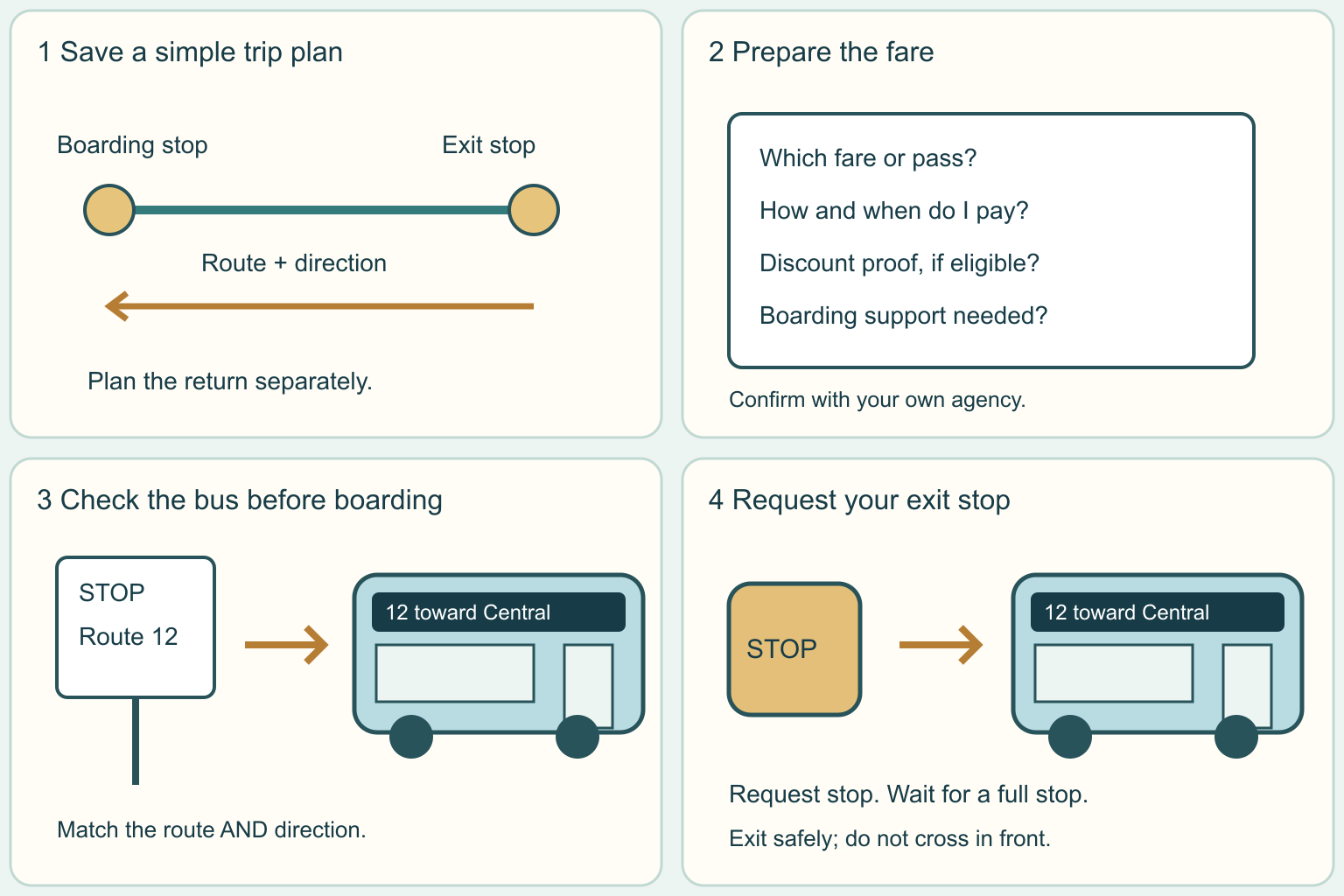
Enter where you start and the exact destination. Choose the required arrival day and time, rather than accepting a route for the current moment.
Get ready
Use a map and the local transport agency’s official route planner or timetable.
- The exact destination and time you must arrive.
- Your available transport options and a realistic spending limit.
- Any existing license, vehicle, and insurance records kept securely.
Make it manageable
- Find the office, website, document, or person named above.
- Work on this one action. If it needs a response, write down who you contacted and when.
- Check the result below before checking off the action. Pause and ask if a requirement is unclear.
What finished looks like
You can explain the trip, payment method, and arrival time without guessing.
Words explained
“Requirement” means something you must provide or do. “Deadline” means the last date or time to complete it. “Follow up” means checking what happens next after your first contact.
What you can say
Which side of the road or platform do I need?
Choose a call or message scriptWhere to get more help
If transport makes a school or job schedule impossible, ask about campus shuttles, local routes, ride arrangements, or different hours before making a commitment. A school adviser or transit customer-service team can help you read a route map.
Find your official motor-vehicle agency (USAGov) · Select your state and follow the relevant license, registration, or ownership instructions.
Tire safety basics (NHTSA) · Use the safety guidance alongside your vehicle and tire manufacturer’s instructions.
I’m stuck — help with this action
Your next small step
Check the walking parts, stop names, travel direction, transfers, and last return service. A route that works at noon may not run after an evening shift.
Get ready
Use a map and the local transport agency’s official route planner or timetable.
- The exact destination and time you must arrive.
- Your available transport options and a realistic spending limit.
- Any existing license, vehicle, and insurance records kept securely.
Make it manageable
- Find the office, website, document, or person named above.
- Work on this one action. If it needs a response, write down who you contacted and when.
- Check the result below before checking off the action. Pause and ask if a requirement is unclear.
What finished looks like
You can explain the trip, payment method, and arrival time without guessing.
Words explained
“Requirement” means something you must provide or do. “Deadline” means the last date or time to complete it. “Follow up” means checking what happens next after your first contact.
What you can say
Which side of the road or platform do I need?
Choose a call or message scriptWhere to get more help
If transport makes a school or job schedule impossible, ask about campus shuttles, local routes, ride arrangements, or different hours before making a commitment. A school adviser or transit customer-service team can help you read a route map.
Find your official motor-vehicle agency (USAGov) · Select your state and follow the relevant license, registration, or ownership instructions.
Tire safety basics (NHTSA) · Use the safety guidance alongside your vehicle and tire manufacturer’s instructions.
I’m stuck — help with this action
Your next small step
Write the fare, how to pay, and a realistic buffer for walking and waiting. If possible, make a practice trip before the important first day.
Get ready
Use a map and the local transport agency’s official route planner or timetable.
- The exact destination and time you must arrive.
- Your available transport options and a realistic spending limit.
- Any existing license, vehicle, and insurance records kept securely.
Make it manageable
- Find the office, website, document, or person named above.
- Work on this one action. If it needs a response, write down who you contacted and when.
- Check the result below before checking off the action. Pause and ask if a requirement is unclear.
What finished looks like
You can explain the trip, payment method, and arrival time without guessing.
Words explained
“Requirement” means something you must provide or do. “Deadline” means the last date or time to complete it. “Follow up” means checking what happens next after your first contact.
What you can say
Which side of the road or platform do I need?
Choose a call or message scriptWhere to get more help
If transport makes a school or job schedule impossible, ask about campus shuttles, local routes, ride arrangements, or different hours before making a commitment. A school adviser or transit customer-service team can help you read a route map.
Find your official motor-vehicle agency (USAGov) · Select your state and follow the relevant license, registration, or ownership instructions.
Tire safety basics (NHTSA) · Use the safety guidance alongside your vehicle and tire manufacturer’s instructions.
Questions you can ask, word for word
- “Which side of the road or platform do I need?”
- “What happens if I miss the connection or finish late?”
You are ready to move on whenYou can explain the trip, payment method, and arrival time without guessing.
Find help and useful links for this topic ↗Learn the words, math, and real-life impact ↗