Graduation / First Job resources
Plain-English explanations, worked math, and what it means for you.
You can start with the basics.
Learn the words, follow the numbers, and understand what a choice could mean for your life. Start with the first action. Open examples and explanations when you need them, then continue in the related tool.
Your first useful action
Choose one real role and read the requirements. Write down one truthful example of a skill you can demonstrate.
A worked example
Instead of “good with people,” write: “Helped customers locate products and explained the return process.” Add quantities or results only when you can support them.
What people often mix up
A résumé describes your experience; an application may ask separate required questions. Submitting either does not mean an interview is booked.
What to ask when you are stuck
“Which skills are most important for this role, and what is the next step after I submit my application?”
Ask the organization or person responsible for the decision. Write down the answer, date, and any next action. If their answer uses an unfamiliar word, find it in Words explained below.
How to know this first action is finished
Your résumé matches the role honestly, required questions are complete, and the application has a recorded date and next step.
Rehearse your first-day confirmation
- Read the written start details and list anything missing: arrival, location, contact, equipment or documents.
- Use a short message stating what you understand and the specific detail you need.
- Save the response in your approved records and plan the journey at the actual arrival time.
Check your result: You can explain where to go, when to arrive and what to bring.
If something changes
If the location or shift changes, update the commute and arrival plan rather than relying on the old confirmation.
Practical how-to guides
Start with one useful skill. Clear instructions and a checklist help you through it.
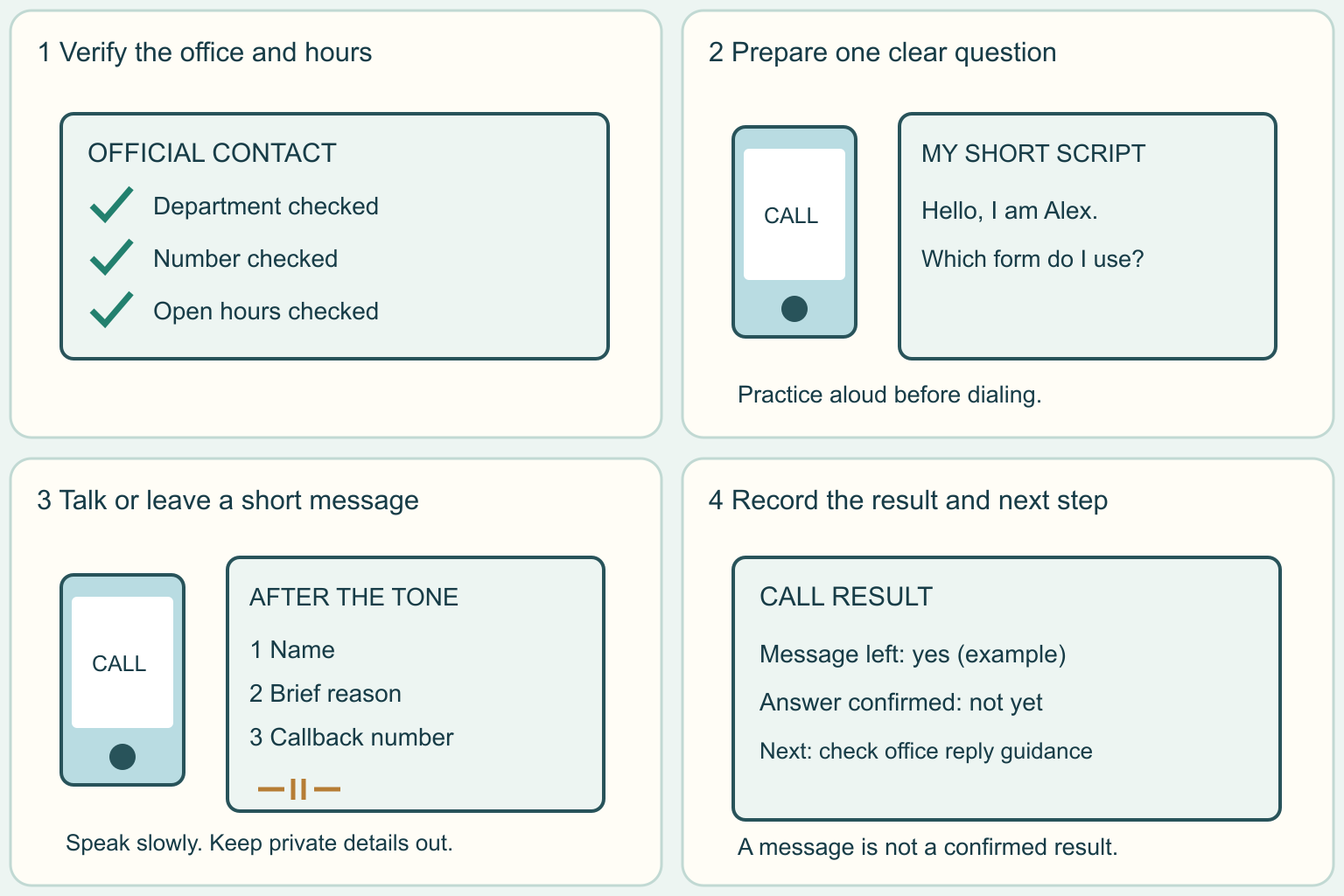
Make a routine office call and leave a clear voicemail
Prepare one simple question, call a verified office number, and know what to say if a person or voicemail answers.
4 clear steps · checklist & download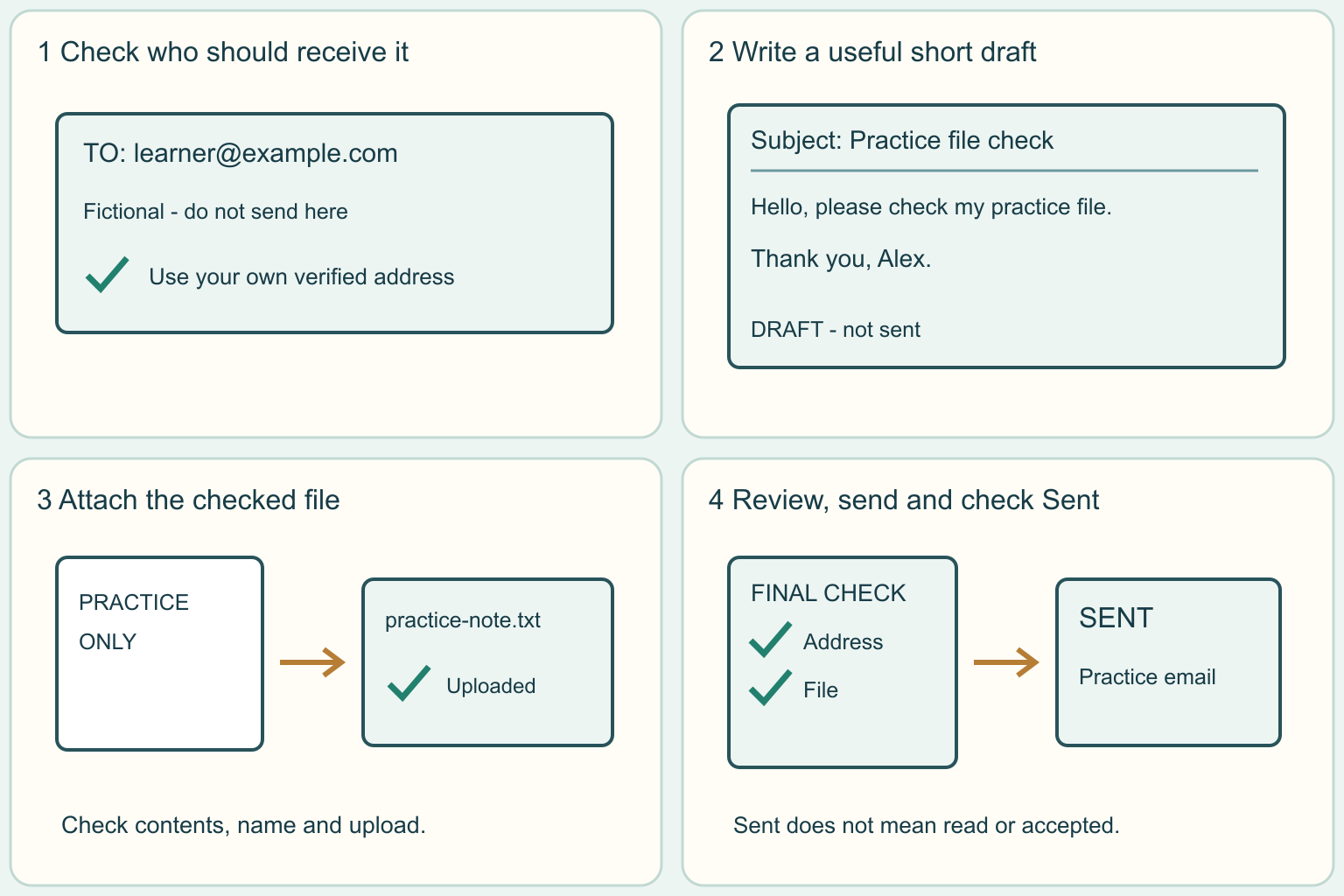
Write a clear email and attach the right file
Practice one short message, check the recipient and attachment, and learn how to confirm it left your drafts.
4 clear steps · checklist & download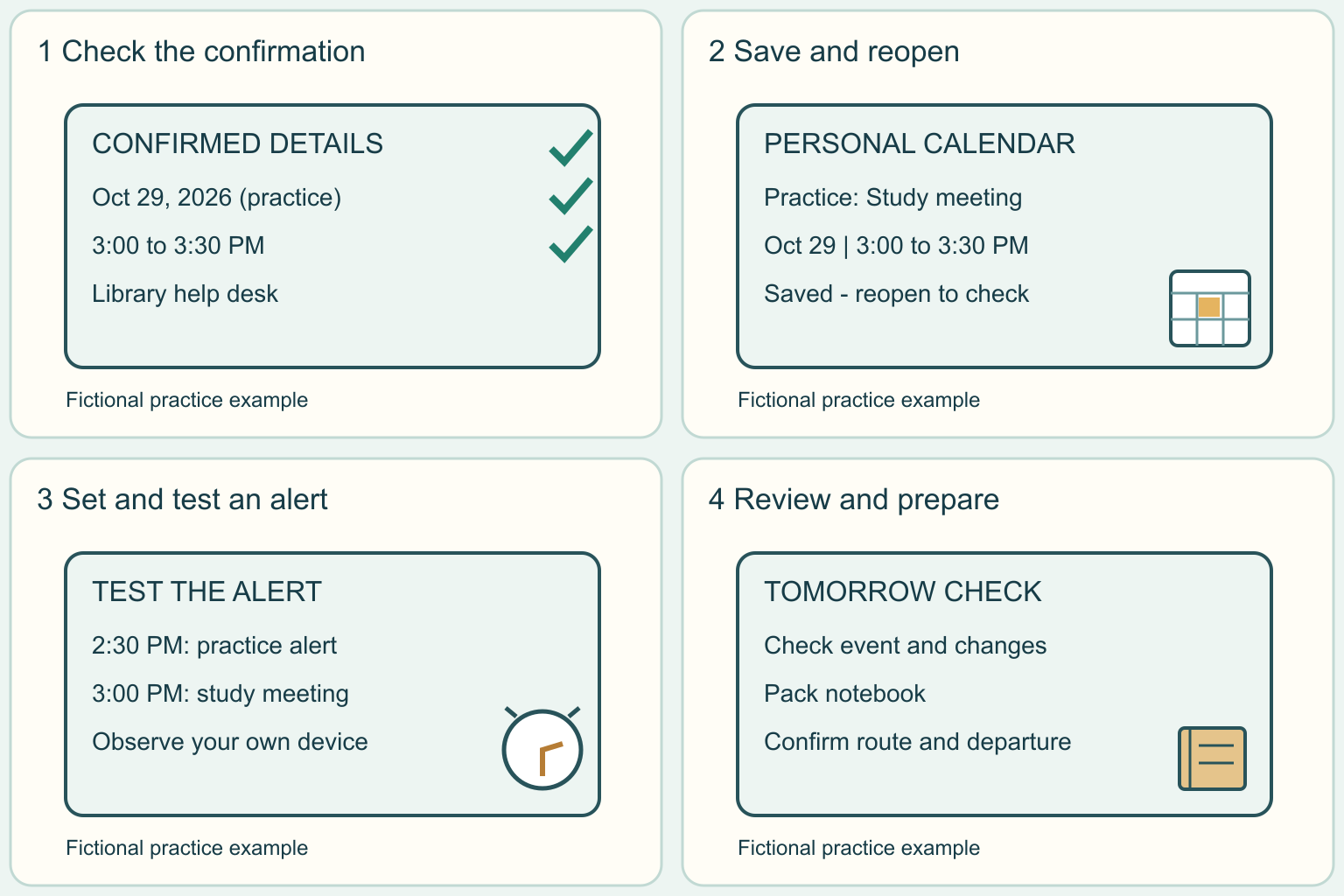
Put one appointment on your calendar and test an alert
Add one confirmed event, save a reminder, and practice finding it again. You can start with a harmless practice event.
4 clear steps · checklist & download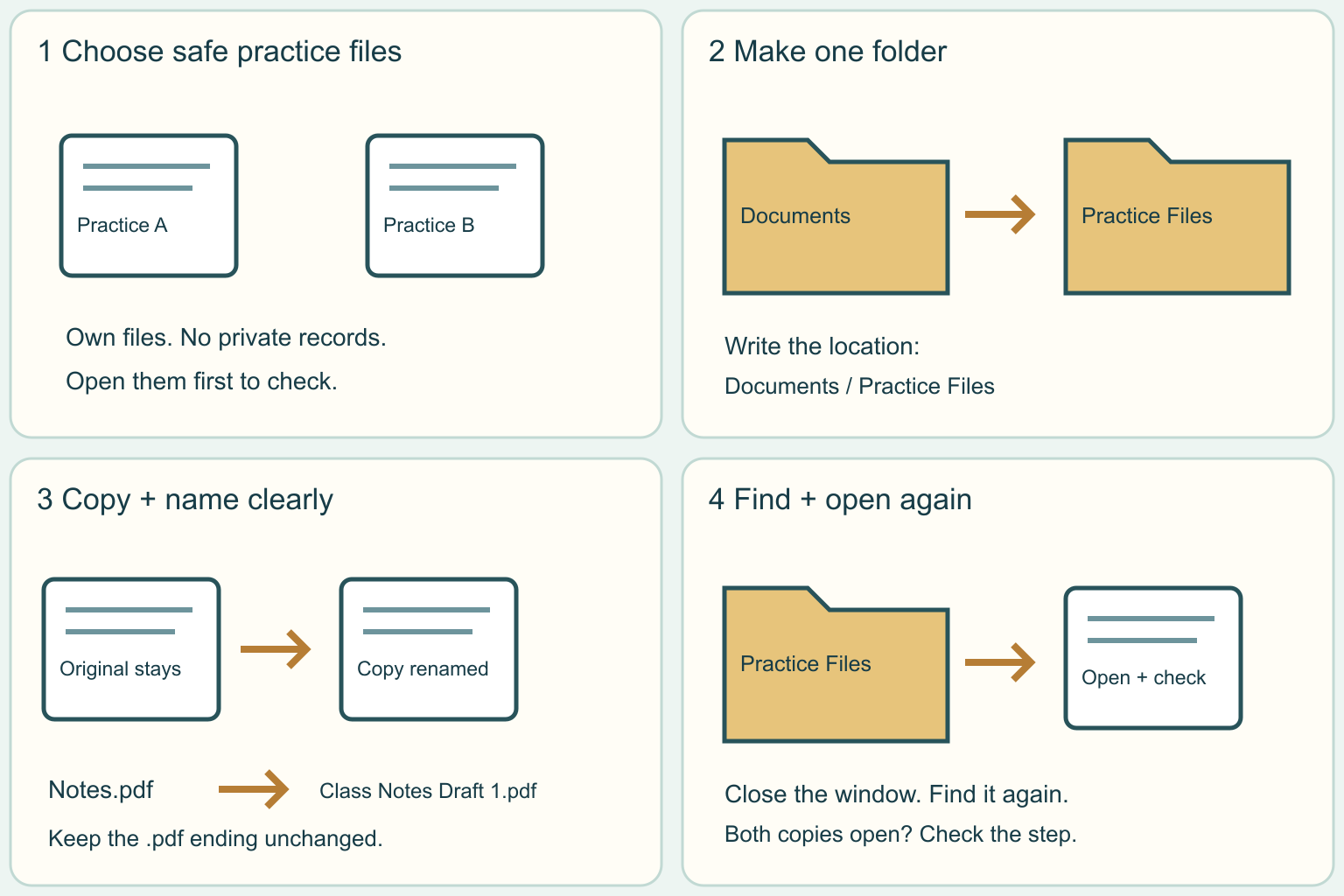
Put computer files in a folder and find them again
Practice with two harmless files. Make a folder, use clear names, and check that you can find and open your copies.
4 clear steps · checklist & downloadWhat to bring
For a U.S. job, identity/work-authorization checks are different from payroll setup. A worker chooses among acceptable Form I-9 document combinations.
Prepare the items that apply to your task. For an appointment or application, confirm the receiving organization’s exact requirements. “Ready” means you have reviewed and prepared the item.
Form I-9 document choice
Why you may need it
Proves identity and employment authorization through the allowed combinations.
Where to get it
Use the current USCIS Lists of Acceptable Documents: one List A choice OR a List B plus List C combination.
Check before you go
The employer must not demand a specific acceptable document. Check current instructions, including special options for minors; do not assume a passport and Social Security card are both required.
Social Security or other tax-ID information, only if required
Why you may need it
Some official financial, school, or employment processes need an identifier.
Where to get it
Use your secure records or the issuing agency’s official process. A replacement Social Security card is free through SSA.
Check before you go
Ask whether only the number is needed and which alternatives apply. Never put full ID numbers or card images into My Vault notes.
Payroll and direct-deposit information
Why you may need it
Tells payroll where to send pay and supports required tax forms.
Where to get it
Get routing/account details from your bank’s secure app or branch; get onboarding forms from verified HR.
Check before you go
A card number is not a bank routing number. Ask about other payment choices if you do not have an account.
Contact details and emergency contact
Why you may need it
Lets the organization reach you and, when requested, someone you trust.
Where to get it
Ask the person’s permission and confirm their current phone number and relationship to you.
Check before you go
A contact is not automatically a co-signer, medical decision-maker, or person allowed to collect your records.
Resume, references, credentials, and work permit if applicable
Why you may need it
Supports the job or training requirements.
Where to get it
Request school records or certifications from the issuer; check state youth-work rules if you are under 18.
Check before you go
Ask references first. Only provide documents relevant to the role and stage of hiring.
0 of 5 reviewed and prepared. These ticks save in this browser only.
A question you can read aloud
“Can you send the current I-9 acceptable-document list and a separate payroll checklist through the official hiring system?”
Keep actual documents in a secure place. Do not put Social Security numbers, full account or ID numbers, passwords, or document images into My Vault notes.
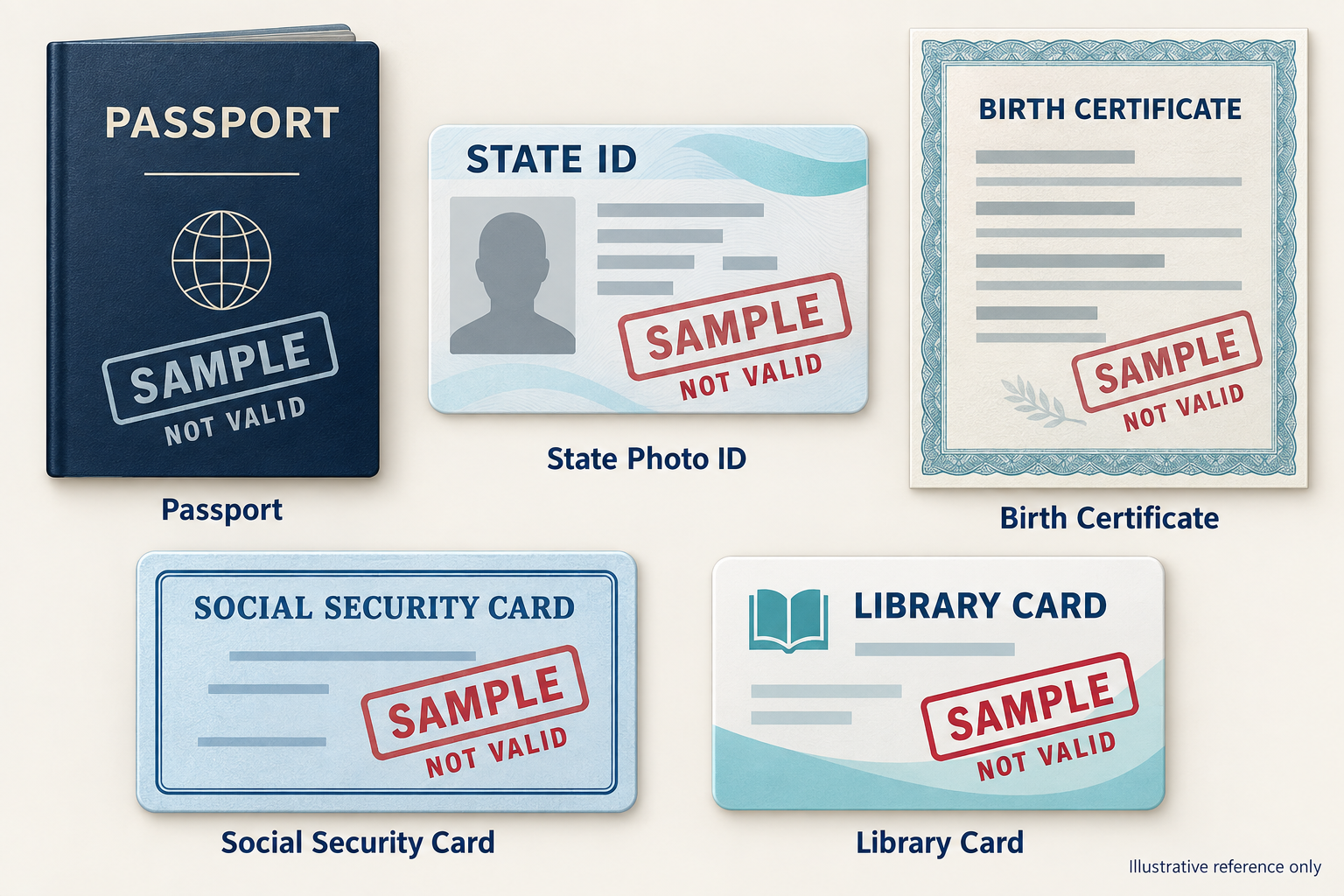
See how DMV and Post Office address rules differ →Picture guideSee labeled examples of the things you are learning about.
Words, in plain English
12 terms in Graduation / First Job · Open any word to learn more.
CommuteThe regular trip between where you live and school or work.
How it works
Compare travel time, reliability, fares, parking, and fuel. Visit or check the route during the hours you would actually travel.
A small example
An apartment $80 cheaper but requiring $140 more transportation costs $60 more overall.
Start here, one step at a time
- Map the trip at the time you would actually travel.
- Check return trips, weekend service, parking, and the full monthly cost.
Try explaining this word yourself
Before looking back, explain “Commute” in your own words. Which part of the example shows it?
Then compare your explanation with “The regular trip between where you live and school or work.” and the example above. If it is still unclear, use the question below with the relevant office or provider.
A question you can ask
“What would this trip cost each month, and can I get home after a late shift?”
Government photo IDA card or document from a government that has your name and picture.
How it works
Examples include a state ID, driver’s license, or passport. The place checking your identity decides which documents it accepts. An expired card or a phone photo may not qualify.
A small example
A library may accept a school ID under its rules. An airport uses a different list.
Start here, one step at a time
- Find the office’s official list for the service you need.
- Compare your document’s name and expiration date with that list.
- Bring the required physical document; ask before relying on a phone copy.
Try explaining this word yourself
Before looking back, explain “Government photo ID” in your own words. Which part of the example shows it?
Then compare your explanation with “A card or document from a government that has your name and picture.” and the example above. If it is still unclear, use the question below with the relevant office or provider.
A question you can ask
“Which exact IDs do you accept for this service, and must they be unexpired?”
USAGov: official document replacements (opens a new tab)See a labeled picture
GPA — grade point averageGPA means grade point average: a number that summarizes your grades.
How it works
Your school gives grades number values, then averages them using its rules. A common unweighted scale uses A = 4, B = 3, C = 2, D = 1, and F = 0. Weighted scales may add points for harder courses; schools differ. Colleges may recalculate GPA. It can affect admission, scholarships, program entry, and staying eligible, but it is only one part of a decision.
A small example
In four equal-weight classes, an A, B, B, and C give (4 + 3 + 3 + 2) ÷ 4 = 3.0 on that example scale. A lower GPA may close some options today; an adviser can help you plan tutoring, stronger future grades, or another entry route.
Start here, one step at a time
- Ask your counselor for your transcript and the school’s GPA scale.
- Check requirements for the college, program, or scholarship you want; ask about support and improvement options.
Try explaining this word yourself
Before looking back, explain “GPA — grade point average” in your own words. Which part of the example shows it?
Then compare your explanation with “GPA means grade point average: a number that summarizes your grades.” and the example above. If it is still unclear, use the question below with the relevant office or provider.
A question you can ask
“Is this GPA weighted, and how does this college recalculate it?”
Gross pay and take-home payGross pay is earnings before deductions. Take-home or net pay is what remains afterward.
How it works
Deductions may include tax withholding, benefits, and other authorized items. Read the payslip instead of multiplying hours and assuming that whole amount reaches your bank.
A small example
20 hours × $15 = $300 gross. With $40 of example deductions, take-home pay is $260.
Start here, one step at a time
- Find gross earnings and net pay on one real pay stub.
- Build your spending plan using the net amount that reaches you.
Try explaining this word yourself
Before looking back, explain “Gross pay and take-home pay” in your own words. Which part of the example shows it?
Then compare your explanation with “Gross pay is earnings before deductions. Take-home or net pay is what remains afterward.” and the example above. If it is still unclear, use the question below with the relevant office or provider.
A question you can ask
“What is each deduction, and where can I see my payslip?”
Learner’s permitPermission to practice driving under specific limits. It is not an unrestricted license.
How it works
Your state sets age, testing, supervision, practice, and driving-hour rules. Passing a written test does not mean you can drive alone.
A small example
A permit holder may need a qualified licensed adult in the front seat. Check your state’s exact rule.
Start here, one step at a time
- Open your state’s page for a first permit for your age.
- Read its study handbook and application-document list.
- Arrange required tests and practice with a person who meets the rules.
Try explaining this word yourself
Before looking back, explain “Learner’s permit” in your own words. Which part of the example shows it?
Then compare your explanation with “Permission to practice driving under specific limits. It is not an unrestricted license.” and the example above. If it is still unclear, use the question below with the relevant office or provider.
A question you can ask
“Who may supervise me, when may I drive, and what comes next?”
USAGov: state motor-vehicle services (opens a new tab)See a labeled picture
Pay period and paydayThe pay period is the time you worked; payday is when that period’s wages are paid.
How it works
Weekly, every two weeks, twice a month, and monthly schedules create different timing. Ask when your first check arrives before committing to bills.
A small example
Every two weeks normally means 26 paychecks a year; twice monthly means 24.
Start here, one step at a time
- Ask payroll which work dates your first paycheck covers.
- Mark actual paydays on your bill calendar.
Try explaining this word yourself
Before looking back, explain “Pay period and payday” in your own words. Which part of the example shows it?
Then compare your explanation with “The pay period is the time you worked; payday is when that period’s wages are paid.” and the example above. If it is still unclear, use the question below with the relevant office or provider.
A question you can ask
“Which dates does this check cover, and when is my first payday?”
U.S. Department of Labor: youth employment (opens a new tab)Pay stubThe itemized explanation of a paycheck.
How it works
Compare hours, rate, gross earnings, deductions, and take-home pay. Report a mismatch to payroll with your own time record.
A small example
$300 gross minus $40 of example deductions leaves $260 net pay. Actual deductions vary.
Start here, one step at a time
- Compare your own time record with paid hours and rate.
- Ask payroll about unfamiliar deductions or missing hours promptly.
Try explaining this word yourself
Before looking back, explain “Pay stub” in your own words. Which part of the example shows it?
Then compare your explanation with “The itemized explanation of a paycheck.” and the example above. If it is still unclear, use the question below with the relevant office or provider.
A question you can ask
“Can you explain each deduction and correct these hours if they are wrong?”
U.S. Department of Labor: youth employment (opens a new tab)Social Security number and cardA Social Security number identifies your Social Security record. The card shows that number and your name.
How it works
It is not a photo ID. A replacement card is free through the Social Security Administration. You often need the number, not the physical card; ask what the process actually requires.
A small example
A replacement card normally keeps the same number. Do not enter that number in this website’s notes.
Start here, one step at a time
- Start at SSA.gov using the official replacement-card process.
- Answer the eligibility questions to learn whether you can finish online or must visit.
- Follow its evidence rules; keep the card secure instead of carrying it every day.
Try explaining this word yourself
Before looking back, explain “Social Security number and card” in your own words. Which part of the example shows it?
Then compare your explanation with “A Social Security number identifies your Social Security record. The card shows that number and your name.” and the example above. If it is still unclear, use the question below with the relevant office or provider.
A question you can ask
“Do you need the number, the physical card, or another accepted document?”
USAGov: get or replace a Social Security card (opens a new tab)See a labeled picture
State ID cardA state-issued card used to show who you are. It does not give permission to drive.
How it works
Apply through your state’s motor-vehicle agency or other issuing office. It may offer a standard card and a REAL ID version with different document requirements.
A small example
Someone who rides the bus can get a state ID without taking a driving test.
Start here, one step at a time
- Choose your state in the official motor-vehicle directory.
- Find “identification card,” not “driver license renewal.”
- Use its checklist, gather documents, and make the required appointment.
Try explaining this word yourself
Before looking back, explain “State ID card” in your own words. Which part of the example shows it?
Then compare your explanation with “A state-issued card used to show who you are. It does not give permission to drive.” and the example above. If it is still unclear, use the question below with the relevant office or provider.
A question you can ask
“What documents, fee, appointment, and parent or guardian involvement apply to my age?”
USAGov: state motor-vehicle services (opens a new tab)See a labeled picture
Tax withholdingMoney an employer takes from pay and sends toward certain taxes.
How it works
It is not always the final amount you owe for the year. Read your pay statement and official tax forms; benefits and other deductions are different from tax.
A small example
Your bank deposit is smaller than gross pay because multiple deductions may be taken out.
Start here, one step at a time
- Use the employer’s official tax-form process.
- Review your pay stub and the IRS withholding guidance when your work or family situation changes.
Try explaining this word yourself
Before looking back, explain “Tax withholding” in your own words. Which part of the example shows it?
Then compare your explanation with “Money an employer takes from pay and sends toward certain taxes.” and the example above. If it is still unclear, use the question below with the relevant office or provider.
A question you can ask
“Who can help me understand my withholding form and payroll deductions?”
IRS: understand tax withholding (opens a new tab)TranscriptAn official record of courses and grades from a school.
How it works
Request it through the school’s registrar, counseling office, or approved portal. A screenshot may not meet an official-transcript requirement.
A small example
A college may require your high school to send the final transcript after graduation.
Start here, one step at a time
- Contact your school’s counselor or registrar.
- Give the exact recipient and deadline; check that the official record arrived.
Try explaining this word yourself
Before looking back, explain “Transcript” in your own words. Which part of the example shows it?
Then compare your explanation with “An official record of courses and grades from a school.” and the example above. If it is still unclear, use the question below with the relevant office or provider.
A question you can ask
“Who must send it, where should it go, and what is the deadline?”
Work-studyA form of aid that can provide part-time work opportunities for eligible students.
How it works
You generally need to obtain a job and earn wages. Do not treat an award amount as money already deposited for tuition.
A small example
A $2,000 work-study offer is not a $2,000 discount on the first bill.
Start here, one step at a time
- Ask financial aid whether the offer requires finding a campus job.
- Apply through the official student employment office and plan around wages paid after work.
Try explaining this word yourself
Before looking back, explain “Work-study” in your own words. Which part of the example shows it?
Then compare your explanation with “A form of aid that can provide part-time work opportunities for eligible students.” and the example above. If it is still unclear, use the question below with the relevant office or provider.
A question you can ask
“How do I apply for jobs, when would I be paid, and are positions available?”
Federal Student Aid: understand aid offers (opens a new tab)What this means for you
Pay, hours, transportation, and the date of your first paycheck affect whether a job works for your life.
What can make it harder
An attractive hourly rate can still leave you short if hours are irregular or travel is expensive. Unexplained payroll errors reduce money available for bills.
What can help
Written job details, your own record of hours, and a budget based on take-home pay make planning easier.
One next stepAsk the employer for expected hours, pay frequency, and first payday. Compare the take-home estimate with travel and work-related costs.
Read a paycheck one line at a time
This example uses an invented hourly rate and deductions. It is not a tax calculation.
Multiply hours by the rate
20 hours × $15 per hour = $300 gross pay for this example period.
Subtract the listed deductions
$300 gross − $40 in example deductions = $260 net, or take-home, pay.
Check the actual deposit
Compare the $260 with the pay stub and bank deposit. Ask payroll about any difference.
Match pay frequency to a budget
If $260 arrives every two weeks, $260 × 26 = $6,760 per year. Divide by 12 for an average of about $563.33 per month. Most months still contain only two checks: $520.
What the answer tells youAn average is not a payday. Use the actual checks arriving before each bill is due, especially when work hours change.
Preparing for a first work week
Knowing where to arrive and whom to contact reduces avoidable first-day uncertainty.
What can make it harder
An unclear start time, commute, or equipment expectation can derail preparation.
What can help
Ask verified HR or your manager for the arrival details and the actual document list.
One next stepConfirm your first-day time and contact before traveling.
Compare two jobs after a commute cost
Assume two offers have already-estimated take-home pay of $520 and $550 per week.
- 1
Subtract travel for offer A
$520 − $20 = $500 remaining.
- 2
Subtract travel for offer B
$550 − $60 = $490 remaining.
- 3
Compare the result
$500 − $490 = $10 more remaining with A, despite B’s higher pay.
What the answer tells youAlso compare time, benefits, reliability, and the assumptions behind take-home estimates.
Go a little deeper
Open a lesson when you need the full explanation. You can return to it at any time.
Which ID works—and who signs a document?A card’s purpose matters more than whether it has a picture.
1. Match the ID to the purpose
A driver’s license gives driving permission under state rules. A state ID shows identity without driving permission. A learner’s permit allows limited practice. A passport serves specified identity, citizenship, and travel uses. REAL ID is a standard available on certain state cards; it does not turn them into passports.
School, library, voter, store, and gym cards have narrower purposes. They may be valid for their own service and sometimes appear on a specific accepted list, but are not interchangeable with government photo ID. A public library may be a government service; its card still is not general-purpose photo identification. Ask the receiving office what it accepts.
2. Read each signature line
A signature is your agreement or certification for the words attached to it. Read the label: applicant, borrower, co-signer, owner, witness, or notary. Each role is different. A beneficiary receives a benefit; an emergency contact gets a call. Neither label automatically allows that person to sign your contracts.
Ask the organization who must sign and whether a guardian, other owner, spouse’s consent, or legally authorized representative is needed. Do not sign another person’s name or assume a parent can sign every adult child’s document. Keep a copy of the completed agreement.
3. Arrange a notary when one is actually required
Ask the receiving organization what notarial act it needs and whether witnesses are separate. Contact your bank, a local notary, or a participating UPS Store. Ask about total price, appointment, accepted current ID, document type, and witness availability. No store chain is always the cheapest.
FedEx Office advertises an online notarization service using your own compatible device; do not assume a notary is inside every FedEx store. Confirm remote notarization is accepted for your document and location. Bring the complete document and required people, and follow the notary’s signing instructions.
The notary verifies a specified act, not whether your deal is wise.
Ask two separate questions
First ask what evidence establishes identity for this transaction. Then ask who has authority to sign. A person can have acceptable identification without being authorized to sign for somebody else. Being a spouse, parent of an adult, emergency contact, or helpful friend does not answer every signing question.
Before an appointment, describe the actual situation to the office and request its current instructions. If an authorized representative is involved, ask what evidence of that authority is required and who must attend. Avoid filling a signature field merely because another person is unavailable.
Check the form’s sequence
Read whether a signature must be witnessed, notarized, or made in front of the receiving official. Some forms must remain unsigned until that step. Bring the correct version of the form and required identification, with questions marked on a separate sheet.
If you make a mistake, ask how to correct it rather than hiding or overwriting information. Keep a copy of the completed record when permitted. A clear signing process protects the purpose of the document and prevents a preparatory checklist from being confused with permission to act for someone else.
Check your understanding
- Explain the main idea of “Which ID works—and who signs a document?” without looking back.
- Choose one example above and identify its assumptions or requirements.
- Write the next question you would ask about your own situation.
Official sources & next places to go
USAGov: official document replacements (opens a new tab)USAGov: state motor-vehicle services (opens a new tab)TSA: accepted identification (opens a new tab)USAGov: find your public library (opens a new tab)USAGov: state voter-ID rules (opens a new tab)The UPS Store: participating notary locations (opens a new tab)FedEx Office: remote online notary service (opens a new tab)USCIS: Form I-9 instructions and document choices (PDF) (opens a new tab)Useful places to start
- Find American Job Center help (U.S. Department of Labor) (opens a new tab)
Use the official center-finder link to look for local employment help.
- Youth employment rules (U.S. Department of Labor) (opens a new tab)
Check youth-work guidance and ask about state requirements for your age and job.
Ready for one small action?
Go back to your path. Each stage has instructions, questions to ask, and a checklist.
U.S. starting points · Foundation references reviewed September 17, 2026; expanded content added September 19, 2026. Examples use invented amounts unless stated otherwise. Requirements, rates, and policies vary; use the linked official sources and the terms that apply to you.
Use notes for plans and reminders. Keep passwords, account numbers, and sensitive documents in a secure storage service.