Where to go / who to contact
Start with your school counselor, campus career center, or a local American Job Center in the U.S.
Do these actions in order
I’m stuck — help with this action
Your next small step
Write your available days and times, including transport time. Decide how far you can travel and which tasks you can do or are willing to learn.
Get ready
Start with your school counselor, campus career center, or a local American Job Center in the U.S.
- Your class schedule and realistic available hours.
- A contact email you check and a voicemail greeting an employer can understand.
- A list of things you have done reliably, even if nobody paid you.
Make it manageable
- Find the office, website, document, or person named above.
- Work on this one action. If it needs a response, write down who you contacted and when.
- Check the result below before checking off the action. Pause and ask if a requirement is unclear.
What finished looks like
You have realistic availability and a draft résumé with truthful examples.
Words explained
“Requirement” means something you must provide or do. “Deadline” means the last date or time to complete it. “Follow up” means checking what happens next after your first contact.
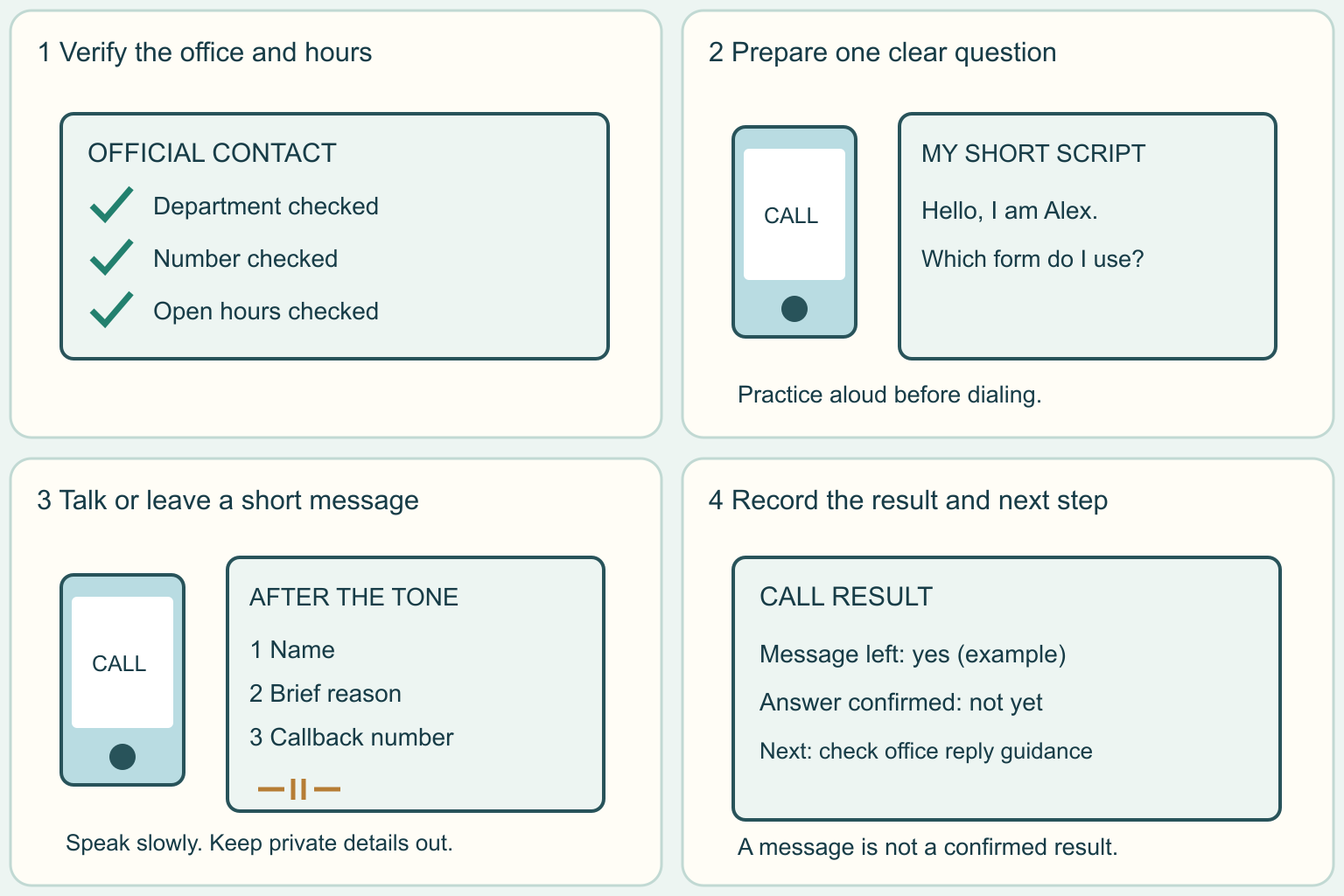
What you can say
Do you help students find first jobs?
Choose a call or message scriptWhere to get more help
If you get no replies, ask a career adviser to review one application and your target roles. If you are turned down, record it and continue with another suitable opening. It does not mean you cannot learn the work.
Find American Job Center help (U.S. Department of Labor) · Use the official center-finder link to look for local employment help.
Youth employment rules (U.S. Department of Labor) · Check youth-work guidance and ask about state requirements for your age and job.
I’m stuck — help with this action
Your next small step
List examples of reliability: finishing a group project, helping with a club event, caring for a family member, or showing up for volunteering. Describe what you actually did.
Get ready
Start with your school counselor, campus career center, or a local American Job Center in the U.S.
- Your class schedule and realistic available hours.
- A contact email you check and a voicemail greeting an employer can understand.
- A list of things you have done reliably, even if nobody paid you.
Make it manageable
- Find the office, website, document, or person named above.
- Work on this one action. If it needs a response, write down who you contacted and when.
- Check the result below before checking off the action. Pause and ask if a requirement is unclear.
What finished looks like
You have realistic availability and a draft résumé with truthful examples.
Words explained
“Requirement” means something you must provide or do. “Deadline” means the last date or time to complete it. “Follow up” means checking what happens next after your first contact.
What you can say
Do you help students find first jobs?
Choose a call or message scriptWhere to get more help
If you get no replies, ask a career adviser to review one application and your target roles. If you are turned down, record it and continue with another suitable opening. It does not mean you cannot learn the work.
Find American Job Center help (U.S. Department of Labor) · Use the official center-finder link to look for local employment help.
Youth employment rules (U.S. Department of Labor) · Check youth-work guidance and ask about state requirements for your age and job.
I’m stuck — help with this action
Your next small step
Ask for help turning those examples into a simple résumé. A résumé is a short summary of your education, experience, and skills; it is not a story about your entire life.
Get ready
Start with your school counselor, campus career center, or a local American Job Center in the U.S.
- Your class schedule and realistic available hours.
- A contact email you check and a voicemail greeting an employer can understand.
- A list of things you have done reliably, even if nobody paid you.
Make it manageable
- Find the office, website, document, or person named above.
- Work on this one action. If it needs a response, write down who you contacted and when.
- Check the result below before checking off the action. Pause and ask if a requirement is unclear.
What finished looks like
You have realistic availability and a draft résumé with truthful examples.
Words explained
“Requirement” means something you must provide or do. “Deadline” means the last date or time to complete it. “Follow up” means checking what happens next after your first contact.
What you can say
Do you help students find first jobs?
Choose a call or message scriptWhere to get more help
If you get no replies, ask a career adviser to review one application and your target roles. If you are turned down, record it and continue with another suitable opening. It does not mean you cannot learn the work.
Find American Job Center help (U.S. Department of Labor) · Use the official center-finder link to look for local employment help.
Youth employment rules (U.S. Department of Labor) · Check youth-work guidance and ask about state requirements for your age and job.
Questions you can ask, word for word
- “Do you help students find first jobs?”
- “Can someone review a résumé with no paid-work history?”
You are ready to move on whenYou have realistic availability and a draft résumé with truthful examples.
Find help and useful links for this topic ↗Learn the words, math, and real-life impact ↗