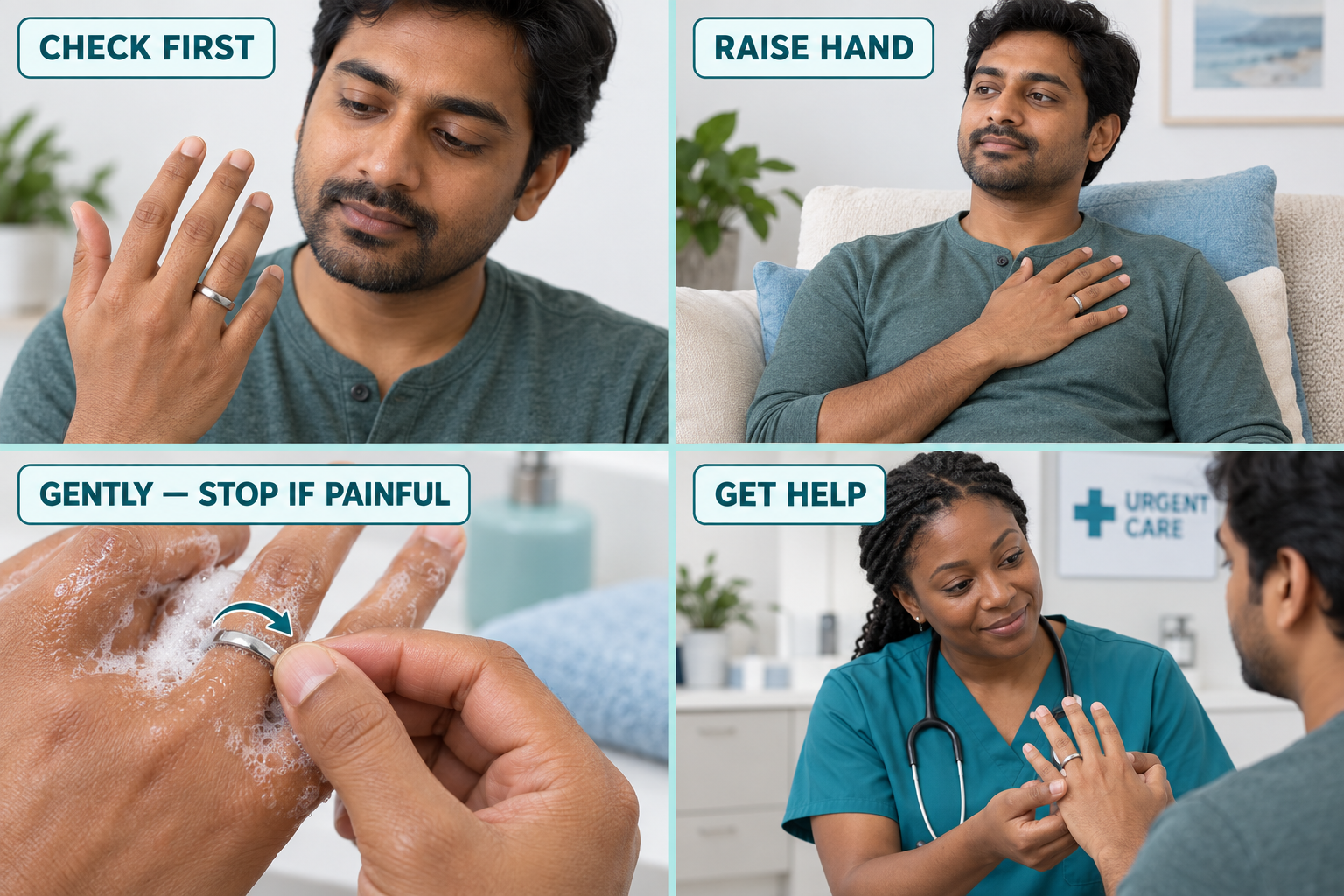
A ring may get tight when a finger swells. First check the finger. A ring that affects blood flow needs prompt medical help.
Why it matters: Pulling harder can make swelling worse. The string trick can injure skin or nerves, so this beginner guide uses gentle first steps and a clear point for getting help.
Written guidance reviewed: September 18, 2026 · Sources and equipment assumptions are below.
Take this guide to another device
Steps, notes, supplies, setup choices, results and check dates save on this browser as you work. Plus can also keep an account copy. Account copies update only when you choose Save; loading one replaces the browser draft shown here.
Review all saved work. Saved account check dates appear in My Day. Clear the date and save again to finish a follow-up. Email settings stay separate; existing opted-in agenda or deadline emails can include these dated actions.
Understand the job before starting
The warning signs determine whether attempting removal is appropriate. Read them before choosing a method.
A common mistake to avoid
Continuing after warning signs appear can delay necessary help.
Use what you already have. Check each item when it is ready.
Before you begin
Get urgent medical help now if the finger is blue, very pale, cold, numb, tingling, very swollen, or very painful, or the ring is cutting into skin. After an injury or with broken skin, skip home removal attempts. Go to an emergency department for possible circulation loss. Do not delay care to finish a checklist; call 911 in the U.S. if you cannot safely get emergency help.
0 of 4 steps checked0%
Guide progress and notes save on this browser; choose Save account copy above to carry them to another device with Plus. Downloads contain the complete blank checklist; print to include your current checks and notes.
Do it with me
Your step position saves on this browser. Use the picture when available, then check the written result.
STEP 1 OF 4
Check first; stop repeated pulling
Start here: Check first; stop repeated pulling
Illustration: Check for warning signs first. Read the steps for your exact task.
Read-aloud is available in supported browsers; the written steps always remain available.
Look at the finger and compare its color, feeling, and warmth with the other fingers.
Do not use this comparison to rule out an emergency.
If any warning above applies, stop here and get care.
Otherwise, take a break from pulling.
A ring is a hard circle; it cannot stretch to match swelling.
Ask a trusted adult for help if you are a student and unsure what to do.
Before moving to the next step
Check this specific result: I checked for warning signs and know whether I need care now.
If that result is not true yet, leave the box unchecked. Write what is missing in your notes; use the official instructions below when the equipment or situation differs.
STEP 1 OF 4
Check first; stop repeated pulling
Start here: Check first; stop repeated pulling
Illustration: Check for warning signs first. Read the steps for your exact task.
Look at the finger and compare its color, feeling, and warmth with the other fingers.
Do not use this comparison to rule out an emergency.
If any warning above applies, stop here and get care.
Otherwise, take a break from pulling.
A ring is a hard circle; it cannot stretch to match swelling.
Ask a trusted adult for help if you are a student and unsure what to do.
Before moving to the next step
Check this specific result: I checked for warning signs and know whether I need care now.
If that result is not true yet, leave the box unchecked. Write what is missing in your notes; use the official instructions below when the equipment or situation differs.
STEP 2 OF 4
Raise a comfortable, uninjured hand
Start here: Raise gently; stop if symptoms change.
Example: Raise gently; stop if symptoms change. Follow the written step.
Only if there are no warning signs or injuries, rest with the hand comfortably raised above heart level for a short time.
This may help mild swelling.
Do not wrap the finger tightly, poke anything under the ring, or use direct ice on the skin.
If swelling or discomfort increases, stop home attempts and get medical advice.
Before moving to the next step
Check this specific result: I raised my hand gently and stopped if symptoms changed.
If that result is not true yet, leave the box unchecked. Write what is missing in your notes; use the official instructions below when the equipment or situation differs.
STEP 3 OF 4
Try gentle lubrication, once
Start here: Use skin-safe lubricant gently.
Example: Use skin-safe lubricant gently. Follow the written step.
On intact skin, apply mild soap with water or a skin-safe water-soluble lubricant around the ring.
Lubricant means something slippery.
Gently turn the ring back and forth while easing it toward the fingertip.
Do not yank or force it over the knuckle.
Stop if it hurts, does not move easily, or the finger gets more swollen.
Do not use household cleaning sprays on skin.
Before moving to the next step
Check this specific result: The ring came off easily, or I stopped instead of forcing it.
If that result is not true yet, leave the box unchecked. Write what is missing in your notes; use the official instructions below when the equipment or situation differs.
STEP 4 OF 4
Get help if it remains stuck
Start here: Get help if it remains stuck
Illustration: Get medical help. Read the steps for your exact task.
If gentle removal fails, seek prompt medical help; do not sleep with a painfully tight ring.
Tell the clinic, “My ring is stuck.
These are my symptoms.
Can you remove it, or should I go to the emergency department?” New warning signs mean emergency care.
A clinician may use a special tool or a string technique after assessing the finger.
Do not cut the ring or tightly wrap string around the finger yourself.
Before moving to the next step
Check this specific result: My ring is off safely, or I am getting the right medical help.
If that result is not true yet, leave the box unchecked. Write what is missing in your notes; use the official instructions below when the equipment or situation differs.
Word or tip
What it means
What a beginner should know
Swelling
Body tissue gets larger.
A tight ring can become harder to remove.
Circulation
Blood moving through the body.
Color, sensation, or temperature changes need urgent attention.
String method
A clinician may compress tissue and unwind string to move a ring.
It can injure skin or nerves; it is not a harmless social-media trick.
Ring cutter
A tool used to remove some trapped rings.
Let a trained professional choose the method; ring materials differ.
Pictures for this guide
Picture 1 of 4 · Check for warning signs first
An adult examines a finger with a ring. The illustration cannot show or rule out a circulation problem.
For: Check first; stop repeated pulling
Illustrations show examples of the actions above. Follow your equipment’s instructions.
Notes about these pictures
Look at the finger and compare its color, feeling, and warmth with the other fingers. Do not use this comparison to rule out an emergency. If any warning above applies, stop here and get care. Otherwise, take a break from pulling. A ring is a hard circle; it cannot stretch to match swelling. Ask a trusted adult for help if you are a student and unsure what to do.
Get urgent medical help now if the finger is blue, very pale, cold, numb, tingling, very swollen, or very painful, or the ring is cutting into skin. After an injury or with broken skin, skip home removal attempts. Go to an emergency department for possible circulation loss. Do not delay care to finish a checklist; call 911 in the U.S. if you cannot safely get emergency help.
Was this step clear?
Flag “Check first; stop repeated pulling” for review. We save the guide and step identifiers with your account to limit duplicates, not your private notes.
What to look for: Clinical footage may be uncomfortable. This shows professional treatment, not a home procedure. Do not copy string wrapping or device use, or delay urgent care to watch.
Link details checked 2026-10-03. Video availability and equipment menus can change.
These YouTube videos belong to their respective creators. Life’s Checklists does not own them and is not affiliated with the creators. Links open on YouTube, where the videos are available independently of our membership.
How to use the video with this guide
Read “Before you begin” first. Watch the relevant part, pause, then return to the written step and its completion check. Use captions and playback speed if they help. A demonstration may cover only part of the task or show different equipment.
Your model’s instructions and current official guidance take priority. For urgent problems, follow the stop instructions without waiting to watch a video.
For this guide, the final result is: My ring is off safely, or I am getting the right medical help.
A concrete way to approach this task
First read the warning signs in this guide. Note when the problem began and whether the finger has changed since then.
What if I cannot complete a step?
The stop signs take priority over removing the ring yourself. Do not keep trying a method when the guide tells you to stop or seek help.
Identify the exact step: “Check first; stop repeated pulling.” Record what you tried, what happened, and which item or model you used. Ask for help with that specific problem rather than repeating an unsafe or unsuccessful action.
Get urgent medical help now if the finger is blue, very pale, cold, numb, tingling, very swollen, or very painful, or the ring is cutting into skin. After an injury or with broken skin, skip home removal attempts. Go to an emergency department for possible circulation loss. Do not delay care to finish a checklist; call 911 in the U.S. if you cannot safely get emergency help.
Connect this skill to everyday life
Write down the total move-in cash and monthly costs before applying. Ask which charges are required and which are optional.
Advertised rent is not necessarily the whole monthly cost. A refundable deposit still needs cash now. An application does not mean you have a signed lease.