Meal Planning & Kitchen Basics resources
Plain-English explanations, worked math, and what it means for you.
You can start with the basics.
Learn the words, follow the numbers, and understand what a choice could mean for your life. Start with the first action. Open examples and explanations when you need them, then continue in the related tool.
Your first useful action
Check what food you own, what equipment you can use, and how many portions you need. Choose one simple meal before planning a whole week.
A worked example
Needed 500 g rice minus 200 g owned leaves 300 g to buy. A 400 g pack covers that amount; its price, rather than a fractional-pack price, belongs in the shopping budget.
What people often mix up
An exact ingredient match does not prove you own enough. Rice and rice vinegar are different; diced tomato and tomato sauce are different. Leftovers still need safe handling.
What to ask when you are stuck
“Which ingredients, quantities, equipment, and cooking checks does this recipe require?”
Ask the organization or person responsible for the decision. Write down the answer, date, and any next action. If their answer uses an unfamiliar word, find it in Words explained below.
How to know this first action is finished
You have enough usable ingredients, suitable equipment, and clear cooking and storage directions.
Plan one complete cooking session
- Choose a recipe for your equipment and number of portions. Check exact ingredients and owned quantities.
- Write missing quantities and the packages needed, then check the actual shopping total.
- Plan cooking checks, cleanup and safe storage using the recipe and official food guidance.
Check your result: You can make the meal with usable quantities and know what to do with leftovers.
If something changes
A substituted ingredient or different appliance may need a different recipe or method; do not assume the original checks transfer.
Practical how-to guides
Start with one useful skill. Clear instructions and a checklist help you through it.
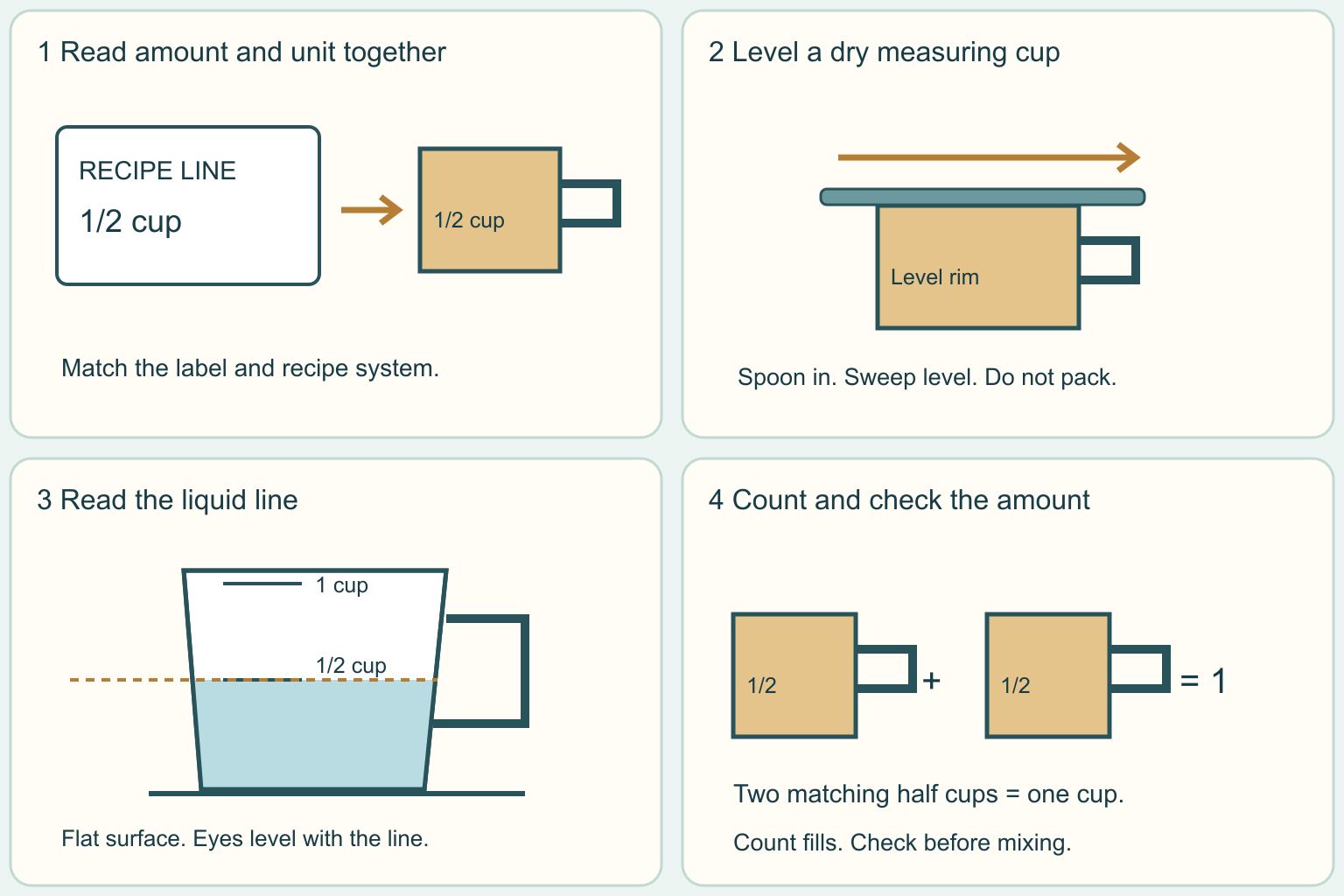
Read recipe amounts and measure dry and liquid ingredients
Learn which measuring tool to pick, what the little labels mean, and how to check an amount before mixing. Start with room-temperature water for liquid practice.
4 clear steps · checklist & download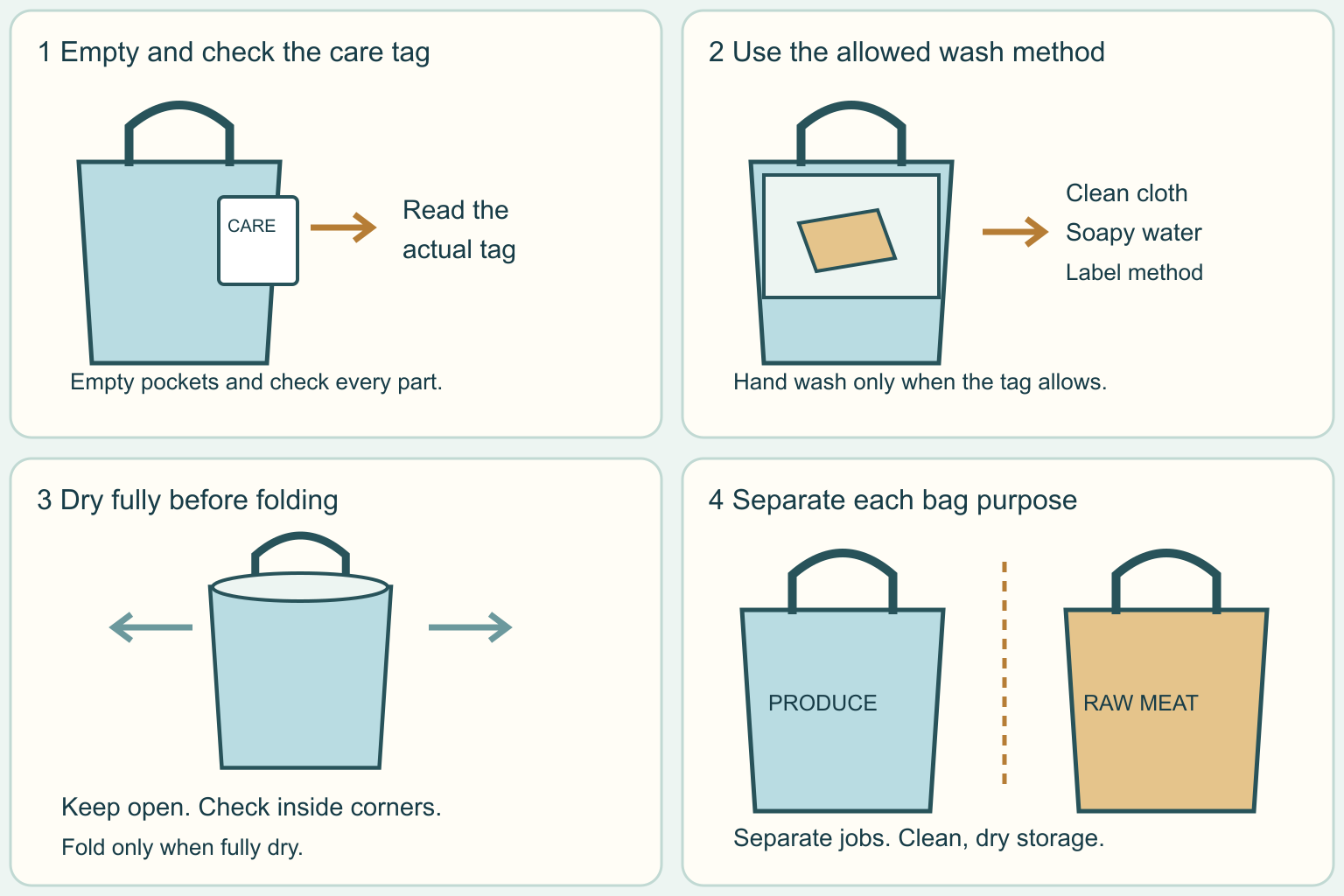
Clean, dry and sort your reusable grocery bags
Start with one ordinary reusable shopping bag. Read its care label, clean it the allowed way, and keep food bags separate from other uses.
4 clear steps · checklist & download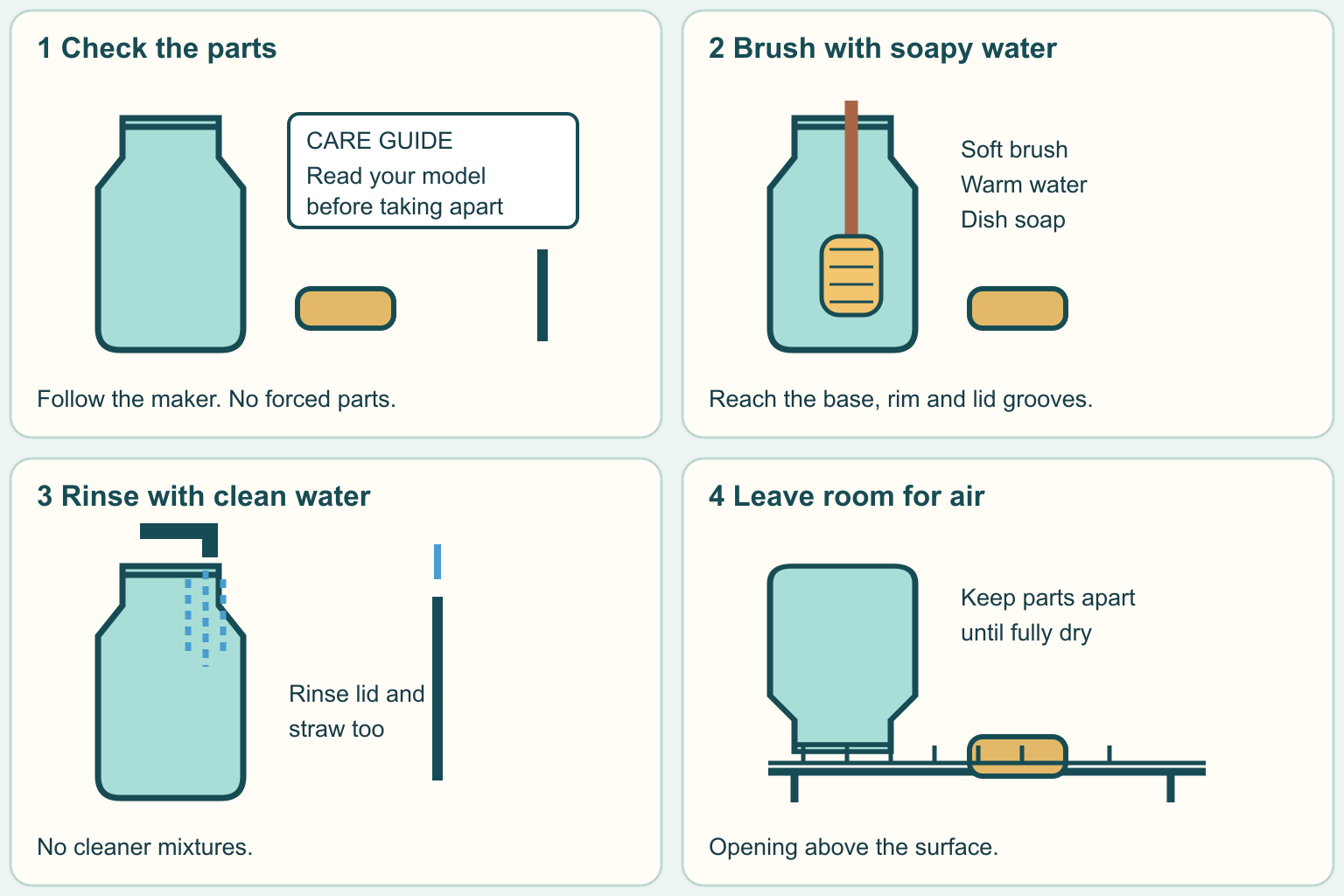
Wash and dry a reusable water bottle
Learn what to take apart, how to reach the inside, and when a bottle is ready to put away. Start with ordinary dish soap and the instructions for your own bottle.
4 clear steps · checklist & downloadChoose a meal plan for your actual equipment
Plan food you can store and prepare in the space you have.
4 clear steps · checklist & downloadWhat to bring
Gather the information and tools for the meals you actually plan to prepare.
Prepare the items that apply to your task. For an appointment or application, confirm the receiving organization’s exact requirements. “Ready” means you have reviewed and prepared the item.
Meal schedule and needs
Why you may need it
Sets the number of meals and any dietary requirements.
Where to get it
Your calendar and the people eating with you.
Check before you go
Confirm allergies, timing, and equipment before choosing recipes.
Food inventory and recipes
Why you may need it
Prevents buying duplicates and shows required quantities.
Where to get it
Your pantry, refrigerator, and complete recipe instructions.
Check before you go
Only count food with a suitable storage history.
Suitable tools and a grocery budget
Why you may need it
Connects the cooking plan to what you can use and afford.
Where to get it
Your own kitchen and actual available spending money.
Check before you go
Keep dish, surface, and floor tools separate.
0 of 3 reviewed and prepared. These ticks save in this browser only.
A question you can read aloud
“What can we prepare safely with the time, equipment, and money available?”
Keep actual documents in a secure place. Do not put Social Security numbers, full account or ID numbers, passwords, or document images into My Vault notes.
Words, in plain English
17 terms in Meal Planning · Open any word to learn more.
Air-drying dishesLetting rinsed dishes dry on a clean rack without wiping.
How it works
Arrange items to drain and allow airflow; keep the rack clean.
A small example
A rinsed cup rests upside down at an angle on a rack.
Start here, one step at a time
- Identify the food, surface, or kitchen task you are working on.
- Arrange items to drain and allow airflow; keep the rack clean.
- Can water drain away without the dish sitting in dirty water?
Try explaining this word yourself
Before looking back, explain “Air-drying dishes” in your own words. Which part of the example shows it?
Then compare your explanation with “Letting rinsed dishes dry on a clean rack without wiping.” and the example above. If it is still unclear, use the question below with the relevant office or provider.
A question you can ask
“Can water drain away without the dish sitting in dirty water?”
FDA: Food safety at home (opens a new tab)Cross-contaminationTransfer of harmful germs between foods, hands, or surfaces.
How it works
Separate raw animal foods and their utensils from ready-to-eat foods; clean appropriately between tasks.
A small example
A board used for raw chicken is not ready for salad just because crumbs were brushed off.
Start here, one step at a time
- Identify the food, surface, or kitchen task you are working on.
- Separate raw animal foods and their utensils from ready-to-eat foods; clean appropriately between tasks.
- Which tools and surfaces touched raw food?
Try explaining this word yourself
Before looking back, explain “Cross-contamination” in your own words. Which part of the example shows it?
Then compare your explanation with “Transfer of harmful germs between foods, hands, or surfaces.” and the example above. If it is still unclear, use the question below with the relevant office or provider.
A question you can ask
“Which tools and surfaces touched raw food?”
FDA: Food safety at home (opens a new tab)Edible yieldThe usable amount left after trimming or preparation.
How it works
Account for peels, bones, or discarded portions when comparing quantities.
A small example
A whole item weighing two pounds may provide less than two pounds of edible food.
Start here, one step at a time
- Identify the food, surface, or kitchen task you are working on.
- Account for peels, bones, or discarded portions when comparing quantities.
- How much of this purchase will we actually use?
Try explaining this word yourself
Before looking back, explain “Edible yield” in your own words. Which part of the example shows it?
Then compare your explanation with “The usable amount left after trimming or preparation.” and the example above. If it is still unclear, use the question below with the relevant office or provider.
A question you can ask
“How much of this purchase will we actually use?”
FDA: Food safety at home (opens a new tab)First in, first outUsing older suitable stock before newer stock.
How it works
Move older safe items forward, but never use age order as proof of safety.
A small example
The older sealed bag of rice is used first if both bags are sound.
Start here, one step at a time
- Identify the food, surface, or kitchen task you are working on.
- Move older safe items forward, but never use age order as proof of safety.
- Which item is both older and still suitable to use?
Try explaining this word yourself
Before looking back, explain “First in, first out” in your own words. Which part of the example shows it?
Then compare your explanation with “Using older suitable stock before newer stock.” and the example above. If it is still unclear, use the question below with the relevant office or provider.
A question you can ask
“Which item is both older and still suitable to use?”
FDA: Food safety at home (opens a new tab)Food thermometerA tool for checking internal food temperature.
How it works
Use the correct insertion point and current food-specific guidance; wash the probe as instructed.
A small example
A thermometer helps check cooked food without relying on surface color.
Start here, one step at a time
- Identify the food, surface, or kitchen task you are working on.
- Use the correct insertion point and current food-specific guidance; wash the probe as instructed.
- Where should the probe go for this food?
Try explaining this word yourself
Before looking back, explain “Food thermometer” in your own words. Which part of the example shows it?
Then compare your explanation with “A tool for checking internal food temperature.” and the example above. If it is still unclear, use the question below with the relevant office or provider.
A question you can ask
“Where should the probe go for this food?”
FDA: Food safety at home (opens a new tab)Food waste logA short record of food discarded and why.
How it works
Use it to change purchase amounts and meal plans.
A small example
Throwing away half a lettuce twice suggests buying a smaller amount.
Start here, one step at a time
- Identify the food, surface, or kitchen task you are working on.
- Use it to change purchase amounts and meal plans.
- Was the problem quantity, storage, or an unrealistic plan?
Try explaining this word yourself
Before looking back, explain “Food waste log” in your own words. Which part of the example shows it?
Then compare your explanation with “A short record of food discarded and why.” and the example above. If it is still unclear, use the question below with the relevant office or provider.
A question you can ask
“Was the problem quantity, storage, or an unrealistic plan?”
FDA: Food safety at home (opens a new tab)Food-contact surfaceA surface that directly touches food.
How it works
Choose a compatible cleaning method and follow any required rinse directions.
A small example
A cutting board directly touches vegetables; a cabinet door usually does not.
Start here, one step at a time
- Identify the food, surface, or kitchen task you are working on.
- Choose a compatible cleaning method and follow any required rinse directions.
- Is this product labeled for this food-contact surface?
Try explaining this word yourself
Before looking back, explain “Food-contact surface” in your own words. Which part of the example shows it?
Then compare your explanation with “A surface that directly touches food.” and the example above. If it is still unclear, use the question below with the relevant office or provider.
A question you can ask
“Is this product labeled for this food-contact surface?”
FDA: Food safety at home (opens a new tab)Hand dish detergentA detergent intended for washing dishes by hand.
How it works
Use it with water and a suitable dish brush or clean dishcloth, then rinse.
A small example
A small label-directed amount goes into hand-washing water, not an automatic dishwasher.
Start here, one step at a time
- Identify the food, surface, or kitchen task you are working on.
- Use it with water and a suitable dish brush or clean dishcloth, then rinse.
- Is this hand dish detergent or machine dishwasher detergent?
Try explaining this word yourself
Before looking back, explain “Hand dish detergent” in your own words. Which part of the example shows it?
Then compare your explanation with “A detergent intended for washing dishes by hand.” and the example above. If it is still unclear, use the question below with the relevant office or provider.
A question you can ask
“Is this hand dish detergent or machine dishwasher detergent?”
FDA: Food safety at home (opens a new tab)Meal planA written outline of what you expect to eat.
How it works
Match meals to your schedule, equipment, and household needs before shopping.
A small example
Tuesday is a late shift, so the plan uses a quick meal rather than a long recipe.
Start here, one step at a time
- Identify the food, surface, or kitchen task you are working on.
- Match meals to your schedule, equipment, and household needs before shopping.
- Which days actually allow time to cook?
Try explaining this word yourself
Before looking back, explain “Meal plan” in your own words. Which part of the example shows it?
Then compare your explanation with “A written outline of what you expect to eat.” and the example above. If it is still unclear, use the question below with the relevant office or provider.
A question you can ask
“Which days actually allow time to cook?”
FDA: Food safety at home (opens a new tab)Mise en placeGathering and preparing ingredients before cooking.
How it works
Read the recipe, measure ingredients, and set out tools before the time-sensitive steps.
A small example
You measure rice and water before turning on the cooker.
Start here, one step at a time
- Identify the food, surface, or kitchen task you are working on.
- Read the recipe, measure ingredients, and set out tools before the time-sensitive steps.
- Which ingredient needs preparation before the pan is hot?
Try explaining this word yourself
Before looking back, explain “Mise en place” in your own words. Which part of the example shows it?
Then compare your explanation with “Gathering and preparing ingredients before cooking.” and the example above. If it is still unclear, use the question below with the relevant office or provider.
A question you can ask
“Which ingredient needs preparation before the pan is hot?”
FDA: Food safety at home (opens a new tab)Opened dateThe date a package was first opened.
How it works
Write it on the container and follow the product’s after-opening storage instructions.
A small example
A jar labeled opened Monday can be checked against its label’s guidance.
Start here, one step at a time
- Identify the food, surface, or kitchen task you are working on.
- Write it on the container and follow the product’s after-opening storage instructions.
- How long does this exact food keep after opening?
Try explaining this word yourself
Before looking back, explain “Opened date” in your own words. Which part of the example shows it?
Then compare your explanation with “The date a package was first opened.” and the example above. If it is still unclear, use the question below with the relevant office or provider.
A question you can ask
“How long does this exact food keep after opening?”
FDA: Food safety at home (opens a new tab)Pantry inventoryA list of usable food already at home.
How it works
Count quantities and check storage history before deciding what you need.
A small example
Two unopened cans of beans replace two cans on the shopping list.
Start here, one step at a time
- Identify the food, surface, or kitchen task you are working on.
- Count quantities and check storage history before deciding what you need.
- What do I already have enough of?
Try explaining this word yourself
Before looking back, explain “Pantry inventory” in your own words. Which part of the example shows it?
Then compare your explanation with “A list of usable food already at home.” and the example above. If it is still unclear, use the question below with the relevant office or provider.
A question you can ask
“What do I already have enough of?”
FDA: Food safety at home (opens a new tab)Recipe scalingChanging ingredient amounts to make a different quantity.
How it works
Multiply each ingredient by the same factor, but check equipment capacity and cooking guidance separately.
A small example
Making half of a four-portion recipe means using half its listed ingredients.
Start here, one step at a time
- Identify the food, surface, or kitchen task you are working on.
- Multiply each ingredient by the same factor, but check equipment capacity and cooking guidance separately.
- Will a different pan or quantity change how this cooks?
Try explaining this word yourself
Before looking back, explain “Recipe scaling” in your own words. Which part of the example shows it?
Then compare your explanation with “Changing ingredient amounts to make a different quantity.” and the example above. If it is still unclear, use the question below with the relevant office or provider.
A question you can ask
“Will a different pan or quantity change how this cooks?”
FDA: Food safety at home (opens a new tab)Recipe yieldThe amount a recipe is expected to produce.
How it works
Use the stated servings or finished quantity when planning ingredients.
A small example
A recipe yielding four portions can cover dinner for two plus two safely stored portions.
Start here, one step at a time
- Identify the food, surface, or kitchen task you are working on.
- Use the stated servings or finished quantity when planning ingredients.
- How large is the recipe’s stated portion?
Try explaining this word yourself
Before looking back, explain “Recipe yield” in your own words. Which part of the example shows it?
Then compare your explanation with “The amount a recipe is expected to produce.” and the example above. If it is still unclear, use the question below with the relevant office or provider.
A question you can ask
“How large is the recipe’s stated portion?”
FDA: Food safety at home (opens a new tab)Refrigerator thermometerA thermometer used to check the refrigerator’s storage temperature.
How it works
A control dial setting is not necessarily a temperature measurement.
A small example
A thermometer reading confirms whether the fridge is at 40°F or below.
Start here, one step at a time
- Identify the food, surface, or kitchen task you are working on.
- A control dial setting is not necessarily a temperature measurement.
- Where does the thermometer maker say to place it?
Try explaining this word yourself
Before looking back, explain “Refrigerator thermometer” in your own words. Which part of the example shows it?
Then compare your explanation with “A thermometer used to check the refrigerator’s storage temperature.” and the example above. If it is still unclear, use the question below with the relevant office or provider.
A question you can ask
“Where does the thermometer maker say to place it?”
FDA: Food safety at home (opens a new tab)Shallow storage containerA relatively low container that spreads food out for cooling and storage.
How it works
Divide larger batches into smaller shallow portions and refrigerate promptly.
A small example
A large batch of leftovers is divided instead of left in one deep pot on the counter.
Start here, one step at a time
- Identify the food, surface, or kitchen task you are working on.
- Divide larger batches into smaller shallow portions and refrigerate promptly.
- Can I divide this into smaller portions now?
Try explaining this word yourself
Before looking back, explain “Shallow storage container” in your own words. Which part of the example shows it?
Then compare your explanation with “A relatively low container that spreads food out for cooling and storage.” and the example above. If it is still unclear, use the question below with the relevant office or provider.
A question you can ask
“Can I divide this into smaller portions now?”
FDA: Food safety at home (opens a new tab)Unit priceThe cost for a fixed amount of a product.
How it works
Compare matching units and usable quantities, not just package totals.
A small example
A 16-ounce pack at $4 costs $0.25 per ounce.
Start here, one step at a time
- Identify the food, surface, or kitchen task you are working on.
- Compare matching units and usable quantities, not just package totals.
- Are both labels comparing ounces, pounds, or another identical unit?
Try explaining this word yourself
Before looking back, explain “Unit price” in your own words. Which part of the example shows it?
Then compare your explanation with “The cost for a fixed amount of a product.” and the example above. If it is still unclear, use the question below with the relevant office or provider.
A question you can ask
“Are both labels comparing ounces, pounds, or another identical unit?”
FDA: Food safety at home (opens a new tab)What this means for you
A meal plan connects your schedule to your shopping, so food has a purpose before it enters the cart.
What can make it harder
Large offers can raise spending and waste when storage or cooking time is limited.
What can help
Buy for a realistic number of meals, check portions, and choose flexible ingredients.
One next stepReview one discarded item and reduce or replace that purchase next week.
Compare the cost per usable portion
A made-up batch costs $12 and makes four portions.
Divide the batch cost
$12 ÷ 4 = $3 per portion.
Include an extra ingredient
$12 + $4 side dish = $16; $16 ÷ 4 = $4 per meal.
Allow for unused food
If only three of the four meals are used, $16 ÷ 3 ≈ $5.33 per eaten meal.
What the answer tells youA low recipe cost helps only when the prepared portions are actually used safely.
Go a little deeper
Open a lesson when you need the full explanation. You can return to it at any time.
Plan, shop, cook, and reset one realistic mealStart with the meal you actually need, then match the ingredients, tools, and storage to it.
Start with the people and the time
Choose a day and count who will eat. Ask about allergies and dietary needs before selecting food. Read the whole recipe and identify any tool you have not used before. A dish that needs an oven is not a workable dorm meal when only a permitted microwave is available.
Check preparation time as well as cooking time. Washing produce, measuring ingredients, and cleaning up take time too. For a busy night, choose a simpler familiar meal instead of relying on an unfamiliar technique under pressure.
Use the inventory to shape the menu
Look at usable ingredients at home and decide which can belong in the meal. Check storage history, packaging, and instructions rather than trusting smell alone. Write the missing quantities after accounting for what you already have.
Choose a second use for leftover ingredients, but do not assume every cooked food can be saved for a full week. Follow the official guidance for the particular food and freeze suitable portions when appropriate. A plan should reduce waste without extending food beyond its safe storage.
Match every tool to its job
Set out suitable utensils and a clean work area. Keep raw animal foods and their tools away from ready-to-eat food. Use appropriate cooking instructions and a food thermometer where needed. Do not replace a reliable cooking check with the color of the outside.
For cleanup, wash compatible dishes with hand dish detergent and a dish brush or clean dishcloth, rinse them, and let them dry on a clean rack. Floor cloths and facial tissues do not belong in this process. Machine dishwasher detergent and hand dish detergent are not interchangeable.
Review the result before repeating it
After the meal, promptly store suitable leftovers safely and clean the food-contact area using compatible products. Put cleaned tools where they can dry. Record how many portions were actually eaten and whether the preparation time fit the evening.
Use one observation to improve the next plan. If half an ingredient was wasted, buy less or schedule another suitable use. If the kitchen was difficult to reset, simplify the recipe or prepare the workspace better. The aim is a routine you can repeat, not an elaborate meal that makes the next day harder.
Check your understanding
- Explain the main idea of “Plan, shop, cook, and reset one realistic meal” without looking back.
- Choose one example above and identify its assumptions or requirements.
- Write the next question you would ask about your own situation.
Official sources & next places to go
FDA: Food safety at home (opens a new tab)Useful places to start
- Food safety at home (opens a new tab)
Check cleaning, storage, and handling guidance for the foods you use.
Ready for one small action?
Go back to your path. Each stage has instructions, questions to ask, and a checklist.
U.S. starting points · Foundation references reviewed September 17, 2026; expanded content added September 19, 2026. Examples use invented amounts unless stated otherwise. Requirements, rates, and policies vary; use the linked official sources and the terms that apply to you.
Use notes for plans and reminders. Keep passwords, account numbers, and sensitive documents in a secure storage service.