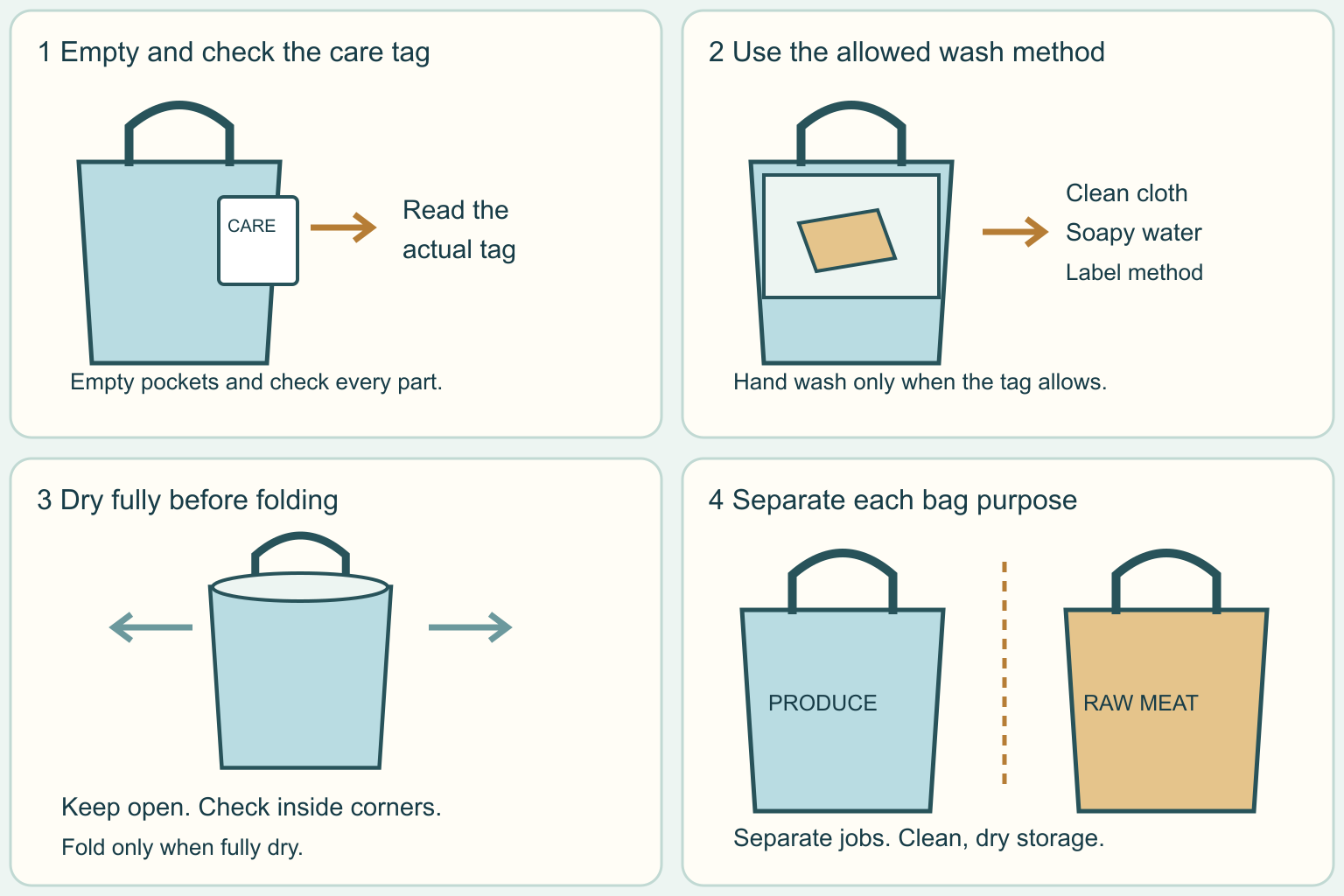
Start with one ordinary reusable shopping bag. Read its care label, clean it the allowed way, and keep food bags separate from other uses.
Why it matters: A bag can carry food residue even when it looks tidy. Cleaning and drying it helps avoid carrying that residue into the next shopping trip.
Written guidance reviewed: 2026-10-30 · Sources and equipment assumptions are below.
Take this guide to another device
Steps, notes, supplies, setup choices, results and check dates save on this browser as you work. Plus can also keep an account copy. Account copies update only when you choose Save; loading one replaces the browser draft shown here.
Review all saved work. Saved account check dates appear in My Day. Clear the date and save again to finish a follow-up. Email settings stay separate; existing opted-in agenda or deadline emails can include these dated actions.
Understand the job before starting
A bag can carry food residue even when it looks tidy. Cleaning and drying it helps avoid carrying that residue into the next shopping trip.
A common mistake to avoid
A wipe, smell test or clean appearance cannot prove that a bag is free of germs. If the maker instructions cannot be found, choose another washable bag for food while asking for advice. Do not reuse a bag that held leaking household chemicals for groceries. This routine is not a universal sanitizing treatment for raw-food spills, mold or every insulated bag.
Words used in this guide
Cross-contamination
Transfer of harmful germs between foods, hands, or surfaces. Read the example
Use what you already have. Check each item when it is ready.
Before you begin
Practice with an ordinary bag without a raw-food spill. Set a bag with raw-meat juices, mold, unknown chemicals or damaged lining aside from clean bags; get the maker specific cleaning advice or replace it if it cannot be cleaned. Do not assume paper, insulated lining or a cardboard insert can go in a washer. Never mix cleaners, add bleach to another product, or use boiling water as a shortcut. Follow bag and cleaner labels.
0 of 4 steps checked0%
Guide progress and notes save on this browser; choose Save account copy above to carry them to another device with Plus. Downloads contain the complete blank checklist; print to include your current checks and notes.
Do it with me
Your step position saves on this browser. Use the picture when available, then check the written result.
STEP 1 OF 4
Empty the bag and find its care label
Start here: Remove everything and check which cleaning method this bag allows.
Illustration: Empty the bag and find its care label. Read the steps for your exact task.
Read-aloud is available in supported browsers; the written steps always remain available.
A reusable bag is made to be used again rather than thrown away after one trip.
Empty every pocket and remove loose receipts and crumbs.
Look inside for a care label: the tag that tells you how to wash and dry it.
Check the maker website if the tag is missing.
Identify any insert or insulated lining, which helps keep food cool.
A cloth-looking bag is not automatically machine washable.
For this first practice, choose a bag with clear instructions and no raw-food leak.
Before moving to the next step
Check this specific result: The bag is empty, and I found a confirmed washing and drying method for this exact bag.
If that result is not true yet, leave the box unchecked. Write what is missing in your notes; use the official instructions below when the equipment or situation differs.
STEP 1 OF 4
Empty the bag and find its care label
Start here: Remove everything and check which cleaning method this bag allows.
Illustration: Empty the bag and find its care label. Read the steps for your exact task.
A reusable bag is made to be used again rather than thrown away after one trip.
Empty every pocket and remove loose receipts and crumbs.
Look inside for a care label: the tag that tells you how to wash and dry it.
Check the maker website if the tag is missing.
Identify any insert or insulated lining, which helps keep food cool.
A cloth-looking bag is not automatically machine washable.
For this first practice, choose a bag with clear instructions and no raw-food leak.
Before moving to the next step
Check this specific result: The bag is empty, and I found a confirmed washing and drying method for this exact bag.
If that result is not true yet, leave the box unchecked. Write what is missing in your notes; use the official instructions below when the equipment or situation differs.
STEP 2 OF 4
Clean it using the allowed method
Start here: Follow either the confirmed machine-wash or hand-wash instructions.
Illustration: Clean it using the allowed method. Read the steps for your exact task.
Machine washable means the care label permits a washing machine.
Use its stated cycle, water temperature and detergent instructions.
For a bag confirmed suitable for hand washing, use a clean cloth or sponge with soapy water at the label allowed temperature.
Wash inside surfaces, corners and handles, then remove soap as the care instructions direct.
Do not soak or remove a stiff insert unless allowed.
Cleaning means removing dirt and residue; a fragrance spray or shaking out crumbs does not replace washing.
No homemade cleaner mixture is needed.
Before moving to the next step
Check this specific result: I cleaned the inside, corners and handles by the approved method without mixing products.
If that result is not true yet, leave the box unchecked. Write what is missing in your notes; use the official instructions below when the equipment or situation differs.
STEP 3 OF 4
Dry the inside completely
Start here: Open the bag so air can reach its corners, then check before folding.
Illustration: Dry the inside completely. Read the steps for your exact task.
Air-dry means let air remove moisture.
Open the bag fully in a clean place.
Turn it inside out only if its construction allows this without damage.
Keep corners and pockets open rather than pressed together.
Use a dryer only when the label permits it and at its stated setting.
Feel inside seams and corners with clean hands before folding; they should be dry, not just the outside.
Do not seal a damp bag in a cupboard or another bag.
If it still smells bad or has residue after the approved cleaning, pause and ask the maker or replace it.
Before moving to the next step
Check this specific result: The inside, seams and pockets are fully dry, or the bag remains open to finish drying.
If that result is not true yet, leave the box unchecked. Write what is missing in your notes; use the official instructions below when the equipment or situation differs.
STEP 4 OF 4
Separate food bags and store them clean
Start here: Choose a purpose for each clean bag and check it after each trip.
Illustration: Separate food bags and store them clean. Read the steps for your exact task.
Cross-contamination means germs or residue move from one item to another.
Use separate bags for raw meat, poultry or seafood and for produce or ready-to-eat foods.
Ready-to-eat means food you will eat without cooking it first.
Keep cleaners and non-food items separate from food bags.
Use a label or a consistent identifying feature to remember each bag purpose.
Store dry bags in a clean, dry place.
Check after shopping and wash frequently; a food-juice leak needs thorough cleaning before reuse.
Also clean the surface where a dirty bag sat, using that surface approved instructions.
Before moving to the next step
Check this specific result: My clean bags have separate purposes and a clean, dry storage place, with a plan to check after use.
If that result is not true yet, leave the box unchecked. Write what is missing in your notes; use the official instructions below when the equipment or situation differs.
Pictures for this guide
Picture 1 of 4 · Empty the bag and find its care label
An empty grocery tote has a care tag highlighted with an arrow.
For: Empty the bag and find its care label
Illustrations show examples of the actions above. Follow your equipment’s instructions.
Notes about these pictures
A reusable bag is made to be used again rather than thrown away after one trip. Empty every pocket and remove loose receipts and crumbs. Look inside for a care label: the tag that tells you how to wash and dry it. Check the maker website if the tag is missing. Identify any insert or insulated lining, which helps keep food cool. A cloth-looking bag is not automatically machine washable. For this first practice, choose a bag with clear instructions and no raw-food leak.
Practice with an ordinary bag without a raw-food spill. Set a bag with raw-meat juices, mold, unknown chemicals or damaged lining aside from clean bags; get the maker specific cleaning advice or replace it if it cannot be cleaned. Do not assume paper, insulated lining or a cardboard insert can go in a washer. Never mix cleaners, add bleach to another product, or use boiling water as a shortcut. Follow bag and cleaner labels.
Was this step clear?
Flag “Empty the bag and find its care label” for review. We save the guide and step identifiers with your account to limit duplicates, not your private notes.
A specific companion has not been selected for this new guide yet. You can search for related demonstrations; search results have not been reviewed by Life’s Checklists.
These YouTube videos belong to their respective creators. Life’s Checklists does not own them and is not affiliated with the creators. Links open on YouTube, where the videos are available independently of our membership.
How to use the video with this guide
Read “Before you begin” first. Watch the relevant part, pause, then return to the written step and its completion check. Use captions and playback speed if they help. A demonstration may cover only part of the task or show different equipment.
Your model’s instructions and current official guidance take priority. For urgent problems, follow the stop instructions without waiting to watch a video.
Finish the job and know what to do next.
For this guide, the final result is: My clean bags have separate purposes and a clean, dry storage place, with a plan to check after use.
A concrete way to approach this task
Fictional practice: a cotton tote has a tag allowing machine washing and air drying. Empty it, use the tag cycle and detergent directions, open it to dry, and check the corners. Label its purpose Produce. A second bag carries packaged raw meat separately. Your actual bag may need another method.
What if I cannot complete a step?
A wipe, smell test or clean appearance cannot prove that a bag is free of germs. If the maker instructions cannot be found, choose another washable bag for food while asking for advice. Do not reuse a bag that held leaking household chemicals for groceries. This routine is not a universal sanitizing treatment for raw-food spills, mold or every insulated bag.
Identify the exact step: “Empty the bag and find its care label.” Record what you tried, what happened, and which item or model you used. Ask for help with that specific problem rather than repeating an unsafe or unsuccessful action.
Practice with an ordinary bag without a raw-food spill. Set a bag with raw-meat juices, mold, unknown chemicals or damaged lining aside from clean bags; get the maker specific cleaning advice or replace it if it cannot be cleaned. Do not assume paper, insulated lining or a cardboard insert can go in a washer. Never mix cleaners, add bleach to another product, or use boiling water as a shortcut. Follow bag and cleaner labels.
Connect this skill to everyday life
Write down the total move-in cash and monthly costs before applying. Ask which charges are required and which are optional.
Advertised rent is not necessarily the whole monthly cost. A refundable deposit still needs cash now. An application does not mean you have a signed lease.
A useful record for this task: Record the result of “Separate food bags and store them clean”: My clean bags have separate purposes and a clean, dry storage place, with a plan to check after use.
When finished, record the result and any next check or follow-up date. Your original step checks and notes remain on this browser.
Keep the result of your work
Finish and check every step before recording completion. You can write a draft below now.
Result: Not recorded · Next check: Not chosen
Choose a date from your own manual or situation. No email is enabled by saving this record.