Where to go / who to contact
Start with your high-school counseling office or a college’s official “Admissions” page.
Do these actions in order
I’m stuck — help with this action
Your next small step
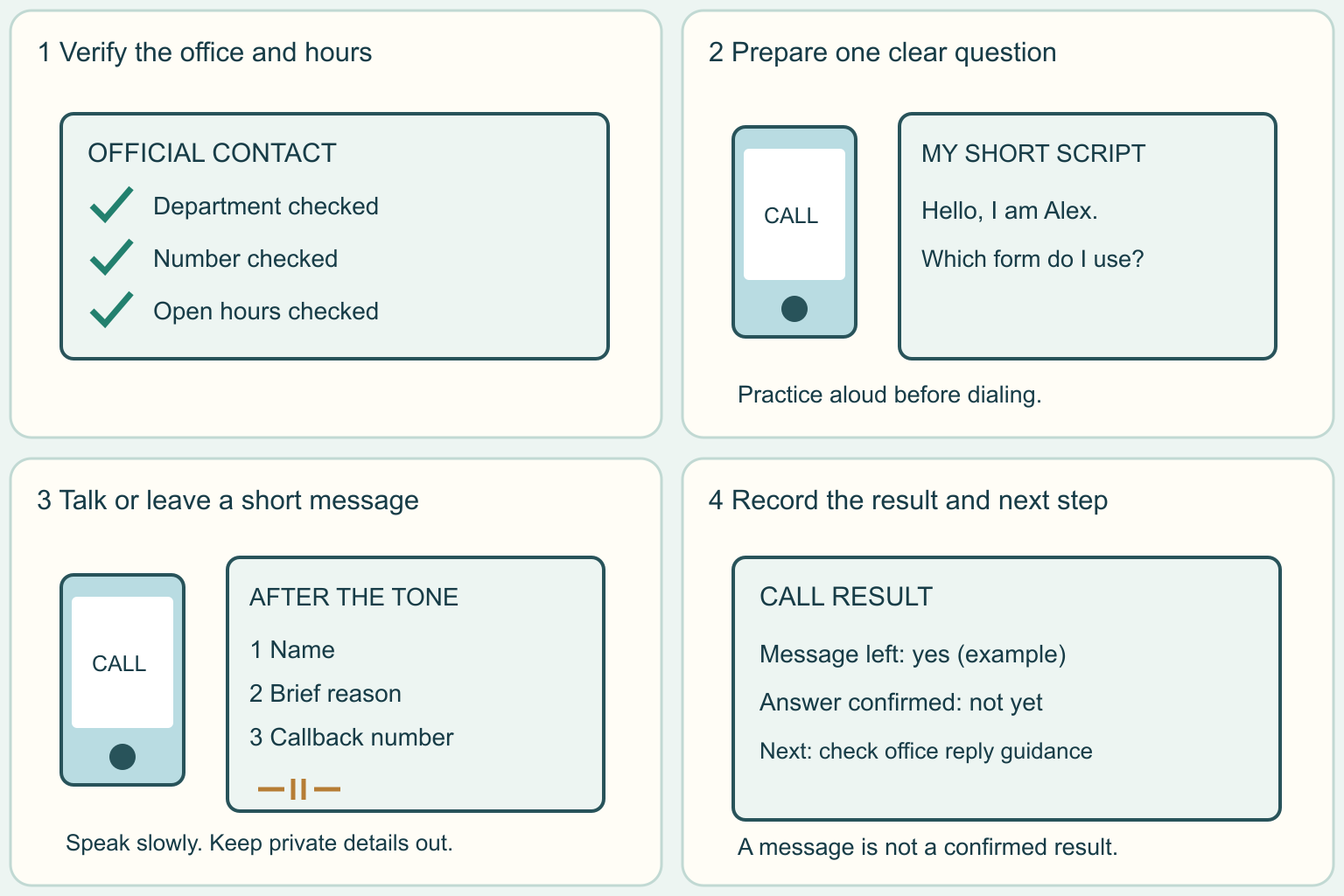
Tell the counselor: “I want to compare college, community college, or training options. I do not know the first step.” Ask how to book a meeting if you cannot walk in.
Get ready
Start with your high-school counseling office or a college’s official “Admissions” page.
- Your expected graduation year and subjects or careers you want to explore.
- A list of schools or training programs you are curious about.
- A calendar and a private folder for application records.
Make it manageable
- Find the office, website, document, or person named above.
- Work on this one action. If it needs a response, write down who you contacted and when.
- Check the result below before checking off the action. Pause and ask if a requirement is unclear.
What finished looks like
You have a short comparison list and an official admissions contact.
Words explained
“Requirement” means something you must provide or do. “Deadline” means the last date or time to complete it. “Follow up” means checking what happens next after your first contact.
What you can say
What would I study and what qualification would I earn?
Choose a call or message scriptWhere to get more help
If a form or deadline is confusing, send admissions or financial aid a short message with the name of the form and the exact question. Ask a counselor to sit with you while you work through it. Avoid sending sensitive documents in an ordinary message unless the office directs you to a secure submission method.
Official FAFSA starting instructions (U.S.) · Choose the application year that matches when you plan to attend school.
Understand and compare aid offers · Use this alongside each school’s offer, then ask its aid office about unclear amounts.
I’m stuck — help with this action
Your next small step
Choose a few programs to compare. On each school’s own website, find the program description, entry requirements, location, length, and cost information. Save the page links in your notes.
Get ready
Start with your high-school counseling office or a college’s official “Admissions” page.
- Your expected graduation year and subjects or careers you want to explore.
- A list of schools or training programs you are curious about.
- A calendar and a private folder for application records.
Make it manageable
- Find the office, website, document, or person named above.
- Work on this one action. If it needs a response, write down who you contacted and when.
- Check the result below before checking off the action. Pause and ask if a requirement is unclear.
What finished looks like
You have a short comparison list and an official admissions contact.
Words explained
“Requirement” means something you must provide or do. “Deadline” means the last date or time to complete it. “Follow up” means checking what happens next after your first contact.
What you can say
What would I study and what qualification would I earn?
Choose a call or message scriptWhere to get more help
If a form or deadline is confusing, send admissions or financial aid a short message with the name of the form and the exact question. Ask a counselor to sit with you while you work through it. Avoid sending sensitive documents in an ordinary message unless the office directs you to a secure submission method.
Official FAFSA starting instructions (U.S.) · Choose the application year that matches when you plan to attend school.
Understand and compare aid offers · Use this alongside each school’s offer, then ask its aid office about unclear amounts.
I’m stuck — help with this action
Your next small step
Ask whether you can visit or attend an information session. If you already attend college, contact your academic adviser about your current program instead of starting a new application.
Get ready
Start with your high-school counseling office or a college’s official “Admissions” page.
- Your expected graduation year and subjects or careers you want to explore.
- A list of schools or training programs you are curious about.
- A calendar and a private folder for application records.
Make it manageable
- Find the office, website, document, or person named above.
- Work on this one action. If it needs a response, write down who you contacted and when.
- Check the result below before checking off the action. Pause and ask if a requirement is unclear.
What finished looks like
You have a short comparison list and an official admissions contact.
Words explained
“Requirement” means something you must provide or do. “Deadline” means the last date or time to complete it. “Follow up” means checking what happens next after your first contact.
What you can say
What would I study and what qualification would I earn?
Choose a call or message scriptWhere to get more help
If a form or deadline is confusing, send admissions or financial aid a short message with the name of the form and the exact question. Ask a counselor to sit with you while you work through it. Avoid sending sensitive documents in an ordinary message unless the office directs you to a secure submission method.
Official FAFSA starting instructions (U.S.) · Choose the application year that matches when you plan to attend school.
Understand and compare aid offers · Use this alongside each school’s offer, then ask its aid office about unclear amounts.
Questions you can ask, word for word
- “What would I study and what qualification would I earn?”
- “Who can explain the admission requirements for my situation?”
You are ready to move on whenYou have a short comparison list and an official admissions contact.
Find help and useful links for this topic ↗Learn the words, math, and real-life impact ↗