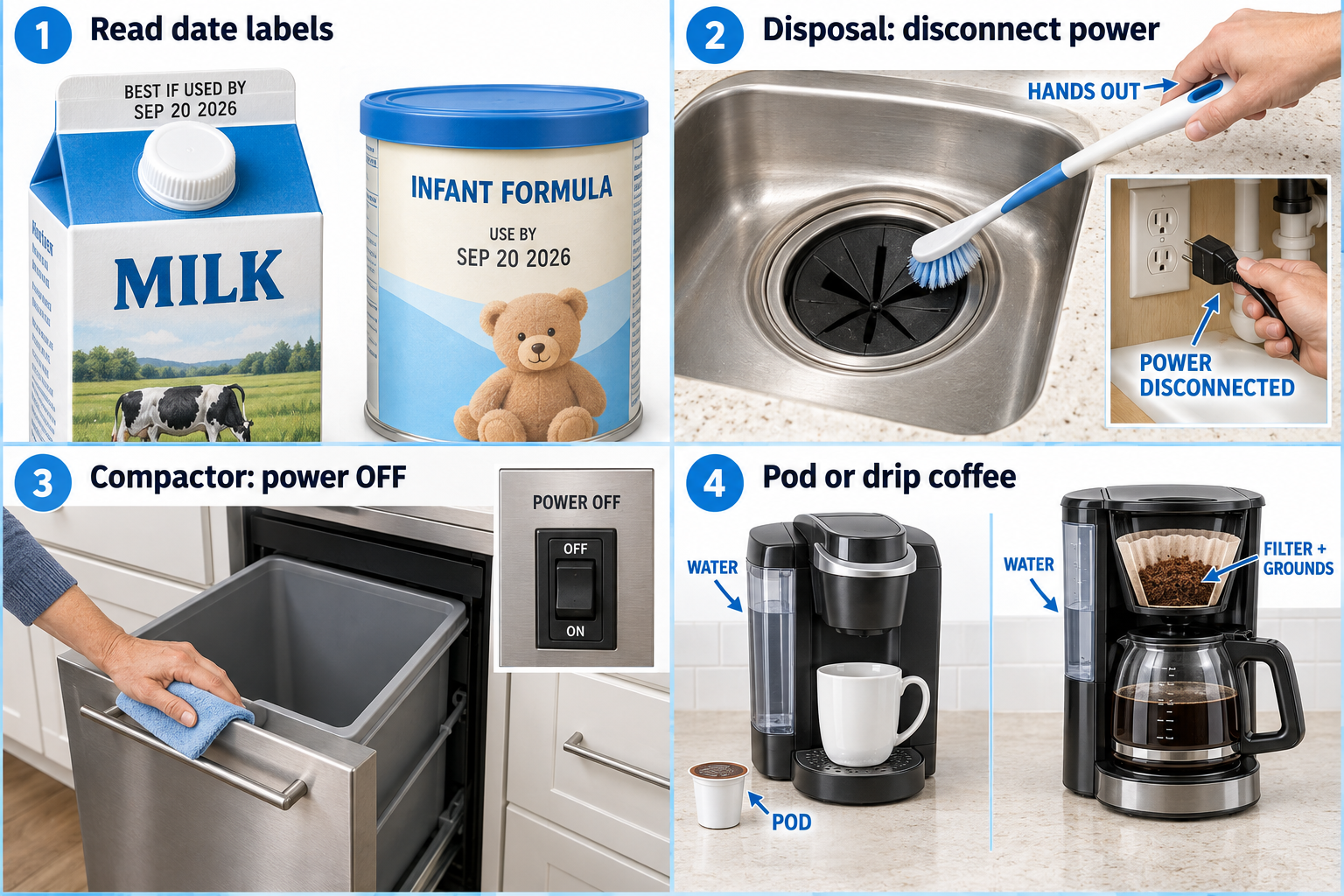
“Best if used by” often refers to quality. Dates do not replace safe storage or tell you every food is safe to eat.
Why it matters: Harmful bacteria may have no smell. Time and temperature can matter more than a printed date.
Written guidance reviewed: September 17, 2026 · Sources and equipment assumptions are below.
Take this guide to another device
Steps, notes, supplies, setup choices, results and check dates save on this browser as you work. Plus can also keep an account copy. Account copies update only when you choose Save; loading one replaces the browser draft shown here.
Review all saved work. Saved account check dates appear in My Day. Clear the date and save again to finish a follow-up. Email settings stay separate; existing opted-in agenda or deadline emails can include these dated actions.
Understand the job before starting
Label wording, food type and storage history are all relevant.
A common mistake to avoid
A printed date or normal smell alone cannot establish safe handling.
Use what you already have. Check each item when it is ready.
Before you begin
Do not taste food to test safety. Discard swollen/leaking cans, food with unsafe storage history, and infant formula after its use-by date. Follow recalls and special product warnings.
0 of 4 steps checked0%
Guide progress and notes save on this browser; choose Save account copy above to carry them to another device with Plus. Downloads contain the complete blank checklist; print to include your current checks and notes.
Do it with me
Your step position saves on this browser. Use the picture when available, then check the written result.
STEP 1 OF 4
Find the printed date
Start here: Find the printed date
Illustration: Read date labels. Read the steps for your exact task.
Read-aloud is available in supported browsers; the written steps always remain available.
Look on a lid, bottom, neck, seam, or label.
Use light to read stamped numbers. “Sell by” helps store inventory; “best if used by” commonly describes quality; “use by” wording can have product-specific meaning.
Infant formula has a required use-by date.
Before moving to the next step
Check this specific result: I found the date and read its wording.
If that result is not true yet, leave the box unchecked. Write what is missing in your notes; use the official instructions below when the equipment or situation differs.
STEP 1 OF 4
Find the printed date
Start here: Find the printed date
Illustration: Read date labels. Read the steps for your exact task.
Look on a lid, bottom, neck, seam, or label.
Use light to read stamped numbers. “Sell by” helps store inventory; “best if used by” commonly describes quality; “use by” wording can have product-specific meaning.
Infant formula has a required use-by date.
Before moving to the next step
Check this specific result: I found the date and read its wording.
If that result is not true yet, leave the box unchecked. Write what is missing in your notes; use the official instructions below when the equipment or situation differs.
STEP 2 OF 4
Check storage and the whole label
Start here: Read the whole food label.
Example: Read the whole food label. Follow the written step.
Read “keep refrigerated” and “use within X days after opening.” A sealed shelf-stable package can need refrigeration once opened.
Write the opening date.
A date does not make food safe after hours at the wrong temperature.
Before moving to the next step
Check this specific result: I recorded when it was opened and how it should be stored.
If that result is not true yet, leave the box unchecked. Write what is missing in your notes; use the official instructions below when the equipment or situation differs.
STEP 3 OF 4
Use safe time and temperature
Start here: Check time and temperature.
Example: Check time and temperature. Follow the written step.
Keep the refrigerator at 40°F or below and freezer at 0°F.
Refrigerate perishables within two hours, or one hour above 90°F.
Many cooked leftovers keep 3–4 days refrigerated; use the official storage chart for the particular food.
Before moving to the next step
Check this specific result: The food stayed within its safe storage limits.
If that result is not true yet, leave the box unchecked. Write what is missing in your notes; use the official instructions below when the equipment or situation differs.
STEP 4 OF 4
Discard when safety is uncertain
Start here: Discard unsafe or uncertain food.
Example: Discard unsafe or uncertain food. Follow the written step.
A bad smell or visible spoilage means discard, but no smell does not prove safety.
Do not cut mold off soft foods and assume the rest is safe.
If you cannot establish a perishable food’s safe history, throw it away.
Check recalls when relevant.
Before moving to the next step
Check this specific result: I used storage guidance rather than a taste test.
If that result is not true yet, leave the box unchecked. Write what is missing in your notes; use the official instructions below when the equipment or situation differs.
Pictures for this guide
Picture 1 of 4 · Read date labels
A generic food carton has BEST IF USED BY above an example date; a separate infant-formula container has USE BY above an example date.
For: Find the printed date
Illustrations show examples of the actions above. Follow your equipment’s instructions.
Notes about these pictures
Look on a lid, bottom, neck, seam, or label. Use light to read stamped numbers. “Sell by” helps store inventory; “best if used by” commonly describes quality; “use by” wording can have product-specific meaning. Infant formula has a required use-by date.
Do not taste food to test safety. Discard swollen/leaking cans, food with unsafe storage history, and infant formula after its use-by date. Follow recalls and special product warnings.
Was this step clear?
Flag “Find the printed date” for review. We save the guide and step identifiers with your account to limit duplicates, not your private notes.
What to look for: This explains labeling and waste. The written guide’s storage history, recalls, infant-formula rules, and food-specific limits determine what to keep.
Link details checked 2026-10-03. Video availability and equipment menus can change.
These YouTube videos belong to their respective creators. Life’s Checklists does not own them and is not affiliated with the creators. Links open on YouTube, where the videos are available independently of our membership.
How to use the video with this guide
Read “Before you begin” first. Watch the relevant part, pause, then return to the written step and its completion check. Use captions and playback speed if they help. A demonstration may cover only part of the task or show different equipment.
Your model’s instructions and current official guidance take priority. For urgent problems, follow the stop instructions without waiting to watch a video.
For this guide, the final result is: I used storage guidance rather than a taste test.
A concrete way to approach this task
Record the food type, storage history, and what the date label actually says. A date alone does not tell the whole story.
What if I cannot complete a step?
If you cannot establish safe handling or storage, use the official food guidance linked below rather than guessing from appearance.
Identify the exact step: “Find the printed date.” Record what you tried, what happened, and which item or model you used. Ask for help with that specific problem rather than repeating an unsafe or unsuccessful action.
Do not taste food to test safety. Discard swollen/leaking cans, food with unsafe storage history, and infant formula after its use-by date. Follow recalls and special product warnings.
Connect this skill to everyday life
Write down the total move-in cash and monthly costs before applying. Ask which charges are required and which are optional.
Advertised rent is not necessarily the whole monthly cost. A refundable deposit still needs cash now. An application does not mean you have a signed lease.