White marks around a faucet may be minerals left by water. Some faucets allow diluted white vinegar. Others need a different cleaner.
Why it matters: Hard water contains dissolved minerals. When drops dry, those minerals can stay behind. Wiping the faucet dry can help prevent new marks.
Written guidance reviewed: September 18, 2026 · Sources and equipment assumptions are below.
Take this guide to another device
Steps, notes, supplies, setup choices, results and check dates save on this browser as you work. Plus can also keep an account copy. Account copies update only when you choose Save; loading one replaces the browser draft shown here.
Review all saved work. Saved account check dates appear in My Day. Clear the date and save again to finish a follow-up. Email settings stay separate; existing opted-in agenda or deadline emails can include these dated actions.
Understand the job before starting
A water spot can be mineral buildup, but finish damage can look similar.
A common mistake to avoid
Applying an acidic method to an incompatible surface can worsen the problem.
Words used in this guide
Rent
The amount paid to use someone else’s property for an agreed time. Read the example
Use what you already have. Check each item when it is ready.
Before you begin
Never mix vinegar with bleach or another cleaner. Do not use stronger cleaning vinegar as a substitute for the product your instructions specify. Protect nearby stone, grout, and other surfaces from drips. If the finish is unknown or the tap is leaking, ask the landlord or maker first.
0 of 4 steps checked0%
Guide progress and notes save on this browser; choose Save account copy above to carry them to another device with Plus. Downloads contain the complete blank checklist; print to include your current checks and notes.
Do it with me
Your step position saves on this browser. Use the picture when available, then check the written result.
STEP 1 OF 4
Find the instructions and try water first
Start here: Find the instructions and try water first
Illustration: Read the finish instructions. Read the steps for your exact task.
Read-aloud is available in supported browsers; the written steps always remain available.
Look for the maker’s name on the faucet, receipt, or home paperwork.
On the official website, search “clean [model] [finish].” The finish might be chrome or a special coating.
Wipe the mark with a soft cloth dampened with warm water, then dry.
Do not use steel wool or a rough scrub pad.
If water removes it, you are finished; skip vinegar.
Before moving to the next step
Check this specific result: I checked the finish instructions and tried a soft damp cloth.
If that result is not true yet, leave the box unchecked. Write what is missing in your notes; use the official instructions below when the equipment or situation differs.
STEP 1 OF 4
Find the instructions and try water first
Start here: Find the instructions and try water first
Illustration: Read the finish instructions. Read the steps for your exact task.
Look for the maker’s name on the faucet, receipt, or home paperwork.
On the official website, search “clean [model] [finish].” The finish might be chrome or a special coating.
Wipe the mark with a soft cloth dampened with warm water, then dry.
Do not use steel wool or a rough scrub pad.
If water removes it, you are finished; skip vinegar.
Before moving to the next step
Check this specific result: I checked the finish instructions and tried a soft damp cloth.
If that result is not true yet, leave the box unchecked. Write what is missing in your notes; use the official instructions below when the equipment or situation differs.
STEP 2 OF 4
Measure only the solution your maker allows
Start here: Measure the approved mix.
Example: Measure the approved mix. Follow the written step.
Delta’s linked care page allows equal amounts of white vinegar and water for hard-water stains.
This is an example for a compatible faucet, not a rule for every brand.
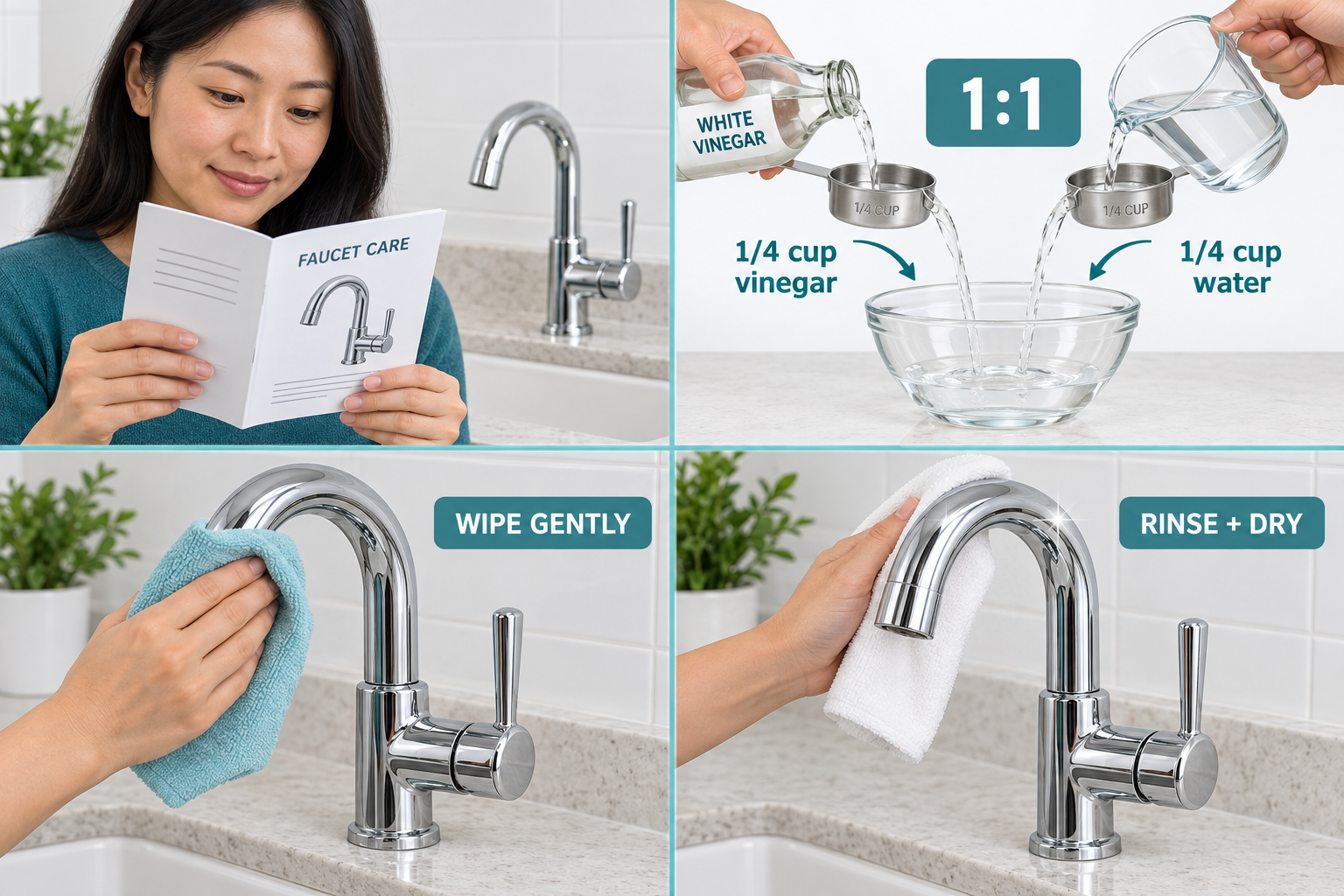
Equal parts means the same amount of each: ¼ cup vinegar plus ¼ cup water makes ½ cup total.
Check your own instructions first.
Pour into a small bowl used for this job; keep it away from food, children, and pets.
Before moving to the next step
Check this specific result: My maker allows this mixture, and I measured equal amounts.
If that result is not true yet, leave the box unchecked. Write what is missing in your notes; use the official instructions below when the equipment or situation differs.
STEP 3 OF 4
Wipe a small area gently
Start here: Wipe a small area gently
Illustration: Wipe a small area. Read the steps for your exact task.
Dampen a soft cloth with the allowed solution rather than flooding the faucet.
Try a tiny hidden area, rinse it, dry it, and check for a change in color or shine.
If unchanged, wipe the spots gently.
Do not improvise an overnight soak or attach a vinegar-filled bag: contact time and finish compatibility vary.
Stop if the finish changes or the mark does not lift.
Before moving to the next step
Check this specific result: I used a small amount gently and did not damage the finish.
If that result is not true yet, leave the box unchecked. Write what is missing in your notes; use the official instructions below when the equipment or situation differs.
STEP 4 OF 4
Rinse completely and dry
Start here: Rinse completely and dry
Illustration: Rinse and dry. Read the steps for your exact task.
Use a fresh cloth dampened with plain water to remove the solution, following your faucet instructions.
Wipe dry with a soft cloth.
Check nearby surfaces for drips.
Put the vinegar away in its labeled container and wash the bowl and cloth.
If marks return, dry the faucet after use.
If water keeps dripping from a closed faucet, report the leak; cleaning does not repair it.
Before moving to the next step
Check this specific result: The faucet is rinsed and dry, and any leak has been reported.
If that result is not true yet, leave the box unchecked. Write what is missing in your notes; use the official instructions below when the equipment or situation differs.
Term
Simple meaning
What to do
Mineral deposit
Material left when water dries.
Use the faucet maker’s approved method.
Dilute
Add water to make a solution less concentrated.
Measure the stated amounts; more vinegar is not automatically better.
50/50 or 1:1
Half of the mix is each ingredient.
¼ cup + ¼ cup = ½ cup total.
Corrosion or a damaged finish
The metal or its coating has changed.
Ask for repair advice; do not scrub harder.
Pictures for this guide
Picture 1 of 4 · Read the finish instructions
An adult reads care instructions for the faucet model and finish.
For: Find the instructions and try water first
Illustrations show examples of the actions above. Follow your equipment’s instructions.
Notes about these pictures
Look for the maker’s name on the faucet, receipt, or home paperwork. On the official website, search “clean [model] [finish].” The finish might be chrome or a special coating. Wipe the mark with a soft cloth dampened with warm water, then dry. Do not use steel wool or a rough scrub pad. If water removes it, you are finished; skip vinegar.
Never mix vinegar with bleach or another cleaner. Do not use stronger cleaning vinegar as a substitute for the product your instructions specify. Protect nearby stone, grout, and other surfaces from drips. If the finish is unknown or the tap is leaking, ask the landlord or maker first.
Was this step clear?
Flag “Find the instructions and try water first” for review. We save the guide and step identifiers with your account to limit duplicates, not your private notes.
Link details checked 2026-10-03. Video availability and equipment menus can change.
These YouTube videos belong to their respective creators. Life’s Checklists does not own them and is not affiliated with the creators. Links open on YouTube, where the videos are available independently of our membership.
How to use the video with this guide
Read “Before you begin” first. Watch the relevant part, pause, then return to the written step and its completion check. Use captions and playback speed if they help. A demonstration may cover only part of the task or show different equipment.
Your model’s instructions and current official guidance take priority. For urgent problems, follow the stop instructions without waiting to watch a video.
For this guide, the final result is: The faucet is rinsed and dry, and any leak has been reported.
A concrete way to approach this task
Check whether the faucet finish allows the method before applying it. A mineral spot and damaged finish can need different responses.
What if I cannot complete a step?
If you are unsure of the finish or cleaner compatibility, use the manufacturer’s guidance rather than testing stronger mixtures.
Identify the exact step: “Find the instructions and try water first.” Record what you tried, what happened, and which item or model you used. Ask for help with that specific problem rather than repeating an unsafe or unsuccessful action.
Never mix vinegar with bleach or another cleaner. Do not use stronger cleaning vinegar as a substitute for the product your instructions specify. Protect nearby stone, grout, and other surfaces from drips. If the finish is unknown or the tap is leaking, ask the landlord or maker first.
Connect this skill to everyday life
Write down the total move-in cash and monthly costs before applying. Ask which charges are required and which are optional.
Advertised rent is not necessarily the whole monthly cost. A refundable deposit still needs cash now. An application does not mean you have a signed lease.