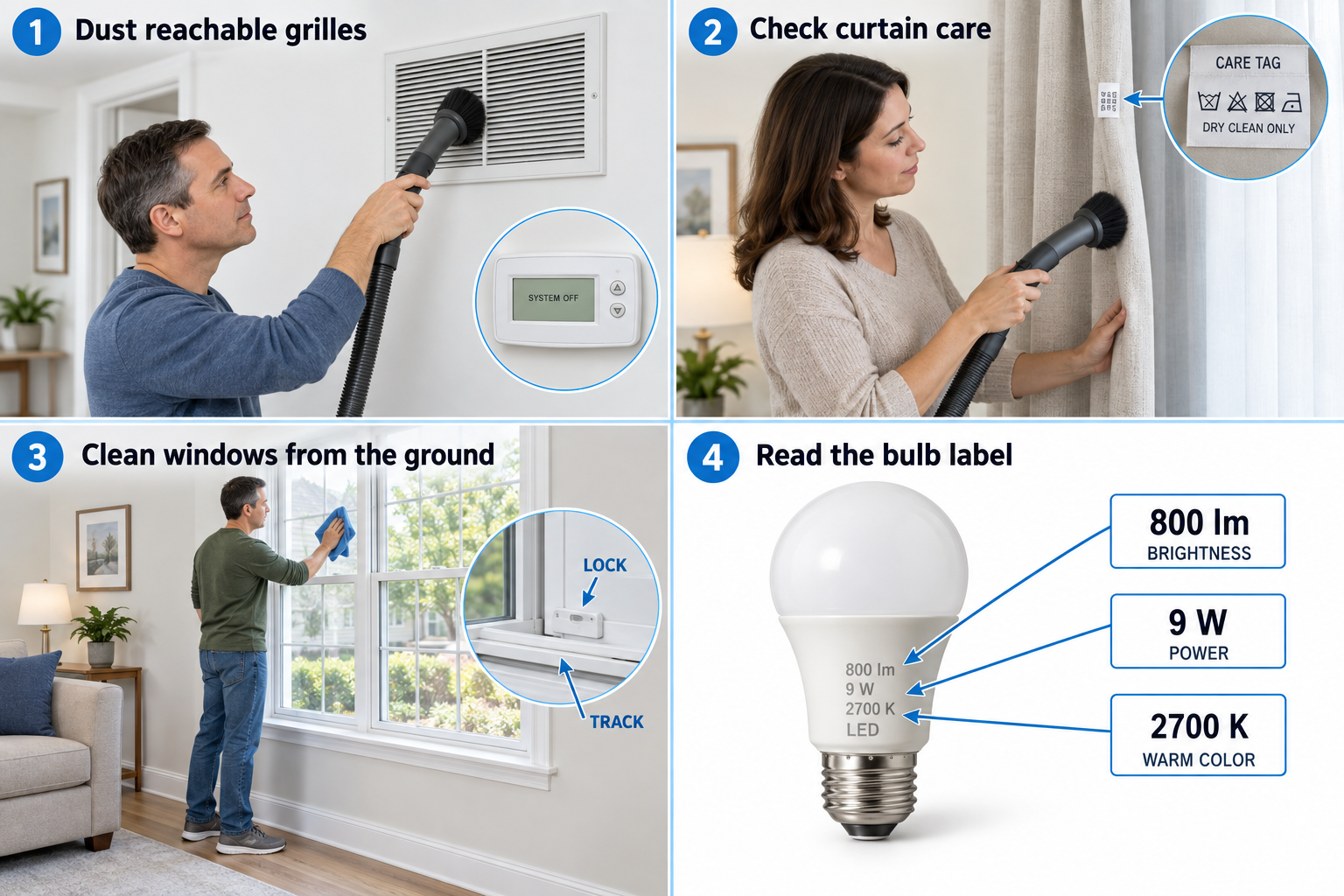
Lumens describe brightness. Watts describe electricity use. Kelvin describes whether the light looks warm or cool.
Why it matters: An LED can provide similar brightness with fewer watts and less frequent replacement.
Written guidance reviewed: September 17, 2026 · Sources and equipment assumptions are below.
Take this guide to another device
Steps, notes, supplies, setup choices, results and check dates save on this browser as you work. Plus can also keep an account copy. Account copies update only when you choose Save; loading one replaces the browser draft shown here.
Review all saved work. Saved account check dates appear in My Day. Clear the date and save again to finish a follow-up. Email settings stay separate; existing opted-in agenda or deadline emails can include these dated actions.
Understand the job before starting
Physical fit, fixture limits and lighting needs must be checked before comparing energy cost.
A common mistake to avoid
A bulb can be efficient and still unsuitable for the fixture.
Use what you already have. Check each item when it is ready.
Before you begin
Turn the light off and let it cool. Use stable access; never change a bulb in a wet or damaged fixture. Do not exceed the fixture’s actual wattage limit.
0 of 4 steps checked0%
Guide progress and notes save on this browser; choose Save account copy above to carry them to another device with Plus. Downloads contain the complete blank checklist; print to include your current checks and notes.
Do it with me
Your step position saves on this browser. Use the picture when available, then check the written result.
STEP 1 OF 4
Match the fitting first
Start here: Match the fitting first
Illustration: Read the bulb label. Read the steps for your exact task.
Read-aloud is available in supported browsers; the written steps always remain available.
Check the bulb base, shape, voltage, and the fixture instructions.
Enclosed fixtures and dimmers may need specially compatible LEDs.
A “60-watt equivalent” LED means similar brightness, not 60 watts of power use.
Before moving to the next step
Check this specific result: My bulb fits the fixture and its restrictions.
If that result is not true yet, leave the box unchecked. Write what is missing in your notes; use the official instructions below when the equipment or situation differs.
STEP 1 OF 4
Match the fitting first
Start here: Match the fitting first
Illustration: Read the bulb label. Read the steps for your exact task.
Check the bulb base, shape, voltage, and the fixture instructions.
Enclosed fixtures and dimmers may need specially compatible LEDs.
A “60-watt equivalent” LED means similar brightness, not 60 watts of power use.
Before moving to the next step
Check this specific result: My bulb fits the fixture and its restrictions.
If that result is not true yet, leave the box unchecked. Write what is missing in your notes; use the official instructions below when the equipment or situation differs.
STEP 2 OF 4
Choose brightness and color
Start here: Choose brightness and color
Illustration: Read the bulb label. Read the steps for your exact task.
Use lumens to compare brightness.
Around 800 lumens is a common replacement for an old 60-watt bulb.
Warm white around 2700 K looks yellowish and may feel comfortable in a bedroom; 4000 K looks cooler.
Dimmer, warmer evening light is a comfort choice, not a promise to fix sleep or eye problems.
Before moving to the next step
Check this specific result: I chose lumens and color for the room.
If that result is not true yet, leave the box unchecked. Write what is missing in your notes; use the official instructions below when the equipment or situation differs.
STEP 3 OF 4
Do the running-cost math
Start here: Work out the running cost.
Example: Work out the running cost. Follow the written step.
Example only: a 60 W bulb used 3 hours/day for 365 days uses 60 ÷ 1000 × 3 × 365 = 65.7 kWh.
A 9 W LED uses 9.855 kWh.
At $0.16/kWh, that is $10.51 versus $1.58 per year, about $8.94 saved per bulb before purchase cost.
Before moving to the next step
Check this specific result: I understand watts ÷ 1000 × hours × electricity price.
If that result is not true yet, leave the box unchecked. Write what is missing in your notes; use the official instructions below when the equipment or situation differs.
STEP 4 OF 4
Install and check
Start here: Fit the compatible bulb.
Example: Fit the compatible bulb. Follow the written step.
With the light off and cool, remove the old bulb and fit the replacement without overtightening.
Restore power.
Persistent flicker, heat, or buzzing needs a compatibility check or electrician.
Recycle CFLs containing mercury through the proper local program.
Before moving to the next step
Check this specific result: The new bulb works normally.
If that result is not true yet, leave the box unchecked. Write what is missing in your notes; use the official instructions below when the equipment or situation differs.
Pictures for this guide
Picture 1 of 4 · Read the bulb label
An LED bulb label separates example brightness of 800 lumens, power of 9 watts, and warm color temperature of 2700 kelvin.
For: Match the fitting first
Illustrations show examples of the actions above. Follow your equipment’s instructions.
Notes about these pictures
Check the bulb base, shape, voltage, and the fixture instructions. Enclosed fixtures and dimmers may need specially compatible LEDs. A “60-watt equivalent” LED means similar brightness, not 60 watts of power use.
Turn the light off and let it cool. Use stable access; never change a bulb in a wet or damaged fixture. Do not exceed the fixture’s actual wattage limit.
Was this step clear?
Flag “Match the fitting first” for review. We save the guide and step identifiers with your account to limit duplicates, not your private notes.
Link details checked 2026-10-03. Video availability and equipment menus can change.
These YouTube videos belong to their respective creators. Life’s Checklists does not own them and is not affiliated with the creators. Links open on YouTube, where the videos are available independently of our membership.
How to use the video with this guide
Read “Before you begin” first. Watch the relevant part, pause, then return to the written step and its completion check. Use captions and playback speed if they help. A demonstration may cover only part of the task or show different equipment.
Your model’s instructions and current official guidance take priority. For urgent problems, follow the stop instructions without waiting to watch a video.
For this guide, the final result is: The new bulb works normally.
A concrete way to approach this task
Compare the bulb’s fit and lighting requirements with the fixture instructions before comparing running costs.
What if I cannot complete a step?
A bulb that is cheaper to run still needs to be suitable for the fixture. If the labeling is unclear, take the exact details to a knowledgeable seller.
Identify the exact step: “Match the fitting first.” Record what you tried, what happened, and which item or model you used. Ask for help with that specific problem rather than repeating an unsafe or unsuccessful action.
Turn the light off and let it cool. Use stable access; never change a bulb in a wet or damaged fixture. Do not exceed the fixture’s actual wattage limit.
Connect this skill to everyday life
Write down the total move-in cash and monthly costs before applying. Ask which charges are required and which are optional.
Advertised rent is not necessarily the whole monthly cost. A refundable deposit still needs cash now. An application does not mean you have a signed lease.