Understand a chimney flue and wood-fireplace damper
The flue is the passage that carries smoke out. A damper is a movable door that controls that passage.
Why it matters: Closing the damper over a fire or warm embers can send smoke and carbon monoxide into the room.
Written guidance reviewed: September 17, 2026 · Sources and equipment assumptions are below.
Take this guide to another device
Steps, notes, supplies, setup choices, results and check dates save on this browser as you work. Plus can also keep an account copy. Account copies update only when you choose Save; loading one replaces the browser draft shown here.
Review all saved work. Saved account check dates appear in My Day. Clear the date and save again to finish a follow-up. Email settings stay separate; existing opted-in agenda or deadline emails can include these dated actions.
Understand the job before starting
The fireplace type, inspection status and operating controls must be identified before use.
A common mistake to avoid
A general drawing does not confirm that your fireplace is ready to operate.
Use what you already have. Check each item when it is ready.
Before you begin
Use this identification walkthrough only on a completely cold wood-burning fireplace. Gas fireplaces have different rules. Stop for a stuck damper, missing instructions, damage, smoke indoors, or an unknown inspection history.
0 of 5 steps checked0%
Guide progress and notes save on this browser; choose Save account copy above to carry them to another device with Plus. Downloads contain the complete blank checklist; print to include your current checks and notes.
Do it with me
Your step position saves on this browser. Use the picture when available, then check the written result.
STEP 1 OF 5
Identify the fireplace type
Start here: Identify your fireplace type.
Example: Identify your fireplace type. Follow the written step.
Read-aloud is available in supported browsers; the written steps always remain available.
Ask the landlord or chimney professional whether it is wood burning, gas logs, a gas insert, or electric.
A decorative log set can hide a gas system.
Do not assume a chimney means you can burn wood.
Before moving to the next step
Check this specific result: I confirmed this is a wood-burning fireplace.
If that result is not true yet, leave the box unchecked. Write what is missing in your notes; use the official instructions below when the equipment or situation differs.
STEP 1 OF 5
Identify the fireplace type
Start here: Identify your fireplace type.
Example: Identify your fireplace type. Follow the written step.
Ask the landlord or chimney professional whether it is wood burning, gas logs, a gas insert, or electric.
A decorative log set can hide a gas system.
Do not assume a chimney means you can burn wood.
Before moving to the next step
Check this specific result: I confirmed this is a wood-burning fireplace.
If that result is not true yet, leave the box unchecked. Write what is missing in your notes; use the official instructions below when the equipment or situation differs.
STEP 2 OF 5
Find the damper while everything is cold
Start here: Find the damper safely.
Example: Find the damper safely. Follow the written step.
Use the manual to find the handle, lever, or cable.
The damper may be above the firebox or at the top of the chimney.
A throat damper often moves a metal plate above the opening.
Do not reach into an unfamiliar or dirty mechanism.
Before moving to the next step
Check this specific result: I located the control and its open/closed positions.
If that result is not true yet, leave the box unchecked. Write what is missing in your notes; use the official instructions below when the equipment or situation differs.
STEP 3 OF 5
Open before a wood fire
Start here: Open before a wood fire
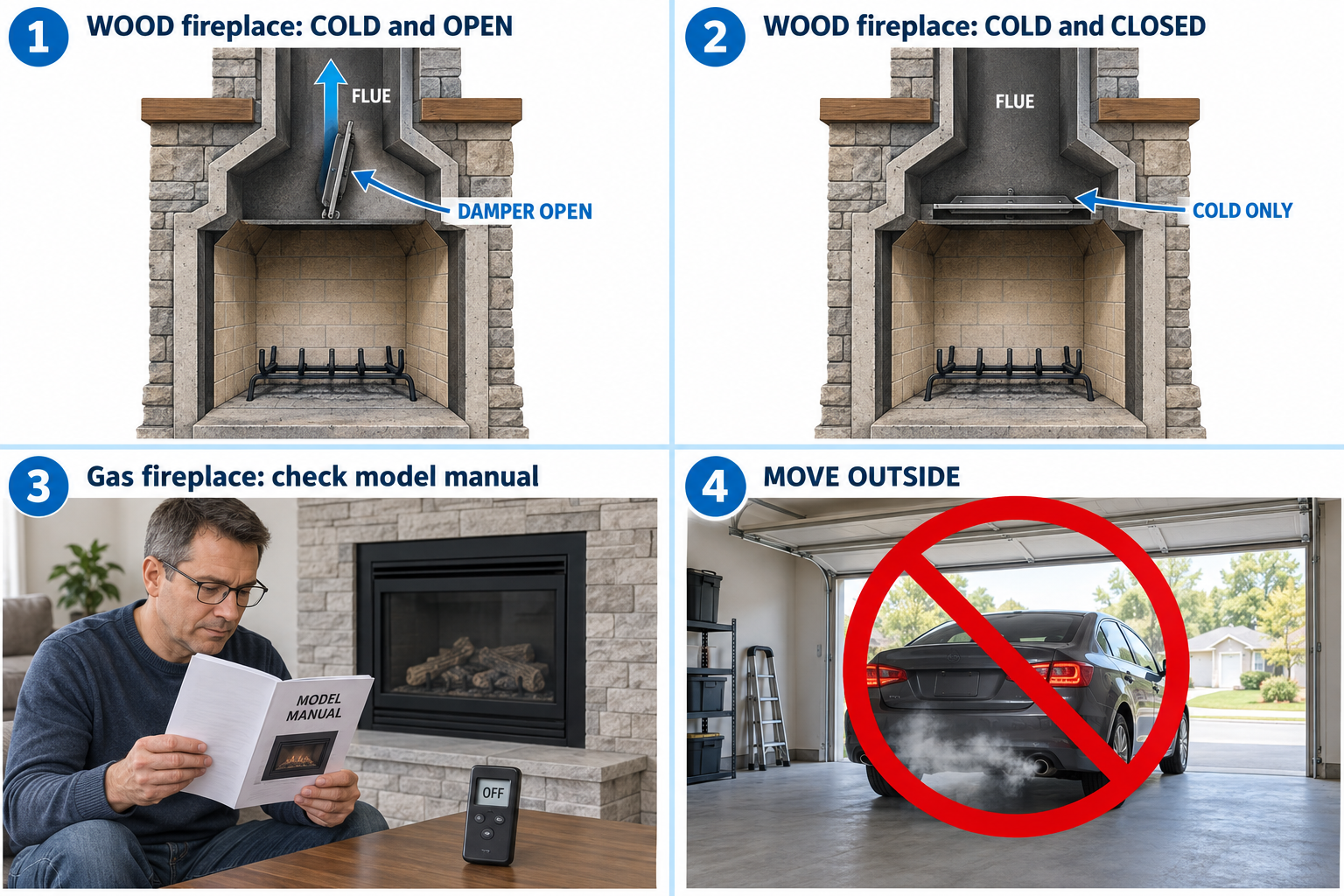
Illustration: WOOD fireplace: COLD and OPEN. Read the steps for your exact task.
Move the control only as the manual says.
Confirm the damper is fully open using the approved indicator or a professional’s demonstration.
Handle direction is not universal.
A flashlight view alone does not prove the entire chimney is clear.
Before moving to the next step
Check this specific result: I can identify the open position; inspection is current.
If that result is not true yet, leave the box unchecked. Write what is missing in your notes; use the official instructions below when the equipment or situation differs.
STEP 4 OF 5
Keep it open through cooling
Start here: Follow the cooling instructions.
Example: Follow the cooling instructions. Follow the written step.
Keep the damper open while a fire burns and while any embers or ashes remain warm.
Do not close it to “save heat” or extinguish a fire.
Leave it open when uncertain.
Before moving to the next step
Check this specific result: I know not to close it over fire or warm embers.
If that result is not true yet, leave the box unchecked. Write what is missing in your notes; use the official instructions below when the equipment or situation differs.
STEP 5 OF 5
Close only when completely cold and allowed
Start here: Close only when completely cold and allowed
Illustration: WOOD fireplace: COLD and CLOSED. Read the steps for your exact task.
When there is no fire and no heat remaining, follow the manual to close the damper if appropriate.
Have the chimney/fireplace/vent inspected at least yearly and cleaned when needed.
A gas-log damper may be required to stay permanently open.
Before moving to the next step
Check this specific result: I know when closure is allowed and when to call a professional.
If that result is not true yet, leave the box unchecked. Write what is missing in your notes; use the official instructions below when the equipment or situation differs.
Pictures for this guide
Picture 1 of 5 · Identify the fireplace type
Identify the fireplace type: Wood, gas, or another design?. Find the model before use.
For: Identify the fireplace type
Illustrations show examples of the actions above. Follow your equipment’s instructions.
Notes about these pictures
Ask the landlord or chimney professional whether it is wood burning, gas logs, a gas insert, or electric. A decorative log set can hide a gas system. Do not assume a chimney means you can burn wood.
Use this identification walkthrough only on a completely cold wood-burning fireplace. Gas fireplaces have different rules. Stop for a stuck damper, missing instructions, damage, smoke indoors, or an unknown inspection history.
Was this step clear?
Flag “Identify the fireplace type” for review. We save the guide and step identifiers with your account to limit duplicates, not your private notes.
By Chimney Safety Institute of America · External video
What to look for: Learn what the damper does. A video cannot establish that your chimney is safe to use; arrange the required inspection and follow your fireplace instructions.
Link details checked 2026-10-03. Video availability and equipment menus can change.
These YouTube videos belong to their respective creators. Life’s Checklists does not own them and is not affiliated with the creators. Links open on YouTube, where the videos are available independently of our membership.
How to use the video with this guide
Read “Before you begin” first. Watch the relevant part, pause, then return to the written step and its completion check. Use captions and playback speed if they help. A demonstration may cover only part of the task or show different equipment.
Your model’s instructions and current official guidance take priority. For urgent problems, follow the stop instructions without waiting to watch a video.
For this guide, the final result is: I know when closure is allowed and when to call a professional.
A concrete way to approach this task
Identify your fireplace type and collect its operating and inspection information before choosing a first action.
What if I cannot complete a step?
If you cannot confirm that the fireplace is ready for safe use, follow the guide’s stop conditions and ask a qualified professional.
Identify the exact step: “Identify the fireplace type.” Record what you tried, what happened, and which item or model you used. Ask for help with that specific problem rather than repeating an unsafe or unsuccessful action.
Use this identification walkthrough only on a completely cold wood-burning fireplace. Gas fireplaces have different rules. Stop for a stuck damper, missing instructions, damage, smoke indoors, or an unknown inspection history.
Connect this skill to everyday life
Write down the total move-in cash and monthly costs before applying. Ask which charges are required and which are optional.
Advertised rent is not necessarily the whole monthly cost. A refundable deposit still needs cash now. An application does not mean you have a signed lease.