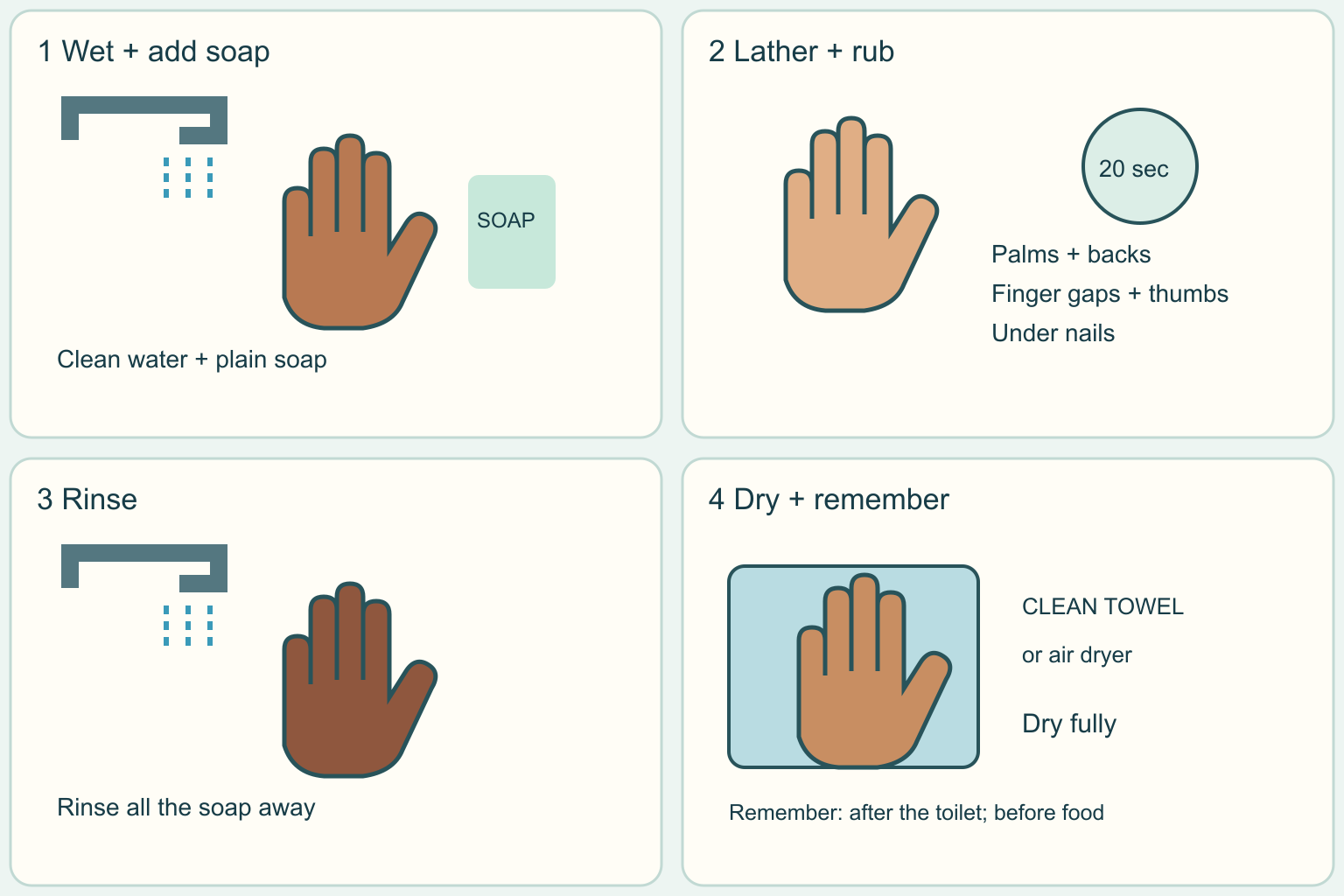
Learn a simple soap-and-water routine, including the places that are easy to miss.
Why it matters: Clean hands help reduce the spread of germs during ordinary daily life.
Written guidance reviewed: 2026-10-23 · Sources and equipment assumptions are below.
Take this guide to another device
Steps, notes, supplies, setup choices, results and check dates save on this browser as you work. Plus can also keep an account copy. Account copies update only when you choose Save; loading one replaces the browser draft shown here.
Review all saved work. Saved account check dates appear in My Day. Clear the date and save again to finish a follow-up. Email settings stay separate; existing opted-in agenda or deadline emails can include these dated actions.
Understand the job before starting
Clean hands help reduce the spread of germs during ordinary daily life.
A common mistake to avoid
No soap and water available? Use labeled hand sanitizer containing at least 60% alcohol, following its amount instructions. Spread over all hand surfaces and rub until dry; do not wipe or rinse it off early. It is less useful on visibly dirty or greasy hands and does not remove every germ or harmful chemical. Find a sink when you can. Do not make homemade sanitizer, use surface-disinfecting wipes on skin, or mix products. Keep sanitizer away from children who might swallow it.
Use what you already have. Check each item when it is ready.
Before you begin
This is an everyday routine, not treatment for an injury or chemical spill. If washing hurts or skin is badly irritated, stop and ask a health professional for advice. Follow local water-advisory instructions. Never put household disinfectants or cleaning mixtures on your skin.
0 of 4 steps checked0%
Guide progress and notes save on this browser; choose Save account copy above to carry them to another device with Plus. Downloads contain the complete blank checklist; print to include your current checks and notes.
Do it with me
Your step position saves on this browser. Use the picture when available, then check the written result.
STEP 1 OF 4
Get ready, then wet your hands
Start here: Get ready, then wet your hands
Illustration: Get ready, then wet your hands. Read the steps for your exact task.
Read-aloud is available in supported browsers; the written steps always remain available.
Check that you can reach the soap and a clean drying option.
Ask for help or an accessible sink if needed.
Use clean running water at a comfortable temperature; cold or warm is fine.
Wet both hands, turn off the tap, then add plain hand soap.
You do not need extra-hot water or a costly antibacterial soap.
Set a timer before touching the soap if you want help keeping time.
Before moving to the next step
Check this specific result: I have soap and a drying option, and both hands are wet.
If that result is not true yet, leave the box unchecked. Write what is missing in your notes; use the official instructions below when the equipment or situation differs.
STEP 1 OF 4
Get ready, then wet your hands
Start here: Get ready, then wet your hands
Illustration: Get ready, then wet your hands. Read the steps for your exact task.
Check that you can reach the soap and a clean drying option.
Ask for help or an accessible sink if needed.
Use clean running water at a comfortable temperature; cold or warm is fine.
Wet both hands, turn off the tap, then add plain hand soap.
You do not need extra-hot water or a costly antibacterial soap.
Set a timer before touching the soap if you want help keeping time.
Before moving to the next step
Check this specific result: I have soap and a drying option, and both hands are wet.
If that result is not true yet, leave the box unchecked. Write what is missing in your notes; use the official instructions below when the equipment or situation differs.
STEP 2 OF 4
Make lather and rub for 20 seconds
Start here: Make lather and rub for 20 seconds
Illustration: Make lather and rub for 20 seconds. Read the steps for your exact task.
Lather means the soapy layer made by rubbing wet, soapy hands together.
Rub both palms, then the backs of both hands.
Rub between your fingers and around your thumbs, and clean beneath your nails.
Keep rubbing with soap for at least 20 seconds.
That is one-third of a minute.
The 20 seconds is rubbing time, rather than the whole trip to the sink.
Use gentle rubbing; you do not need a harsh scrubber.
Before moving to the next step
Check this specific result: I rubbed all these areas with soap for at least 20 seconds.
If that result is not true yet, leave the box unchecked. Write what is missing in your notes; use the official instructions below when the equipment or situation differs.
STEP 3 OF 4
Rinse the soap away
Start here: Rinse the soap away
Illustration: Rinse the soap away. Read the steps for your exact task.
Turn the water back on.
Put both hands under the clean running water and rinse the soap away, including between the fingers.
Rinsing carries away the loosened dirt and germs.
A quick splash without soap and rubbing skips part of the job.
Turn off the tap.
If you are concerned about touching it again, a paper towel can help you turn it off.
Do not reach for your phone while hands are still soapy.
Before moving to the next step
Check this specific result: I rinsed all the soap away with clean running water.
If that result is not true yet, leave the box unchecked. Write what is missing in your notes; use the official instructions below when the equipment or situation differs.
STEP 4 OF 4
Dry fully and remember the next useful moment
Start here: Dry fully and remember the next useful moment
Illustration: Dry fully and remember the next useful moment. Read the steps for your exact task.
Dry both hands with a clean towel or an air dryer.
At home, change a towel when dirty and before it becomes mildewed from staying damp.
Useful times to wash include after the toilet, after handling garbage or pet waste, and around preparing or eating food.
Put a simple reminder by your sink if that helps.
A worksheet is a learning aid, not proof that your hands have no germs.
Before moving to the next step
Check this specific result: My hands are dry, and I know one daily moment to remember washing.
If that result is not true yet, leave the box unchecked. Write what is missing in your notes; use the official instructions below when the equipment or situation differs.
Pictures for this guide
Picture 1 of 4 · Get ready, then wet your hands
A tap supplies water above hands; plain soap is beside it.
For: Get ready, then wet your hands
Illustrations show examples of the actions above. Follow your equipment’s instructions.
Notes about these pictures
Check that you can reach the soap and a clean drying option. Ask for help or an accessible sink if needed. Use clean running water at a comfortable temperature; cold or warm is fine. Wet both hands, turn off the tap, then add plain hand soap. You do not need extra-hot water or a costly antibacterial soap. Set a timer before touching the soap if you want help keeping time.
This is an everyday routine, not treatment for an injury or chemical spill. If washing hurts or skin is badly irritated, stop and ask a health professional for advice. Follow local water-advisory instructions. Never put household disinfectants or cleaning mixtures on your skin.
Was this step clear?
Flag “Get ready, then wet your hands” for review. We save the guide and step identifiers with your account to limit duplicates, not your private notes.
A specific companion has not been selected for this new guide yet. You can search for related demonstrations; search results have not been reviewed by Life’s Checklists.
These YouTube videos belong to their respective creators. Life’s Checklists does not own them and is not affiliated with the creators. Links open on YouTube, where the videos are available independently of our membership.
How to use the video with this guide
Read “Before you begin” first. Watch the relevant part, pause, then return to the written step and its completion check. Use captions and playback speed if they help. A demonstration may cover only part of the task or show different equipment.
Your model’s instructions and current official guidance take priority. For urgent problems, follow the stop instructions without waiting to watch a video.
Finish the job and know what to do next.
For this guide, the final result is: My hands are dry, and I know one daily moment to remember washing.
A concrete way to approach this task
Fictional example: Jordan comes home, puts the bag down, and is about to make a sandwich. Jordan washes with soap, rubs for 20 seconds, rinses, then dries before preparing food.
What if I cannot complete a step?
No soap and water available? Use labeled hand sanitizer containing at least 60% alcohol, following its amount instructions. Spread over all hand surfaces and rub until dry; do not wipe or rinse it off early. It is less useful on visibly dirty or greasy hands and does not remove every germ or harmful chemical. Find a sink when you can. Do not make homemade sanitizer, use surface-disinfecting wipes on skin, or mix products. Keep sanitizer away from children who might swallow it.
Identify the exact step: “Get ready, then wet your hands.” Record what you tried, what happened, and which item or model you used. Ask for help with that specific problem rather than repeating an unsafe or unsuccessful action.
This is an everyday routine, not treatment for an injury or chemical spill. If washing hurts or skin is badly irritated, stop and ask a health professional for advice. Follow local water-advisory instructions. Never put household disinfectants or cleaning mixtures on your skin.
Connect this skill to everyday life
Use your school’s official calendar to collect one deadline and its required action. Separate application, registration, payment, housing, and financial-aid dates.
Admission is not course registration, and an aid estimate is not money already received. Each office may need different documents.
A useful record for this task: Record the result of “Dry fully and remember the next useful moment”: My hands are dry, and I know one daily moment to remember washing.
When finished, record the result and any next check or follow-up date. Your original step checks and notes remain on this browser.
Keep the result of your work
Finish and check every step before recording completion. You can write a draft below now.
Result: Not recorded · Next check: Not chosen
Choose a date from your own manual or situation. No email is enabled by saving this record.