Ants often come for food or water. Termites can eat wood and need a different inspection and treatment.
Why it matters: Cleaning and sealing entry points can reduce pest pressure. An ant trap is not termite protection.
Written guidance reviewed: September 17, 2026 · Sources and equipment assumptions are below.
Take this guide to another device
Steps, notes, supplies, setup choices, results and check dates save on this browser as you work. Plus can also keep an account copy. Account copies update only when you choose Save; loading one replaces the browser draft shown here.
Review all saved work. Saved account check dates appear in My Day. Clear the date and save again to finish a follow-up. Email settings stay separate; existing opted-in agenda or deadline emails can include these dated actions.
Understand the job before starting
Observation and confident pest identification are different stages.
A common mistake to avoid
Treating every insect as the same pest may leave the actual problem unresolved.
Words used in this guide
Rent
The amount paid to use someone else’s property for an agreed time. Read the example
Use what you already have. Check each item when it is ready.
Before you begin
No pesticide is automatically safe for pets. Keep bait and chemicals inaccessible. Suspected termites, stinging nests, severe infestation, or unknown insects deserve professional identification.
0 of 5 steps checked0%
Guide progress and notes save on this browser; choose Save account copy above to carry them to another device with Plus. Downloads contain the complete blank checklist; print to include your current checks and notes.
Do it with me
Your step position saves on this browser. Use the picture when available, then check the written result.
STEP 1 OF 5
Look and record before treating
Start here: Look and record before treating
Illustration: Look for termite clues. Read the steps for your exact task.
Read-aloud is available in supported browsers; the written steps always remain available.
Photograph the insect and its trail.
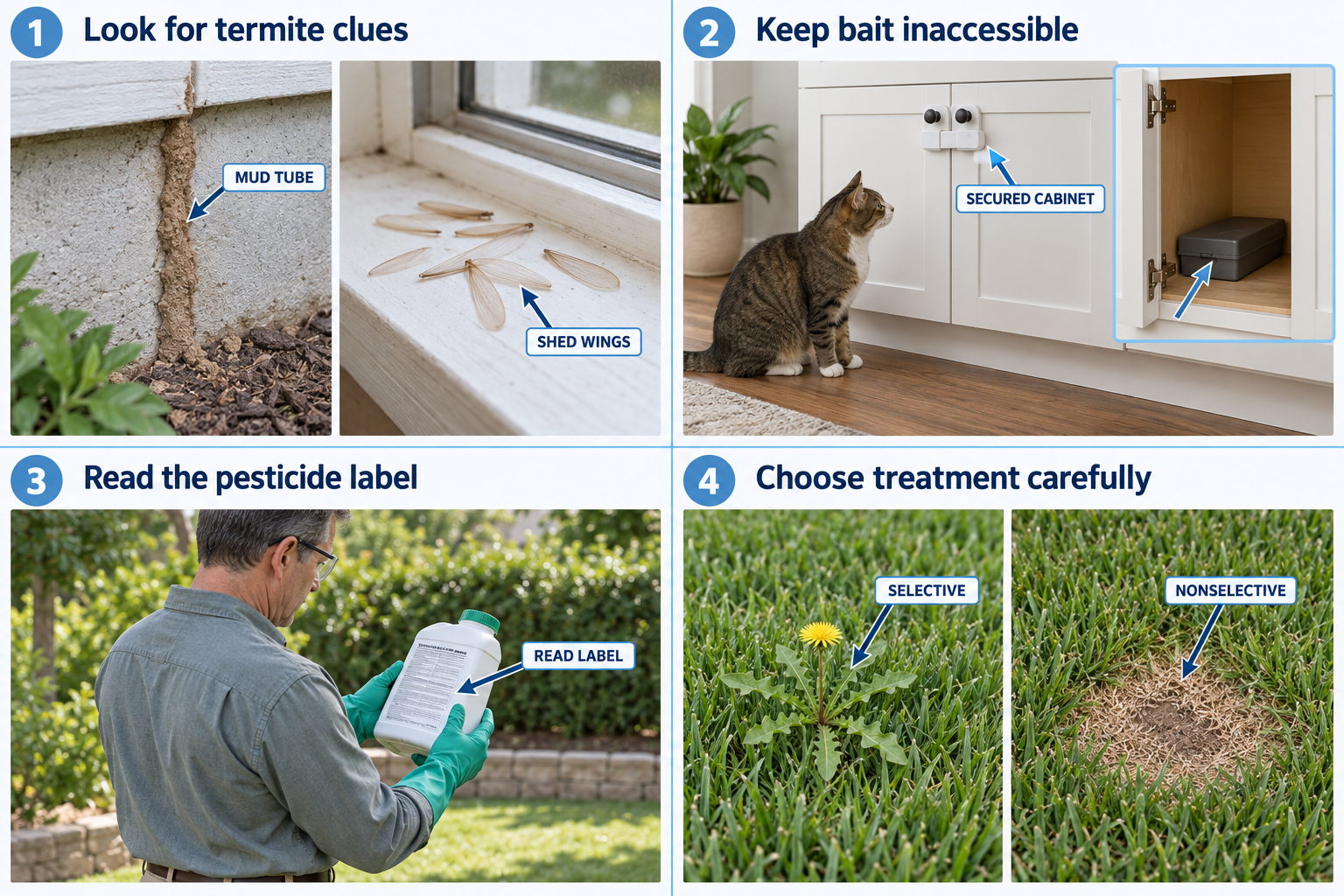
Termite warning signs can include mud tubes on foundations, discarded similar-sized wings, or damaged hollow-sounding wood.
Ants and termites can both swarm; a professional can identify them.
Do not tear open a wall to investigate.
Before moving to the next step
Check this specific result: I recorded the signs and whether inspection is needed.
If that result is not true yet, leave the box unchecked. Write what is missing in your notes; use the official instructions below when the equipment or situation differs.
STEP 1 OF 5
Look and record before treating
Start here: Look and record before treating
Illustration: Look for termite clues. Read the steps for your exact task.
Photograph the insect and its trail.
Termite warning signs can include mud tubes on foundations, discarded similar-sized wings, or damaged hollow-sounding wood.
Ants and termites can both swarm; a professional can identify them.
Do not tear open a wall to investigate.
Before moving to the next step
Check this specific result: I recorded the signs and whether inspection is needed.
If that result is not true yet, leave the box unchecked. Write what is missing in your notes; use the official instructions below when the equipment or situation differs.
STEP 2 OF 5
Remove easy food and water
Start here: Remove pest food and water.
Example: Remove pest food and water. Follow the written step.
Wipe crumbs, seal food, empty sticky trash, and repair leaks through maintenance.
Clean pet bowls after feeding.
Seal appropriate entry gaps after identification; do not block vents or drainage holes.
Before moving to the next step
Check this specific result: I removed accessible food and water.
If that result is not true yet, leave the box unchecked. Write what is missing in your notes; use the official instructions below when the equipment or situation differs.
STEP 3 OF 5
Use a labeled enclosed ant bait if appropriate
Start here: Use a labeled enclosed ant bait if appropriate
Illustration: Keep bait inaccessible. Read the steps for your exact task.
TERRO T300 liquid ant bait is one option for listed sweet-feeding ants.
Place only where its label allows and where children and pets cannot reach or chew the station.
Enclosed does not mean pet-proof.
Do not spray insecticide around bait; ants need to carry it back to the colony.
Before moving to the next step
Check this specific result: Any bait is labeled for these ants and inaccessible to pets.
If that result is not true yet, leave the box unchecked. Write what is missing in your notes; use the official instructions below when the equipment or situation differs.
STEP 4 OF 5
Monitor instead of adding more chemicals
Start here: Track whether the plan works.
Example: Track whether the plan works. Follow the written step.
Early ant activity at bait can increase.
Follow the label’s replacement and cleanup instructions and avoid moving it constantly.
If pets can reach every usable location, choose a professional plan rather than a bait on the open floor.
Before moving to the next step
Check this specific result: I have a safe monitoring plan.
If that result is not true yet, leave the box unchecked. Write what is missing in your notes; use the official instructions below when the equipment or situation differs.
STEP 5 OF 5
Call for termites or persistent problems
Start here: Get help for termites or ongoing pests.
Example: Get help for termites or ongoing pests. Follow the written step.
Ask a licensed pest professional for identification, evidence, written treatment scope, pet instructions, and follow-up.
Do not confuse a sales inspection with proof that all wood damage is active termite damage.
Before moving to the next step
Check this specific result: I know what evidence and instructions to request.
If that result is not true yet, leave the box unchecked. Write what is missing in your notes; use the official instructions below when the equipment or situation differs.
Pictures for this guide
Picture 1 of 5 · Look for termite clues
Arrows identify a mud tube on a foundation and discarded translucent wings on a sill.
For: Look and record before treating
Illustrations show examples of the actions above. Follow your equipment’s instructions.
Notes about these pictures
Photograph the insect and its trail. Termite warning signs can include mud tubes on foundations, discarded similar-sized wings, or damaged hollow-sounding wood. Ants and termites can both swarm; a professional can identify them. Do not tear open a wall to investigate.
No pesticide is automatically safe for pets. Keep bait and chemicals inaccessible. Suspected termites, stinging nests, severe infestation, or unknown insects deserve professional identification.
Was this step clear?
Flag “Look and record before treating” for review. We save the guide and step identifiers with your account to limit duplicates, not your private notes.
What to look for: This shows one ant-bait product, not termite treatment. Match the current label and keep bait inaccessible to children and pets; suspected termites need inspection.
Link details checked 2026-10-03. Video availability and equipment menus can change.
These YouTube videos belong to their respective creators. Life’s Checklists does not own them and is not affiliated with the creators. Links open on YouTube, where the videos are available independently of our membership.
How to use the video with this guide
Read “Before you begin” first. Watch the relevant part, pause, then return to the written step and its completion check. Use captions and playback speed if they help. A demonstration may cover only part of the task or show different equipment.
Your model’s instructions and current official guidance take priority. For urgent problems, follow the stop instructions without waiting to watch a video.
For this guide, the final result is: I know what evidence and instructions to request.
A concrete way to approach this task
Record what you saw, where it appeared, and when. Keep observations separate from a confident pest identification.
What if I cannot complete a step?
If signs may indicate a structural pest or the problem persists, use appropriate professional identification rather than treating every insect the same.
Identify the exact step: “Look and record before treating.” Record what you tried, what happened, and which item or model you used. Ask for help with that specific problem rather than repeating an unsafe or unsuccessful action.
No pesticide is automatically safe for pets. Keep bait and chemicals inaccessible. Suspected termites, stinging nests, severe infestation, or unknown insects deserve professional identification.
Connect this skill to everyday life
Write down the total move-in cash and monthly costs before applying. Ask which charges are required and which are optional.
Advertised rent is not necessarily the whole monthly cost. A refundable deposit still needs cash now. An application does not mean you have a signed lease.