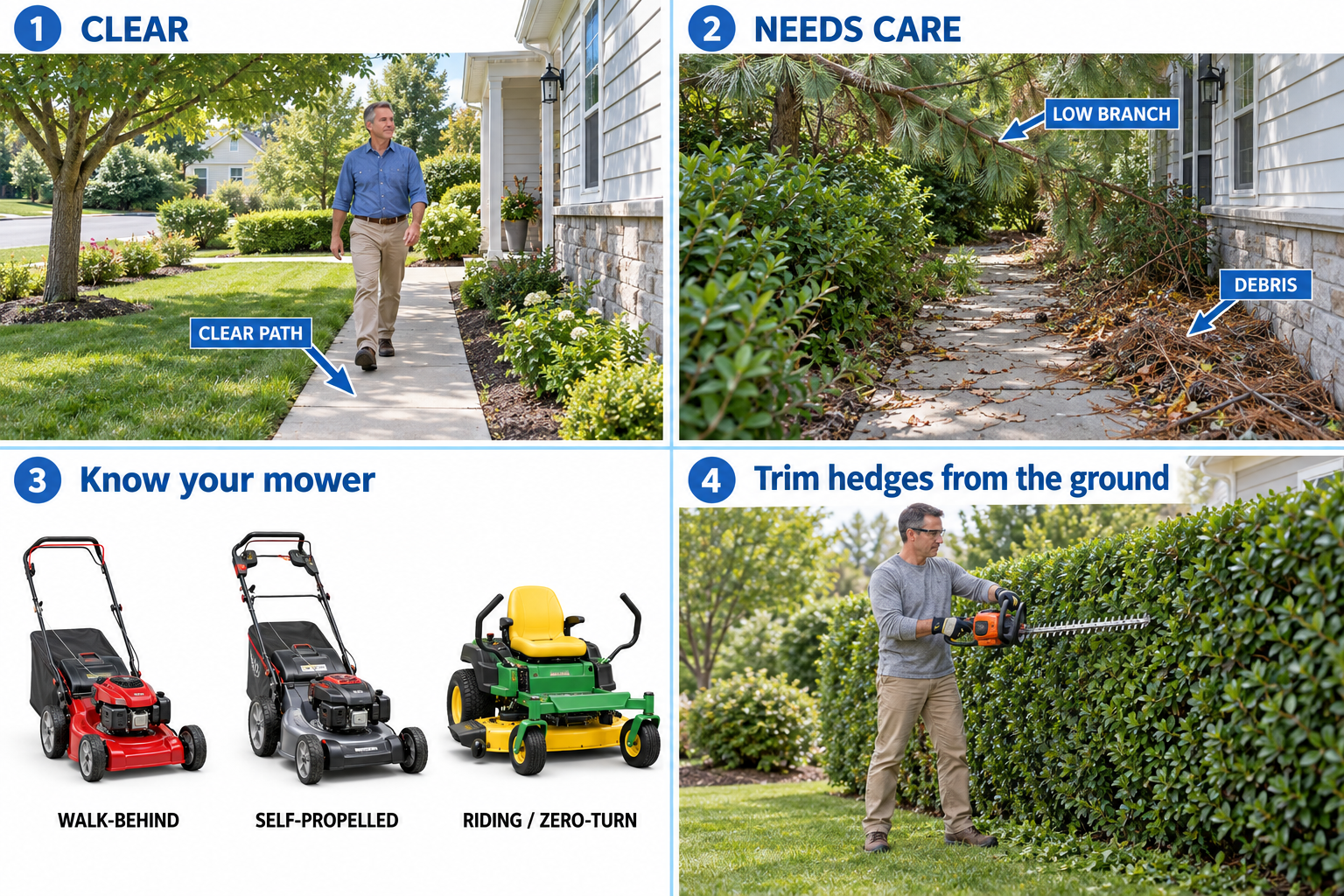
Hedge trimmers cut small soft stems. They are not saws for thick tree limbs.
Why it matters: A controlled trim can keep paths clear, but the moving blades can seriously cut fingers or throw debris.
Written guidance reviewed: September 17, 2026 · Sources and equipment assumptions are below.
Take this guide to another device
Steps, notes, supplies, setup choices, results and check dates save on this browser as you work. Plus can also keep an account copy. Account copies update only when you choose Save; loading one replaces the browser draft shown here.
Review all saved work. Saved account check dates appear in My Day. Clear the date and save again to finish a follow-up. Email settings stay separate; existing opted-in agenda or deadline emails can include these dated actions.
Understand the job before starting
Small reachable trimming and high-branch work are different tasks.
A common mistake to avoid
Extending the reach of a small task changes its safety conditions.
Use what you already have. Check each item when it is ready.
Before you begin
Work from the ground. Stop for thick limbs, ladders, hidden wire, nests, power lines, or unstable branches. Use a trained tree professional for overhead hazards.
0 of 4 steps checked0%
Guide progress and notes save on this browser; choose Save account copy above to carry them to another device with Plus. Downloads contain the complete blank checklist; print to include your current checks and notes.
Do it with me
Your step position saves on this browser. Use the picture when available, then check the written result.
STEP 1 OF 4
Check the plant and area
Start here: Inspect the work area first.
Example: Inspect the work area first. Follow the written step.
Read-aloud is available in supported browsers; the written steps always remain available.
Find the right pruning season for the plant through your local Extension office.
Check for nesting wildlife, cords, fences, and hard objects in the hedge.
Keep other people and pets away.
Before moving to the next step
Check this specific result: I checked the plant, timing, and hidden obstacles.
If that result is not true yet, leave the box unchecked. Write what is missing in your notes; use the official instructions below when the equipment or situation differs.
STEP 1 OF 4
Check the plant and area
Start here: Inspect the work area first.
Example: Inspect the work area first. Follow the written step.
Find the right pruning season for the plant through your local Extension office.
Check for nesting wildlife, cords, fences, and hard objects in the hedge.
Keep other people and pets away.
Before moving to the next step
Check this specific result: I checked the plant, timing, and hidden obstacles.
If that result is not true yet, leave the box unchecked. Write what is missing in your notes; use the official instructions below when the equipment or situation differs.
STEP 2 OF 4
Prepare the tool safely
Start here: Prepare the trimmer safely.
Example: Prepare the trimmer safely. Follow the written step.
Read the blade capacity and safety controls.
Inspect with power off and battery removed/unplugged as applicable.
Do not defeat a two-hand switch.
For corded tools, use the required outdoor-rated supply and keep the cord behind the cutting path.
Before moving to the next step
Check this specific result: The tool is suitable and its protections work.
If that result is not true yet, leave the box unchecked. Write what is missing in your notes; use the official instructions below when the equipment or situation differs.
STEP 3 OF 4
Trim with stable footing
Start here: Trim with stable footing
Illustration: Trim hedges from the ground. Read the steps for your exact task.
Stand on firm ground with both hands on the proper grips.
Keep blades away from your body and below the manual’s height limit.
Take small passes without reaching far.
Never hold a branch with one hand while cutting with the other.
Before moving to the next step
Check this specific result: I trimmed only reachable stems within the tool’s capacity.
If that result is not true yet, leave the box unchecked. Write what is missing in your notes; use the official instructions below when the equipment or situation differs.
STEP 4 OF 4
Stop fully before clearing
Start here: Stop fully before clearing debris.
Example: Stop fully before clearing debris. Follow the written step.
Release controls and wait for blades to stop.
Disconnect the energy source per the manual before clearing clippings or a jam.
Sweep paths and bag clippings.
Report low heavy branches rather than trying to remove them overhead.
Before moving to the next step
Check this specific result: The tool is isolated and clippings are cleared.
If that result is not true yet, leave the box unchecked. Write what is missing in your notes; use the official instructions below when the equipment or situation differs.
Pictures for this guide
Picture 1 of 4 · Check the plant and area
Check the plant and area: Check the plant and wildlife. Look for hidden wires and hazards.
For: Check the plant and area
Illustrations show examples of the actions above. Follow your equipment’s instructions.
Notes about these pictures
Find the right pruning season for the plant through your local Extension office. Check for nesting wildlife, cords, fences, and hard objects in the hedge. Keep other people and pets away.
Work from the ground. Stop for thick limbs, ladders, hidden wire, nests, power lines, or unstable branches. Use a trained tree professional for overhead hazards.
Was this step clear?
Flag “Check the plant and area” for review. We save the guide and step identifiers with your account to limit duplicates, not your private notes.
What to look for: See the safety-equipment portion of the task. Follow your exact trimmer’s manual and stay within safely reachable, ground-level work.
Link details checked 2026-10-03. Video availability and equipment menus can change.
These YouTube videos belong to their respective creators. Life’s Checklists does not own them and is not affiliated with the creators. Links open on YouTube, where the videos are available independently of our membership.
How to use the video with this guide
Read “Before you begin” first. Watch the relevant part, pause, then return to the written step and its completion check. Use captions and playback speed if they help. A demonstration may cover only part of the task or show different equipment.
Your model’s instructions and current official guidance take priority. For urgent problems, follow the stop instructions without waiting to watch a video.
For this guide, the final result is: The tool is isolated and clippings are cleared.
A concrete way to approach this task
Identify a small, reachable area that fits the tools and limits described in the guide. Plan where removed material will go.
What if I cannot complete a step?
A high branch or uncertain cutting task needs a different plan. Do not expand a low-level trimming task beyond the guide’s safe boundaries.
Identify the exact step: “Check the plant and area.” Record what you tried, what happened, and which item or model you used. Ask for help with that specific problem rather than repeating an unsafe or unsuccessful action.
Work from the ground. Stop for thick limbs, ladders, hidden wire, nests, power lines, or unstable branches. Use a trained tree professional for overhead hazards.
Connect this skill to everyday life
Collect the handover records and identify the home systems using the owner manuals. Start with one system or one unresolved handover item.
A warranty and an insurance policy cover different situations. Knowing where a shutoff is does not mean every repair is safe to do yourself.