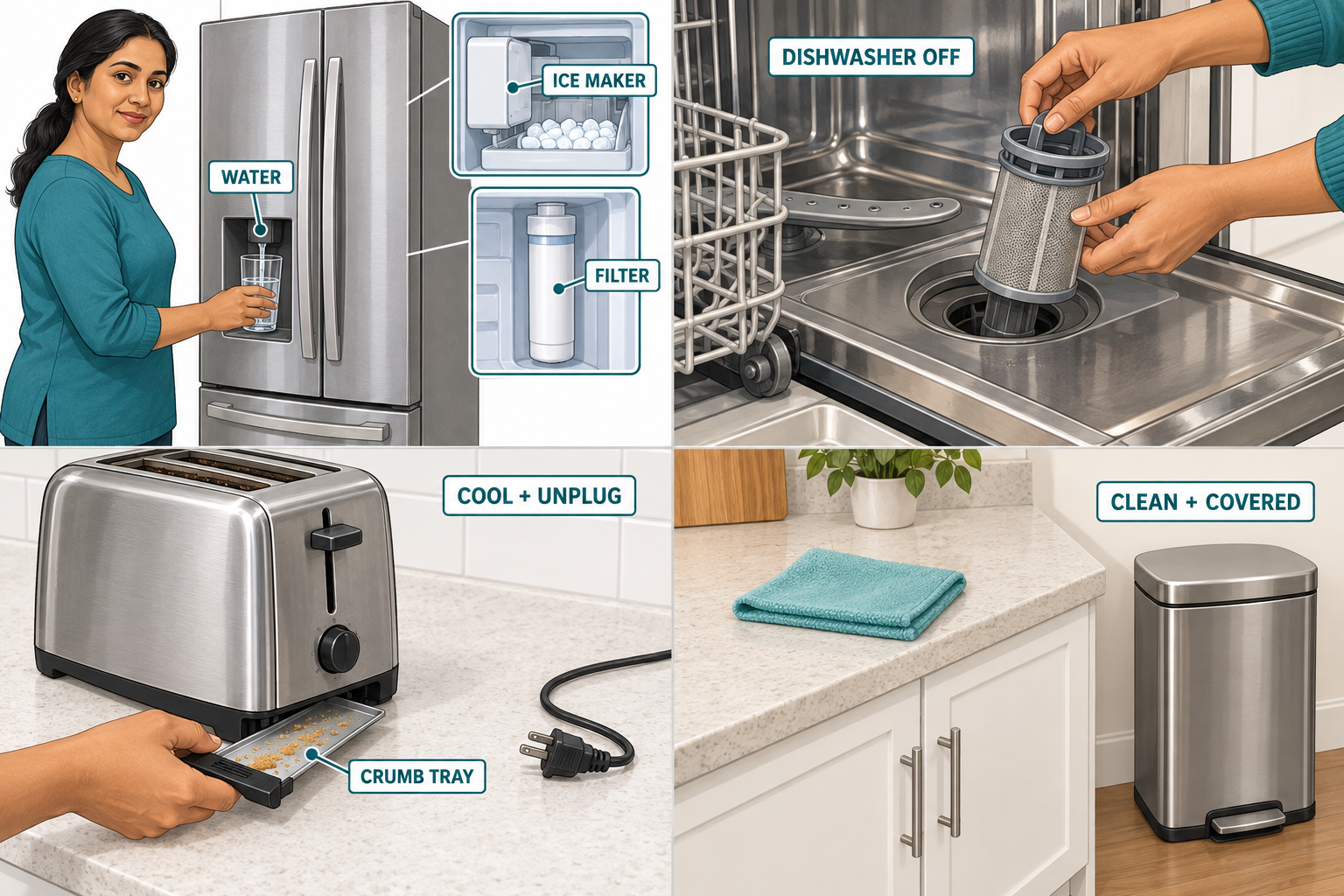
A dishwasher washes dishes using pumps, spray arms, detergent, and a drain. Many models have a removable filter; some do not.
Why it matters: Food scraps and the wrong detergent can leave odors, block flow, or cause leaks.
Written guidance reviewed: September 17, 2026 · Sources and equipment assumptions are below.
Take this guide to another device
Steps, notes, supplies, setup choices, results and check dates save on this browser as you work. Plus can also keep an account copy. Account copies update only when you choose Save; loading one replaces the browser draft shown here.
Review all saved work. Saved account check dates appear in My Day. Clear the date and save again to finish a follow-up. Email settings stay separate; existing opted-in agenda or deadline emails can include these dated actions.
Understand the job before starting
Food residue, poor washing and standing water describe different symptoms.
A common mistake to avoid
Using repeated cleaning cycles can hide an unresolved drain or service fault.
Use what you already have. Check each item when it is ready.
Before you begin
Do not reach into broken glass, open electrical panels, disconnect hoses, or use chemical drain opener. A little water in the sump may be normal; standing water above the normal level needs checking.
0 of 5 steps checked0%
Guide progress and notes save on this browser; choose Save account copy above to carry them to another device with Plus. Downloads contain the complete blank checklist; print to include your current checks and notes.
Do it with me
Your step position saves on this browser. Use the picture when available, then check the written result.
STEP 1 OF 5
Empty it and read the filter instructions
Start here: Empty it and read the filter instructions
Illustration: Dishwasher filter. Read the steps for your exact task.
Read-aloud is available in supported browsers; the written steps always remain available.
Switch it off.
Remove racks only as directed.
Find the filter in the manual, often on the tub floor.
Some filters twist out; others are not meant for user removal.
Photograph the locked position before removal.
Before moving to the next step
Check this specific result: I know whether the filter is removable.
If that result is not true yet, leave the box unchecked. Write what is missing in your notes; use the official instructions below when the equipment or situation differs.
STEP 1 OF 5
Empty it and read the filter instructions
Start here: Empty it and read the filter instructions
Illustration: Dishwasher filter. Read the steps for your exact task.
Switch it off.
Remove racks only as directed.
Find the filter in the manual, often on the tub floor.
Some filters twist out; others are not meant for user removal.
Photograph the locked position before removal.
Before moving to the next step
Check this specific result: I know whether the filter is removable.
If that result is not true yet, leave the box unchecked. Write what is missing in your notes; use the official instructions below when the equipment or situation differs.
STEP 2 OF 5
Clean approved parts gently
Start here: Clean the permitted parts gently.
Example: Clean the permitted parts gently. Follow the written step.
Lift out the filter as directed, avoiding sharp debris.
Rinse under running water with a soft brush if allowed.
Wipe the door seal and edges.
Check spray-arm holes without poking damaging metal tools into them.
Reinstall the filter until properly locked.
Before moving to the next step
Check this specific result: The filter is clean and securely locked.
If that result is not true yet, leave the box unchecked. Write what is missing in your notes; use the official instructions below when the equipment or situation differs.
STEP 3 OF 5
Run the correct cleaning cycle
Start here: Run the correct cleaning cycle.
Example: Run the correct cleaning cycle. Follow the written step.
Use only a dishwasher-compatible cleaner such as affresh when the maker permits it.
Follow whether the product needs an empty machine.
Do not add hand dish soap, bleach, vinegar, or a second cleaner to the same cycle.
Before moving to the next step
Check this specific result: I used one approved cleaner and cycle.
If that result is not true yet, leave the box unchecked. Write what is missing in your notes; use the official instructions below when the equipment or situation differs.
STEP 4 OF 5
Check a draining problem safely
Start here: Check the manual before troubleshooting.
Example: Check the manual before troubleshooting. Follow the written step.
Read the manual’s cancel/drain control; it may require holding a button for a set time.
Check accessible filter debris after turning it off.
If connected to a disposal, a blocked sink may affect drainage.
Recent installation can involve a drain connection error; maintenance should inspect it.
Before moving to the next step
Check this specific result: I used the model’s drain instructions or called maintenance.
If that result is not true yet, leave the box unchecked. Write what is missing in your notes; use the official instructions below when the equipment or situation differs.
STEP 5 OF 5
Prevent the next problem
Start here: Build a simple care routine.
Example: Build a simple care routine. Follow the written step.
Scrape large food pieces into trash, load so spray arms turn, and use the right dishwasher detergent dose.
Report repeated standing water, leaks, or errors.
Never treat a recurring leak as a normal cleaning issue.
Before moving to the next step
Check this specific result: My next filter check is on the calendar.
If that result is not true yet, leave the box unchecked. Write what is missing in your notes; use the official instructions below when the equipment or situation differs.
Pictures for this guide
Picture 1 of 5 · Dishwasher filter
An adult removes a cylindrical dishwasher filter with the appliance shown OFF.
For: Empty it and read the filter instructions
Illustrations show examples of the actions above. Follow your equipment’s instructions.
Notes about these pictures
Switch it off. Remove racks only as directed. Find the filter in the manual, often on the tub floor. Some filters twist out; others are not meant for user removal. Photograph the locked position before removal.
Do not reach into broken glass, open electrical panels, disconnect hoses, or use chemical drain opener. A little water in the sump may be normal; standing water above the normal level needs checking.
Was this step clear?
Flag “Empty it and read the filter instructions” for review. We save the guide and step identifiers with your account to limit duplicates, not your private notes.
What to look for: This shows one owner’s removable filter. Confirm your model has a user-removable filter and use its locking instructions; do not dismantle a pump.
Link details checked 2026-10-03. Video availability and equipment menus can change.
These YouTube videos belong to their respective creators. Life’s Checklists does not own them and is not affiliated with the creators. Links open on YouTube, where the videos are available independently of our membership.
How to use the video with this guide
Read “Before you begin” first. Watch the relevant part, pause, then return to the written step and its completion check. Use captions and playback speed if they help. A demonstration may cover only part of the task or show different equipment.
Your model’s instructions and current official guidance take priority. For urgent problems, follow the stop instructions without waiting to watch a video.
For this guide, the final result is: My next filter check is on the calendar.
A concrete way to approach this task
Record the model and the symptom: leftover food, poor washing, or standing water. Those descriptions help you choose the right troubleshooting section.
What if I cannot complete a step?
If the approved cleaning steps do not resolve the symptom, keep a short record of what you tried for the service contact.
Identify the exact step: “Empty it and read the filter instructions.” Record what you tried, what happened, and which item or model you used. Ask for help with that specific problem rather than repeating an unsafe or unsuccessful action.
Do not reach into broken glass, open electrical panels, disconnect hoses, or use chemical drain opener. A little water in the sump may be normal; standing water above the normal level needs checking.
Connect this skill to everyday life
Write down the total move-in cash and monthly costs before applying. Ask which charges are required and which are optional.
Advertised rent is not necessarily the whole monthly cost. A refundable deposit still needs cash now. An application does not mean you have a signed lease.