A circuit is one electrical path. One breaker may supply several rooms, or only part of a room.
Why it matters: Clear labels help you ask for help and shut down a known circuit when needed.
Written guidance reviewed: September 17, 2026 · Sources and equipment assumptions are below.
Take this guide to another device
Steps, notes, supplies, setup choices, results and check dates save on this browser as you work. Plus can also keep an account copy. Account copies update only when you choose Save; loading one replaces the browser draft shown here.
Review all saved work. Saved account check dates appear in My Day. Clear the date and save again to finish a follow-up. Email settings stay separate; existing opted-in agenda or deadline emails can include these dated actions.
Understand the job before starting
A room label records what a circuit serves; it does not diagnose an electrical fault.
A common mistake to avoid
An unclear label is not a reason to access unsafe parts of a panel.
Use what you already have. Check each item when it is ready.
Before you begin
Keep the panel cover screwed in place. Stop for water, heat, burning smell, sparks, rust, buzzing, damaged covers, or medical equipment affected by power loss. Older fuse panels and unlabeled hazards need an electrician.
0 of 5 steps checked0%
Guide progress and notes save on this browser; choose Save account copy above to carry them to another device with Plus. Downloads contain the complete blank checklist; print to include your current checks and notes.
Do it with me
Your step position saves on this browser. Use the picture when available, then check the written result.
STEP 1 OF 5
Locate the closed panel
Start here: Locate the closed panel
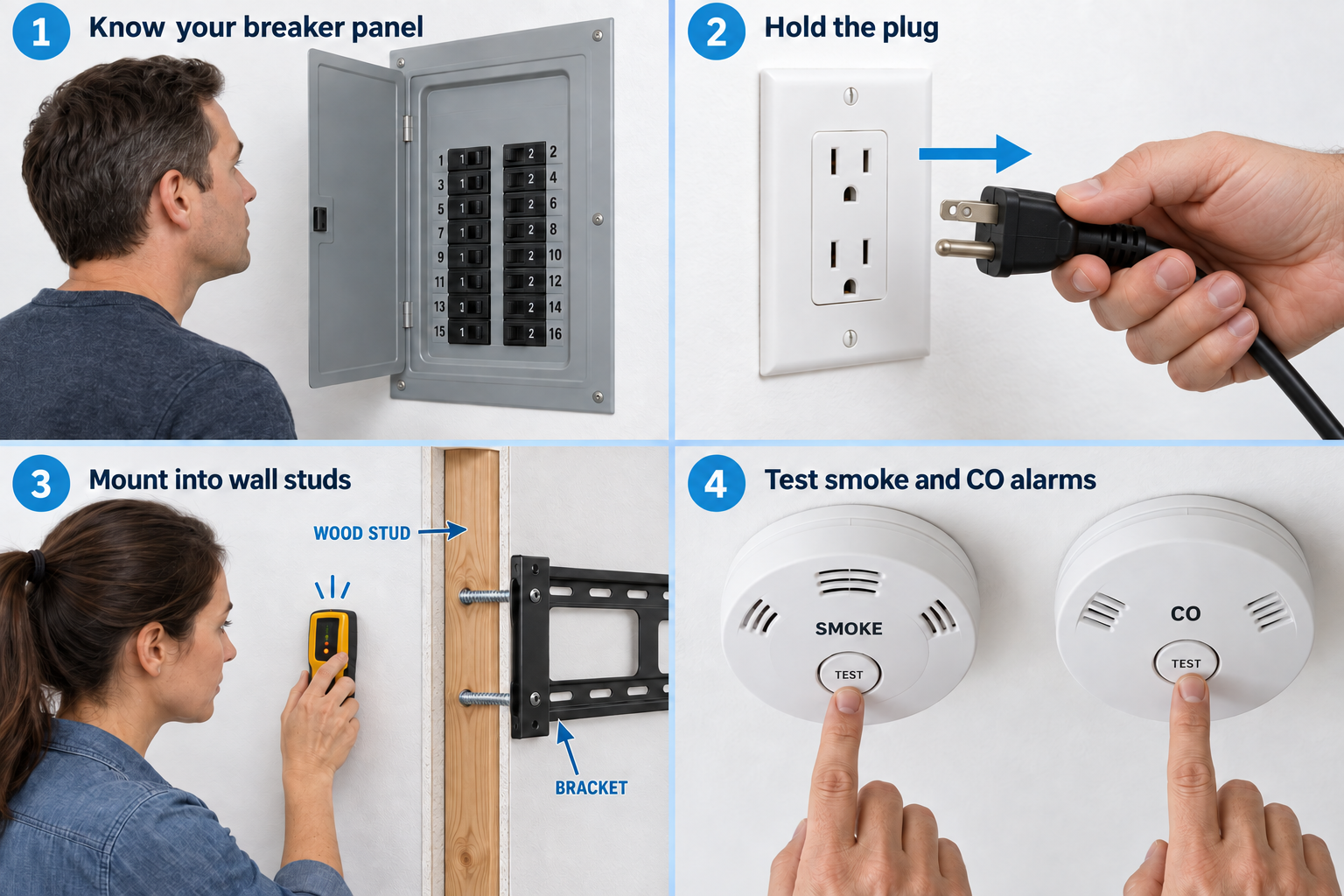
Illustration: Know your breaker panel. Read the steps for your exact task.
Read-aloud is available in supported browsers; the written steps always remain available.
Check a utility area, garage, hallway, basement, or closet allowed by local rules.
Ask the landlord if locked or shared.
Open only the hinged door meant for users; never remove the metal cover or touch wires.
Keep the access path clear.
Before moving to the next step
Check this specific result: I found safe access to the closed-cover panel.
If that result is not true yet, leave the box unchecked. Write what is missing in your notes; use the official instructions below when the equipment or situation differs.
STEP 1 OF 5
Locate the closed panel
Start here: Locate the closed panel
Illustration: Know your breaker panel. Read the steps for your exact task.
Check a utility area, garage, hallway, basement, or closet allowed by local rules.
Ask the landlord if locked or shared.
Open only the hinged door meant for users; never remove the metal cover or touch wires.
Keep the access path clear.
Before moving to the next step
Check this specific result: I found safe access to the closed-cover panel.
If that result is not true yet, leave the box unchecked. Write what is missing in your notes; use the official instructions below when the equipment or situation differs.
STEP 2 OF 5
Prepare people and equipment
Start here: Prepare the household first.
Example: Prepare the household first. Follow the written step.
Tell everyone there will be brief power interruptions.
Save computer work and switch off sensitive equipment.
Plan around refrigerators, alarms, internet, and medical devices.
If someone depends on power, have an electrician plan the work.
Before moving to the next step
Check this specific result: Everyone is ready and no essential care is interrupted.
If that result is not true yet, leave the box unchecked. Write what is missing in your notes; use the official instructions below when the equipment or situation differs.
STEP 3 OF 5
Test one normal branch breaker at a time
Start here: Follow the safe testing limits.
Example: Follow the safe testing limits. Follow the written step.
With dry hands and a dry floor, use only the normal handle of a breaker you can safely access.
Have your helper watch a lamp plugged into an ordinary outlet.
Switch that breaker OFF, note which lights/outlets stop, then switch it back ON before checking the next.
Do not use this as proof wiring is safe to touch.
Before moving to the next step
Check this specific result: I tested one circuit at a time without opening the panel.
If that result is not true yet, leave the box unchecked. Write what is missing in your notes; use the official instructions below when the equipment or situation differs.
STEP 4 OF 5
Label exact places
Start here: Label the places you verified.
Example: Label the places you verified. Follow the written step.
Write “kitchen counter left of sink” rather than just “kitchen.” Check each outlet and light you want on the map.
A room can use several breakers.
An electrician can trace circuits you cannot safely identify.
Before moving to the next step
Check this specific result: My map lists specific outlets and lights.
If that result is not true yet, leave the box unchecked. Write what is missing in your notes; use the official instructions below when the equipment or situation differs.
STEP 5 OF 5
Know a safe reset limit
Start here: Know when to stop resetting.
Example: Know when to stop resetting. Follow the written step.
A tripped breaker may sit between ON and OFF.
After unplugging the likely overload, follow panel instructions to move it fully OFF then ON once.
If it trips again, will not reset, or you do not know why, leave it off and call for help.
The main breaker can leave incoming parts energized.
Before moving to the next step
Check this specific result: I know to stop after a repeated trip.
If that result is not true yet, leave the box unchecked. Write what is missing in your notes; use the official instructions below when the equipment or situation differs.
Pictures for this guide
Picture 1 of 5 · Know your breaker panel
An adult observes numbered breaker switches with the protective deadfront cover intact.
For: Locate the closed panel
Illustrations show examples of the actions above. Follow your equipment’s instructions.
Notes about these pictures
Check a utility area, garage, hallway, basement, or closet allowed by local rules. Ask the landlord if locked or shared. Open only the hinged door meant for users; never remove the metal cover or touch wires. Keep the access path clear.
Keep the panel cover screwed in place. Stop for water, heat, burning smell, sparks, rust, buzzing, damaged covers, or medical equipment affected by power loss. Older fuse panels and unlabeled hazards need an electrician.
Was this step clear?
Flag “Locate the closed panel” for review. We save the guide and step identifiers with your account to limit duplicates, not your private notes.
Link details checked 2026-10-03. Video availability and equipment menus can change.
These YouTube videos belong to their respective creators. Life’s Checklists does not own them and is not affiliated with the creators. Links open on YouTube, where the videos are available independently of our membership.
How to use the video with this guide
Read “Before you begin” first. Watch the relevant part, pause, then return to the written step and its completion check. Use captions and playback speed if they help. A demonstration may cover only part of the task or show different equipment.
Your model’s instructions and current official guidance take priority. For urgent problems, follow the stop instructions without waiting to watch a video.
For this guide, the final result is: I know to stop after a repeated trip.
A concrete way to approach this task
A useful map says which labeled room or outlet loses power during an approved mapping step. Keep the labels clear to everyone in the home.
What if I cannot complete a step?
Do not guess when a circuit or control is unclear. Follow the guide’s electrical boundaries and get qualified help for faults or unsafe access.
Identify the exact step: “Locate the closed panel.” Record what you tried, what happened, and which item or model you used. Ask for help with that specific problem rather than repeating an unsafe or unsuccessful action.
Keep the panel cover screwed in place. Stop for water, heat, burning smell, sparks, rust, buzzing, damaged covers, or medical equipment affected by power loss. Older fuse panels and unlabeled hazards need an electrician.
Connect this skill to everyday life
Write down the total move-in cash and monthly costs before applying. Ask which charges are required and which are optional.
Advertised rent is not necessarily the whole monthly cost. A refundable deposit still needs cash now. An application does not mean you have a signed lease.