Travel & Packing resources
Plain-English explanations, worked math, and what it means for you.
You can start with the basics.
Learn the words, follow the numbers, and understand what a choice could mean for your life. Start with the first action. Open examples and explanations when you need them, then continue in the related tool.
Your first useful action
Confirm the itinerary, booking conditions, and documents required for your own destination before packing. Make one accessible travel summary.
A worked example
A summary can list transport departure time, arrival address, booking-reference storage location, luggage allowance, and the verified contact for a delay.
What people often mix up
A booking confirmation does not establish entry eligibility or guarantee every connection. Different journeys can have different document and baggage requirements.
What to ask when you are stuck
“What documents, arrival time, baggage limits, and change conditions apply to this exact booking?”
Ask the organization or person responsible for the decision. Write down the answer, date, and any next action. If their answer uses an unfamiliar word, find it in Words explained below.
How to know this first action is finished
You know the requirements for this itinerary and can find the next contact or document without opening every email.
Check one travel connection
- Write the actual departure, arrival, required documents and next transport details for your itinerary.
- Read luggage, arrival-time and change conditions from the actual providers.
- Save the important details in a readable file and test that it opens offline.
Check your result: You can find the next address and contact even when a web link will not load.
If something changes
After a change, update the saved summary and reconfirm affected connections instead of keeping contradictory versions.
Practical how-to guides
Start with one useful skill. Clear instructions and a checklist help you through it.
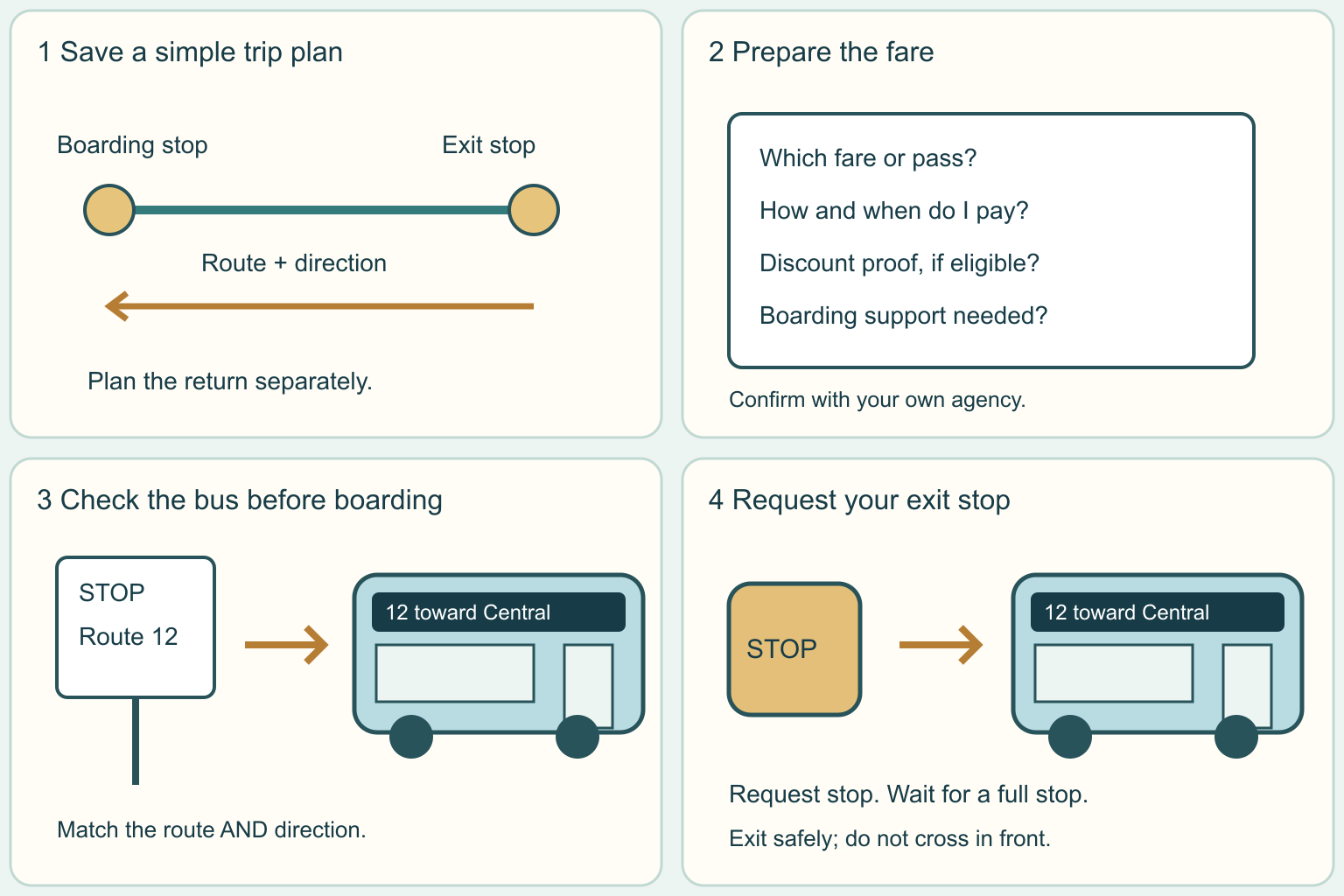
Plan and take your first local bus ride
Find the right stop, check the fare, board the right bus, and get off at your planned stop.
4 clear steps · checklist & downloadOrganize a disrupted trip and follow-up request
Separate immediate travel arrangements from later requests.
4 clear steps · checklist & downloadCheck tire pressure while the tires are cold
Read the vehicle’s pressure label, measure each tire, and adjust only to the specified value.
4 clear steps · checklist & download · YouTube companionReplace wiper blades that fit your vehicle
Identify the correct blades and connector, replace one at a time, and test on a wet windshield.
4 clear steps · checklist & download · YouTube companionWhat to bring
Prepare for the exact traveler, route, and booking rather than a generic packing list.
Prepare the items that apply to your task. For an appointment or application, confirm the receiving organization’s exact requirements. “Ready” means you have reviewed and prepared the item.
Confirmed itinerary and provider rules
Why you may need it
Defines where, when, and how you are traveling.
Where to get it
Your actual booking and official provider pages.
Check before you go
Check each segment’s baggage and timing rules.
Required documents in secure storage
Why you may need it
Supports identification or entry where required.
Where to get it
The appropriate official issuing office and destination instructions.
Check before you go
Confirm validity and requirements for each traveler; keep sensitive copies out of notes.
Packing list and offline addresses
Why you may need it
Keeps essentials and route information accessible.
Where to get it
Your planned activities and confirmed accommodation details.
Check before you go
Test offline access and measure packed bags.
0 of 3 reviewed and prepared. These ticks save in this browser only.
A question you can read aloud
“What must be ready before paying, and what must be ready before departure?”
Keep actual documents in a secure place. Do not put Social Security numbers, full account or ID numbers, passwords, or document images into My Vault notes.
Words, in plain English
17 terms in Travel & Packing · Open any word to learn more.
Accessibility requestA request for assistance or arrangements suited to a traveler’s needs.
How it works
Contact the actual provider early and confirm what it can supply.
A small example
A traveler asks about step-free access and transfer assistance for the specific route.
Start here, one step at a time
- Use the policy and details for your exact itinerary.
- Contact the actual provider early and confirm what it can supply.
- Where and when will the agreed assistance meet me?
Try explaining this word yourself
Before looking back, explain “Accessibility request” in your own words. Which part of the example shows it?
Then compare your explanation with “A request for assistance or arrangements suited to a traveler’s needs.” and the example above. If it is still unclear, use the question below with the relevant office or provider.
A question you can ask
“Where and when will the agreed assistance meet me?”
TSA: Travel checklist (opens a new tab)Baggage allowanceThe quantity and limits of luggage included or permitted.
How it works
Number, dimensions, weight, and route may all matter.
A small example
Two small bags do not automatically replace one allowed bag.
Start here, one step at a time
- Use the policy and details for your exact itinerary.
- Number, dimensions, weight, and route may all matter.
- What allowance applies to every segment of this ticket?
Try explaining this word yourself
Before looking back, explain “Baggage allowance” in your own words. Which part of the example shows it?
Then compare your explanation with “The quantity and limits of luggage included or permitted.” and the example above. If it is still unclear, use the question below with the relevant office or provider.
A question you can ask
“What allowance applies to every segment of this ticket?”
TSA: Travel checklist (opens a new tab)Booking referenceA provider’s code for finding a reservation.
How it works
Keep it with the provider name and exact traveler details in protected records.
A small example
An airline and a hotel issue different reference codes for the same trip.
Start here, one step at a time
- Use the policy and details for your exact itinerary.
- Keep it with the provider name and exact traveler details in protected records.
- Which provider issued this reference?
Try explaining this word yourself
Before looking back, explain “Booking reference” in your own words. Which part of the example shows it?
Then compare your explanation with “A provider’s code for finding a reservation.” and the example above. If it is still unclear, use the question below with the relevant office or provider.
A question you can ask
“Which provider issued this reference?”
TSA: Travel checklist (opens a new tab)Cancellation windowThe stated period when a cancellation has particular terms.
How it works
Record the deadline, time zone, channel, and any fee.
A small example
A room canceled after its deadline may incur a charge under the booking terms.
Start here, one step at a time
- Use the policy and details for your exact itinerary.
- Record the deadline, time zone, channel, and any fee.
- Which local time applies to the deadline?
Try explaining this word yourself
Before looking back, explain “Cancellation window” in your own words. Which part of the example shows it?
Then compare your explanation with “The stated period when a cancellation has particular terms.” and the example above. If it is still unclear, use the question below with the relevant office or provider.
A question you can ask
“Which local time applies to the deadline?”
TSA: Travel checklist (opens a new tab)Carry-on bagA bag kept in the passenger cabin when the carrier permits it.
How it works
Follow each carrier’s size, weight, and item rules.
A small example
A bag that fits one airline’s limit may not fit a smaller carrier’s rule.
Start here, one step at a time
- Use the policy and details for your exact itinerary.
- Follow each carrier’s size, weight, and item rules.
- Does this ticket include this bag size?
Try explaining this word yourself
Before looking back, explain “Carry-on bag” in your own words. Which part of the example shows it?
Then compare your explanation with “A bag kept in the passenger cabin when the carrier permits it.” and the example above. If it is still unclear, use the question below with the relevant office or provider.
A question you can ask
“Does this ticket include this bag size?”
TSA: Travel checklist (opens a new tab)Check-in windowThe period when a provider permits or requires check-in.
How it works
Use the actual provider’s cutoff; it differs from the departure time.
A small example
A flight departing at 10:00 may stop accepting checked bags earlier.
Start here, one step at a time
- Use the policy and details for your exact itinerary.
- Use the actual provider’s cutoff; it differs from the departure time.
- What is the cutoff for this airport and ticket?
Try explaining this word yourself
Before looking back, explain “Check-in window” in your own words. Which part of the example shows it?
Then compare your explanation with “The period when a provider permits or requires check-in.” and the example above. If it is still unclear, use the question below with the relevant office or provider.
A question you can ask
“What is the cutoff for this airport and ticket?”
TSA: Travel checklist (opens a new tab)Checked baggageLuggage handed to the carrier for transport outside your immediate possession.
How it works
Check fees, weight limits, item restrictions, and collection arrangements.
A small example
A checked bag is tagged at departure and collected at the relevant arrival point.
Start here, one step at a time
- Use the policy and details for your exact itinerary.
- Check fees, weight limits, item restrictions, and collection arrangements.
- Do I need to collect and recheck it during a connection?
Try explaining this word yourself
Before looking back, explain “Checked baggage” in your own words. Which part of the example shows it?
Then compare your explanation with “Luggage handed to the carrier for transport outside your immediate possession.” and the example above. If it is still unclear, use the question below with the relevant office or provider.
A question you can ask
“Do I need to collect and recheck it during a connection?”
TSA: Travel checklist (opens a new tab)Connection bufferTime reserved between travel segments.
How it works
Allow for transfer distance, check-in, screening, and possible delays.
A small example
A connection across different terminals needs more planning than changing nearby gates.
Start here, one step at a time
- Use the policy and details for your exact itinerary.
- Allow for transfer distance, check-in, screening, and possible delays.
- If the first leg is late, who is responsible for the next booking?
Try explaining this word yourself
Before looking back, explain “Connection buffer” in your own words. Which part of the example shows it?
Then compare your explanation with “Time reserved between travel segments.” and the example above. If it is still unclear, use the question below with the relevant office or provider.
A question you can ask
“If the first leg is late, who is responsible for the next booking?”
TSA: Travel checklist (opens a new tab)Fare conditionsThe rules attached to a particular ticket price.
How it works
Change, cancellation, baggage, and seating rules can differ within one provider.
A small example
A cheaper fare may charge for a bag another fare includes.
Start here, one step at a time
- Use the policy and details for your exact itinerary.
- Change, cancellation, baggage, and seating rules can differ within one provider.
- What changes or refunds are allowed on this exact fare?
Try explaining this word yourself
Before looking back, explain “Fare conditions” in your own words. Which part of the example shows it?
Then compare your explanation with “The rules attached to a particular ticket price.” and the example above. If it is still unclear, use the question below with the relevant office or provider.
A question you can ask
“What changes or refunds are allowed on this exact fare?”
TSA: Travel checklist (opens a new tab)ItineraryThe ordered plan for a journey.
How it works
Include dates, local times, locations, and connections.
A small example
An arrival time is followed by the trip from the airport to the accommodation.
Start here, one step at a time
- Use the policy and details for your exact itinerary.
- Include dates, local times, locations, and connections.
- Are these times shown in the destination’s local time?
Try explaining this word yourself
Before looking back, explain “Itinerary” in your own words. Which part of the example shows it?
Then compare your explanation with “The ordered plan for a journey.” and the example above. If it is still unclear, use the question below with the relevant office or provider.
A question you can ask
“Are these times shown in the destination’s local time?”
TSA: Travel checklist (opens a new tab)Local timeThe time used at a particular place.
How it works
Check time zones and dates on departure and arrival information.
A small example
An overnight trip can arrive on the next calendar day.
Start here, one step at a time
- Use the policy and details for your exact itinerary.
- Check time zones and dates on departure and arrival information.
- Does my calendar event use the correct destination time zone?
Try explaining this word yourself
Before looking back, explain “Local time” in your own words. Which part of the example shows it?
Then compare your explanation with “The time used at a particular place.” and the example above. If it is still unclear, use the question below with the relevant office or provider.
A question you can ask
“Does my calendar event use the correct destination time zone?”
TSA: Travel checklist (opens a new tab)Offline copyInformation saved so it can be opened without a connection.
How it works
Download it ahead of time and test access without exposing private details.
A small example
An offline address lets you find the hotel when roaming is unavailable.
Start here, one step at a time
- Use the policy and details for your exact itinerary.
- Download it ahead of time and test access without exposing private details.
- Can I open it with the network turned off?
Try explaining this word yourself
Before looking back, explain “Offline copy” in your own words. Which part of the example shows it?
Then compare your explanation with “Information saved so it can be opened without a connection.” and the example above. If it is still unclear, use the question below with the relevant office or provider.
A question you can ask
“Can I open it with the network turned off?”
TSA: Travel checklist (opens a new tab)Packing inventoryA list of items deliberately included in a bag.
How it works
Match quantities to activities and check restrictions before closing the bag.
A small example
Four planned shirts replace packing a random pile for a two-night trip.
Start here, one step at a time
- Use the policy and details for your exact itinerary.
- Match quantities to activities and check restrictions before closing the bag.
- Which item is essential and which is only a duplicate?
Try explaining this word yourself
Before looking back, explain “Packing inventory” in your own words. Which part of the example shows it?
Then compare your explanation with “A list of items deliberately included in a bag.” and the example above. If it is still unclear, use the question below with the relevant office or provider.
A question you can ask
“Which item is essential and which is only a duplicate?”
TSA: Travel checklist (opens a new tab)Personal itemA smaller cabin item defined by the carrier’s policy.
How it works
Often intended for the space under the seat, subject to its dimensions.
A small example
A small backpack may qualify when it fits the carrier’s stated limit.
Start here, one step at a time
- Use the policy and details for your exact itinerary.
- Often intended for the space under the seat, subject to its dimensions.
- Does my fare allow this in addition to a carry-on?
Try explaining this word yourself
Before looking back, explain “Personal item” in your own words. Which part of the example shows it?
Then compare your explanation with “A smaller cabin item defined by the carrier’s policy.” and the example above. If it is still unclear, use the question below with the relevant office or provider.
A question you can ask
“Does my fare allow this in addition to a carry-on?”
TSA: Travel checklist (opens a new tab)Refundable bookingA booking that permits a refund under defined conditions.
How it works
Read exclusions and timing instead of treating the word as unconditional.
A small example
A refundable room can still have a deadline or no-show condition.
Start here, one step at a time
- Use the policy and details for your exact itinerary.
- Read exclusions and timing instead of treating the word as unconditional.
- Are all fees refundable and how is the refund requested?
Try explaining this word yourself
Before looking back, explain “Refundable booking” in your own words. Which part of the example shows it?
Then compare your explanation with “A booking that permits a refund under defined conditions.” and the example above. If it is still unclear, use the question below with the relevant office or provider.
A question you can ask
“Are all fees refundable and how is the refund requested?”
TSA: Travel checklist (opens a new tab)RoamingUsing a mobile network outside your provider’s usual network arrangements.
How it works
Read plan coverage, charges, and activation requirements before travel.
A small example
A phone can connect abroad while incurring charges absent from a domestic plan.
Start here, one step at a time
- Use the policy and details for your exact itinerary.
- Read plan coverage, charges, and activation requirements before travel.
- What does my plan charge for data, calls, and texts at this destination?
Try explaining this word yourself
Before looking back, explain “Roaming” in your own words. Which part of the example shows it?
Then compare your explanation with “Using a mobile network outside your provider’s usual network arrangements.” and the example above. If it is still unclear, use the question below with the relevant office or provider.
A question you can ask
“What does my plan charge for data, calls, and texts at this destination?”
TSA: Travel checklist (opens a new tab)Travel contingencyMoney or a plan reserved for a disruption.
How it works
Decide what it covers and keep it accessible without relying on uncertain credit.
A small example
A reserved amount can cover a replacement local bus journey.
Start here, one step at a time
- Use the policy and details for your exact itinerary.
- Decide what it covers and keep it accessible without relying on uncertain credit.
- Which interruption would I struggle to handle today?
Try explaining this word yourself
Before looking back, explain “Travel contingency” in your own words. Which part of the example shows it?
Then compare your explanation with “Money or a plan reserved for a disruption.” and the example above. If it is still unclear, use the question below with the relevant office or provider.
A question you can ask
“Which interruption would I struggle to handle today?”
TSA: Travel checklist (opens a new tab)What this means for you
A journey is a chain of arrangements; a late first leg can affect what comes next.
What can make it harder
Separate tickets, tight transfers, and late arrival can create additional costs.
What can help
Read the provider’s terms and retain a realistic backup route and contact method.
One next stepWrite what you would do if the first travel segment arrived late.
Calculate a complete two-night trip
All amounts are invented and already include applicable taxes.
Add fixed trip costs
$180 transport + 2 × $90 lodging = $360.
Add daily and local costs
$360 + 3 × $25 food + $30 local transport = $465.
Reserve a contingency
$465 + $60 set aside = $525 total available money needed.
What the answer tells youReserved money is not an extra booking charge, but it still needs to be available.
Go a little deeper
Open a lesson when you need the full explanation. You can return to it at any time.
Build a trip plan that survives a changeUse confirmed arrangements, clear costs, and accessible records from booking through return.
Compare the entire journey
Write dates, travelers, and the destination before comparing prices. Add accommodation, luggage, local travel, and required charges to the main ticket cost. Check whether a cheaper arrival time creates an additional night or an expensive transfer.
Read the actual fare and room conditions, including cancellation deadlines and time zones. Keep pending arrangements labeled as pending. A saved search result is not a confirmed booking, and one provider’s reference does not prove another reservation is complete.
Check each person and each segment
Use official guidance for documents, destination entry, and transport rules that apply to each traveler. Requirements can differ by citizenship, age, route, or connection. Start any necessary application early and verify the correct process with the issuing authority.
Compare baggage rules across all carriers in the itinerary. Check restricted items directly and ask about anything unclear. Do not assume a bag accepted on the first segment is automatically included or permitted on the next one.
Pack and test your information
Start with empty bags and choose items for the actual activities and weather. Keep permitted essentials accessible. Measure or weigh the packed bag according to the carrier’s method instead of judging it by appearance.
Save addresses and relevant confirmations securely for offline use and test them without a connection. Follow the provider’s ticket or boarding-pass instructions separately; a screenshot is not a universal substitute. Keep a realistic fallback for getting to the accommodation if mobile data fails.
Plan for disruption and close the loop
Identify the official provider contacts and what to do if the first segment is delayed. A separate booking may have different protection from a through itinerary, so read its terms rather than assuming a missed connection will be handled automatically. Set aside a realistic contingency where possible.
On return, compare final charges with agreements, save any needed receipts, unpack perishables and damp items, and update the packing list based on experience. Delete unnecessary sensitive trip copies from shared locations. A brief review makes the next trip easier without keeping every old detail forever.
Check your understanding
- Explain the main idea of “Build a trip plan that survives a change” without looking back.
- Choose one example above and identify its assumptions or requirements.
- Write the next question you would ask about your own situation.
Official sources & next places to go
TSA: Travel checklist (opens a new tab)Useful places to start
- TSA travel checklist (opens a new tab)
Check current screening and packing guidance for U.S. flights.
- Before you go abroad (opens a new tab)
Check the destination and document information for international travel.
Ready for one small action?
Go back to your path. Each stage has instructions, questions to ask, and a checklist.
U.S. starting points · Foundation references reviewed September 17, 2026; expanded content added September 19, 2026. Examples use invented amounts unless stated otherwise. Requirements, rates, and policies vary; use the linked official sources and the terms that apply to you.
Use notes for plans and reminders. Keep passwords, account numbers, and sensitive documents in a secure storage service.