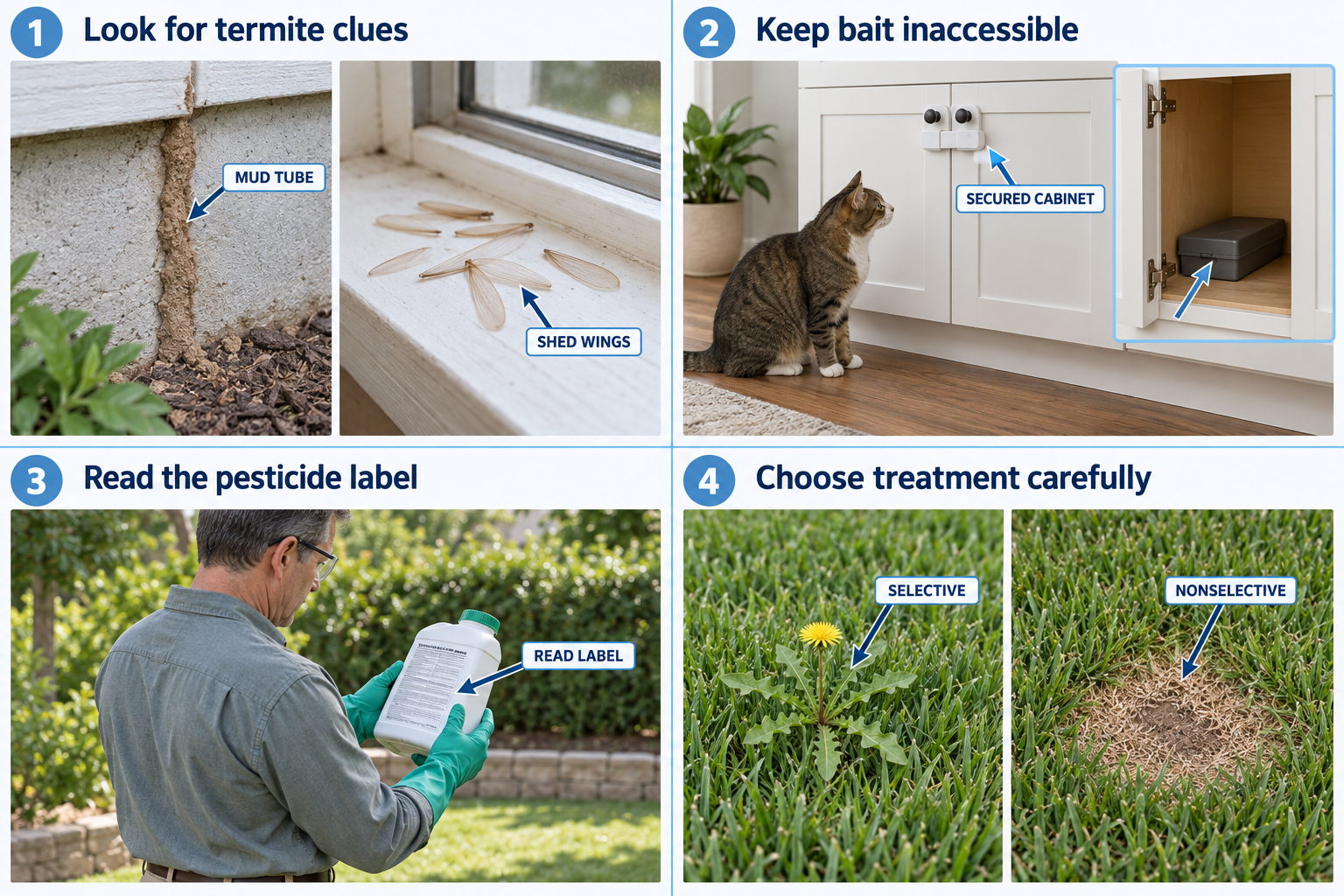
A weed is a plant growing where you do not want it. A selective herbicide targets certain plants; a nonselective herbicide can injure many plants, including lawn grass.
Why it matters: The wrong product can kill the lawn or garden you wanted to protect. Labels, not phrases like “all-killer,” determine what it does.
Written guidance reviewed: September 17, 2026 · Sources and equipment assumptions are below.
Take this guide to another device
Steps, notes, supplies, setup choices, results and check dates save on this browser as you work. Plus can also keep an account copy. Account copies update only when you choose Save; loading one replaces the browser draft shown here.
Review all saved work. Saved account check dates appear in My Day. Clear the date and save again to finish a follow-up. Email settings stay separate; existing opted-in agenda or deadline emails can include these dated actions.
Understand the job before starting
Plant identification and the exact product label come before any application decision.
A common mistake to avoid
Similar product names do not prove matching permitted uses or directions.
Use what you already have. Check each item when it is ready.
Before you begin
Keep people and pets away for the label’s interval. Do not spray near food, water, desired plants, or in wind contrary to the label. Never mix products or increase the dose.
0 of 5 steps checked0%
Guide progress and notes save on this browser; choose Save account copy above to carry them to another device with Plus. Downloads contain the complete blank checklist; print to include your current checks and notes.
Do it with me
Your step position saves on this browser. Use the picture when available, then check the written result.
STEP 1 OF 5
Identify the plant first
Start here: Identify the weed first.
Example: Identify the weed first. Follow the written step.
Read-aloud is available in supported browsers; the written steps always remain available.
Take a clear photo of leaves, stems, and flowers.
Use your local university Extension service to identify it.
Some lawn weeds signal thin turf, compacted soil, or watering problems.
Hand pulling or mulching may solve a small patch.
Before moving to the next step
Check this specific result: I know what plant I am removing.
If that result is not true yet, leave the box unchecked. Write what is missing in your notes; use the official instructions below when the equipment or situation differs.
STEP 1 OF 5
Identify the plant first
Start here: Identify the weed first.
Example: Identify the weed first. Follow the written step.
Take a clear photo of leaves, stems, and flowers.
Use your local university Extension service to identify it.
Some lawn weeds signal thin turf, compacted soil, or watering problems.
Hand pulling or mulching may solve a small patch.
Before moving to the next step
Check this specific result: I know what plant I am removing.
If that result is not true yet, leave the box unchecked. Write what is missing in your notes; use the official instructions below when the equipment or situation differs.
STEP 2 OF 5
Read what the product protects and kills
Start here: Read what the product protects and kills
Illustration: Choose treatment carefully. Read the steps for your exact task.
“Lawn weed killer” may spare only listed grass species. “Weed and grass killer” is usually nonselective and can kill wanted lawn.
A grass-selective product may spare some listed broadleaf plants but damage other grasses. “Total vegetation” products can leave soil effects that prevent replanting for a long time.
Before moving to the next step
Check this specific result: The exact label matches my weed and desired plants.
If that result is not true yet, leave the box unchecked. Write what is missing in your notes; use the official instructions below when the equipment or situation differs.
STEP 3 OF 5
Choose timing and boundaries
Start here: Choose safe treatment conditions.
Example: Choose safe treatment conditions. Follow the written step.
Pre-emergent products act before certain weed seeds sprout; they do not remove all existing weeds and may block grass seed too.
Read rain, wind, temperature, mowing, and reseeding restrictions.
Before moving to the next step
Check this specific result: I checked weather and timing restrictions.
If that result is not true yet, leave the box unchecked. Write what is missing in your notes; use the official instructions below when the equipment or situation differs.
STEP 4 OF 5
Apply only if needed and exactly as labeled
Start here: Apply only if needed and exactly as labeled
Illustration: Read the pesticide label. Read the steps for your exact task.
Use the specified concentration, equipment, coverage, and protective gear.
Do not estimate extra strength.
Prevent drift and runoff.
Mark the treated area if helpful and keep pets/people out until the label allows return.
Before moving to the next step
Check this specific result: I followed the label and protected untreated areas.
If that result is not true yet, leave the box unchecked. Write what is missing in your notes; use the official instructions below when the equipment or situation differs.
STEP 5 OF 5
Record and wait
Start here: Record and wait before repeating.
Example: Record and wait before repeating. Follow the written step.
Write the product, area, date, and allowed repeat interval.
Some plants take time to respond; do not respray early because leaves still look green.
Dispose of containers by the label and local rules.
Before moving to the next step
Check this specific result: I recorded treatment and the safe follow-up time.
If that result is not true yet, leave the box unchecked. Write what is missing in your notes; use the official instructions below when the equipment or situation differs.
Pictures for this guide
Picture 1 of 5 · Identify the plant first
Identify the plant first: Identify the plant before treatment. Ask a local extension service.
For: Identify the plant first
Illustrations show examples of the actions above. Follow your equipment’s instructions.
Notes about these pictures
Take a clear photo of leaves, stems, and flowers. Use your local university Extension service to identify it. Some lawn weeds signal thin turf, compacted soil, or watering problems. Hand pulling or mulching may solve a small patch.
Keep people and pets away for the label’s interval. Do not spray near food, water, desired plants, or in wind contrary to the label. Never mix products or increase the dose.
Was this step clear?
Flag “Identify the plant first” for review. We save the guide and step identifiers with your account to limit duplicates, not your private notes.
By MU Extension Integrated Pest Management · External video
What to look for: Learn where uses, rates, protective equipment, and restrictions appear on a label. The current label for your exact herbicide decides whether it suits the weed and site.
Link details checked 2026-10-03. Video availability and equipment menus can change.
These YouTube videos belong to their respective creators. Life’s Checklists does not own them and is not affiliated with the creators. Links open on YouTube, where the videos are available independently of our membership.
How to use the video with this guide
Read “Before you begin” first. Watch the relevant part, pause, then return to the written step and its completion check. Use captions and playback speed if they help. A demonstration may cover only part of the task or show different equipment.
Your model’s instructions and current official guidance take priority. For urgent problems, follow the stop instructions without waiting to watch a video.
For this guide, the final result is: I recorded treatment and the safe follow-up time.
A concrete way to approach this task
Identify the plant and the exact product before deciding whether any weed treatment is appropriate.
What if I cannot complete a step?
If the plant or permitted application is uncertain, pause and ask for guidance. Product names alone do not establish where or how to use them.
Identify the exact step: “Identify the plant first.” Record what you tried, what happened, and which item or model you used. Ask for help with that specific problem rather than repeating an unsafe or unsuccessful action.
Keep people and pets away for the label’s interval. Do not spray near food, water, desired plants, or in wind contrary to the label. Never mix products or increase the dose.
Connect this skill to everyday life
Collect the handover records and identify the home systems using the owner manuals. Start with one system or one unresolved handover item.
A warranty and an insurance policy cover different situations. Knowing where a shutoff is does not mean every repair is safe to do yourself.