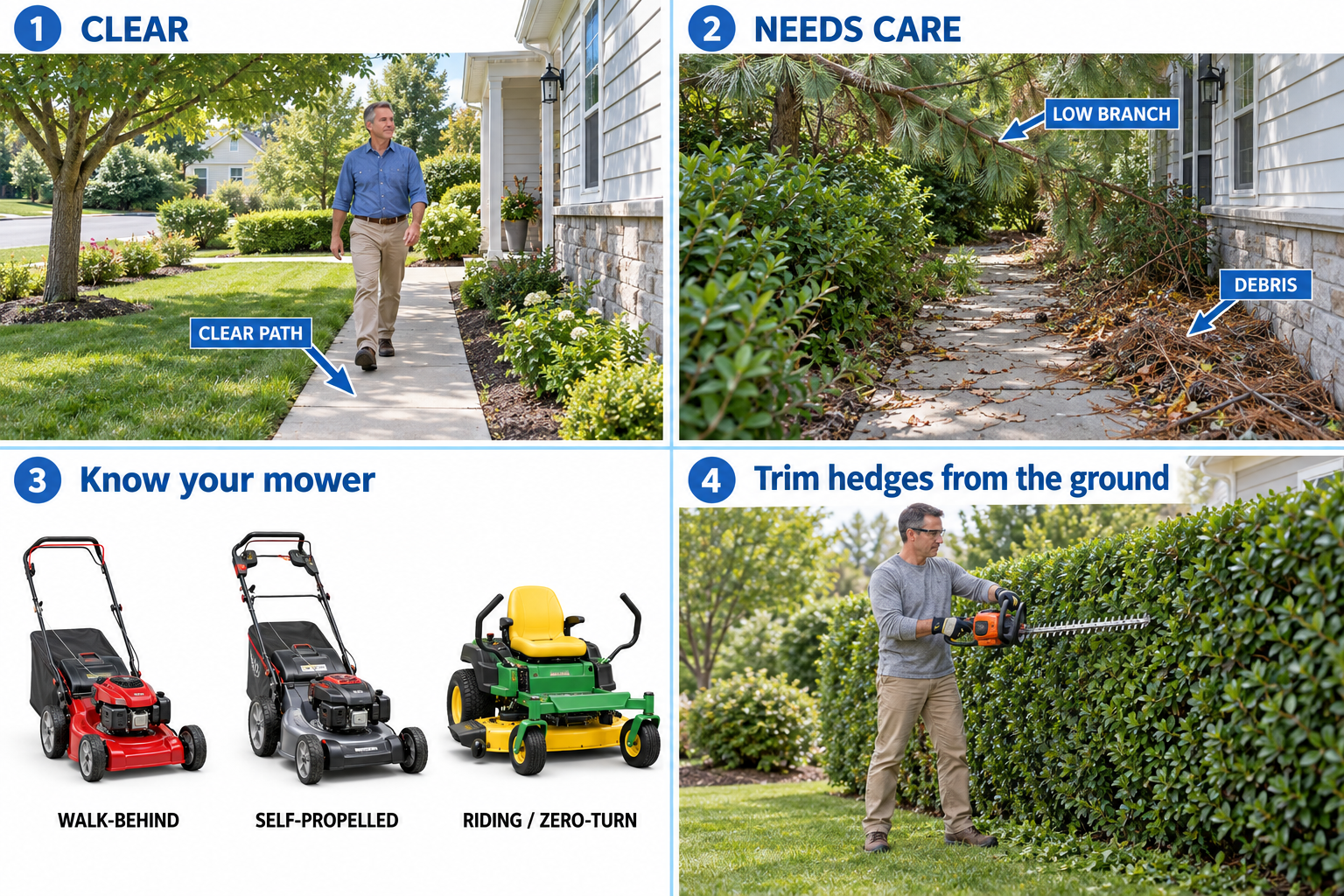
A push mower uses your effort to move. A self-propelled mower helps move itself. A riding mower carries you.
Why it matters: The right size depends on the area you actually mow, slopes, gates, storage, and your ability to use the machine safely.
Written guidance reviewed: September 17, 2026 · Sources and equipment assumptions are below.
Take this guide to another device
Steps, notes, supplies, setup choices, results and check dates save on this browser as you work. Plus can also keep an account copy. Account copies update only when you choose Save; loading one replaces the browser draft shown here.
Review all saved work. Saved account check dates appear in My Day. Clear the date and save again to finish a follow-up. Email settings stay separate; existing opted-in agenda or deadline emails can include these dated actions.
Understand the job before starting
Area, terrain, storage and maintenance requirements determine whether an option fits.
A common mistake to avoid
A cheaper purchase can still have unsuitable operating or upkeep requirements.
Use what you already have. Check each item when it is ready.
Before you begin
An untrained child should not operate a mower. Keep people and pets well away. Never carry a passenger. Stop blades and power before clearing a blockage; follow battery/spark-plug isolation instructions.
0 of 5 steps checked0%
Guide progress and notes save on this browser; choose Save account copy above to carry them to another device with Plus. Downloads contain the complete blank checklist; print to include your current checks and notes.
Do it with me
Your step position saves on this browser. Use the picture when available, then check the written result.
STEP 1 OF 5
Measure the mowing area
Start here: Estimate your mowing area.
Example: Estimate your mowing area. Follow the written step.
Read-aloud is available in supported browsers; the written steps always remain available.
A quarter acre is about 10,890 square feet, but subtract the house, driveway, beds, and other areas you do not mow.
Measure narrow gates and note slopes.
A large machine that cannot fit a gate is not useful.
Before moving to the next step
Check this specific result: I know my approximate grass area and access limits.
If that result is not true yet, leave the box unchecked. Write what is missing in your notes; use the official instructions below when the equipment or situation differs.
STEP 1 OF 5
Measure the mowing area
Start here: Estimate your mowing area.
Example: Estimate your mowing area. Follow the written step.
A quarter acre is about 10,890 square feet, but subtract the house, driveway, beds, and other areas you do not mow.
Measure narrow gates and note slopes.
A large machine that cannot fit a gate is not useful.
Before moving to the next step
Check this specific result: I know my approximate grass area and access limits.
If that result is not true yet, leave the box unchecked. Write what is missing in your notes; use the official instructions below when the equipment or situation differs.
STEP 2 OF 5
Choose a walking or riding style
Start here: Choose a walking or riding style
Illustration: Know your mower. Read the steps for your exact task.
For a small simple lawn, a push mower may be enough.
Self-propelled helps on larger walkable lawns but still requires control.
A riding tractor or zero-turn can save time on larger suitable lawns; zero-turn steering and slopes need particular care.
Acreage alone does not establish safe slope use.
Before moving to the next step
Check this specific result: I chose a style I can store and safely control.
If that result is not true yet, leave the box unchecked. Write what is missing in your notes; use the official instructions below when the equipment or situation differs.
STEP 3 OF 5
Compare battery and gas power
Start here: Compare power requirements.
Example: Compare power requirements. Follow the written step.
Battery mowers need a compatible charged battery and have limited runtime; deck size, grass thickness, and battery capacity change coverage.
Gas mowers need fuel, engine maintenance, and safe storage.
Both can throw objects.
Do not buy by advertised acreage without checking your conditions.
Before moving to the next step
Check this specific result: I compared runtime, maintenance, and total cost.
If that result is not true yet, leave the box unchecked. Write what is missing in your notes; use the official instructions below when the equipment or situation differs.
STEP 4 OF 5
Prepare each mow
Start here: Inspect before each mow.
Example: Inspect before each mow. Follow the written step.
Pick up stones, sticks, wire, and toys.
Read the manual for guards, collection bag, height, and terrain.
Keep bystanders away and stop if anyone enters the area.
Do not mow wet/slippery grass or slopes beyond the machine’s rating.
Before moving to the next step
Check this specific result: The area and mower are ready.
If that result is not true yet, leave the box unchecked. Write what is missing in your notes; use the official instructions below when the equipment or situation differs.
STEP 5 OF 5
Maintain by the correct power type
Start here: Maintain the right power type.
Example: Maintain the right power type. Follow the written step.
For battery units, remove the battery before approved cleaning and store/charge at the allowed temperature with the correct charger.
For gas units, service oil/filter/spark plug at the stated intervals and cool before refueling outdoors.
Blade service needs correct isolation and torque; use a shop if unsure.
Before moving to the next step
Check this specific result: I recorded the manual’s service tasks.
If that result is not true yet, leave the box unchecked. Write what is missing in your notes; use the official instructions below when the equipment or situation differs.
Type
Rough shopping starting point
Tradeoff
Push walk-behind
Often a small lawn, roughly up to ¼ acre of grass.
Least help moving; takes physical effort.
Self-propelled walk-behind
Often roughly ¼–½ acre; larger if runtime and user allow.
Easier travel, still walking and steering.
Riding lawn tractor
Often ½–2 acres of suitable open grass.
Storage, turning space, and more service.
Zero-turn rider
Often large open areas, around 1 acre and up.
Quick turns; special steering skills and slope restrictions.
Battery vs gas
A power choice available across several styles.
Battery count/runtime vs fuel and engine care. These ranges are examples, not safety ratings.
Pictures for this guide
Picture 1 of 5 · Measure the mowing area
Measure the mowing area: Measure only the grass area. Subtract house and paved areas.
For: Measure the mowing area
Illustrations show examples of the actions above. Follow your equipment’s instructions.
Notes about these pictures
A quarter acre is about 10,890 square feet, but subtract the house, driveway, beds, and other areas you do not mow. Measure narrow gates and note slopes. A large machine that cannot fit a gate is not useful.
An untrained child should not operate a mower. Keep people and pets well away. Never carry a passenger. Stop blades and power before clearing a blockage; follow battery/spark-plug isolation instructions.
Was this step clear?
Flag “Measure the mowing area” for review. We save the guide and step identifiers with your account to limit duplicates, not your private notes.
What to look for: Watch the operating-safety overview. Choose the mower and maintenance routine using its manual, your terrain, and your ability to operate it safely.
Link details checked 2026-10-03. Video availability and equipment menus can change.
These YouTube videos belong to their respective creators. Life’s Checklists does not own them and is not affiliated with the creators. Links open on YouTube, where the videos are available independently of our membership.
How to use the video with this guide
Read “Before you begin” first. Watch the relevant part, pause, then return to the written step and its completion check. Use captions and playback speed if they help. A demonstration may cover only part of the task or show different equipment.
Your model’s instructions and current official guidance take priority. For urgent problems, follow the stop instructions without waiting to watch a video.
For this guide, the final result is: I recorded the manual’s service tasks.
A concrete way to approach this task
Compare the area, terrain, storage, and approved maintenance needs with each mower’s instructions before buying.
What if I cannot complete a step?
If the mower does not suit the conditions or you cannot safely perform the required setup, choose another plan or seek qualified help.
Identify the exact step: “Measure the mowing area.” Record what you tried, what happened, and which item or model you used. Ask for help with that specific problem rather than repeating an unsafe or unsuccessful action.
An untrained child should not operate a mower. Keep people and pets well away. Never carry a passenger. Stop blades and power before clearing a blockage; follow battery/spark-plug isolation instructions.
Connect this skill to everyday life
Collect the handover records and identify the home systems using the owner manuals. Start with one system or one unresolved handover item.
A warranty and an insurance policy cover different situations. Knowing where a shutoff is does not mean every repair is safe to do yourself.