Read a shopping receipt and ask about a price mismatch
Check one small purchase line by line. Match items and quantities, understand the total, and ask a calm, specific question if something looks wrong.
Why it matters: A receipt helps you see what you paid and keep a useful record. A checkout scanner can make a mistake, so a quick check can catch an extra item or missing discount.
Written guidance reviewed: 2026-11-04 · Sources and equipment assumptions are below.
Take this guide to another device
Steps, notes, supplies, setup choices, results and check dates save on this browser as you work. Plus can also keep an account copy. Account copies update only when you choose Save; loading one replaces the browser draft shown here.
Review all saved work. Saved account check dates appear in My Day. Clear the date and save again to finish a follow-up. Email settings stay separate; existing opted-in agenda or deadline emails can include these dated actions.
Understand the job before starting
A receipt helps you see what you paid and keep a useful record. A checkout scanner can make a mistake, so a quick check can catch an extra item or missing discount.
A common mistake to avoid
If you cannot match a shortened item name, ask staff before assuming an extra charge. If you notice the problem later, use the store official customer-service contact and keep a private copy of the receipt. Never send a card PIN or password to resolve a receipt question. Do not throw away a paper original until you know whether it is needed for your situation.
Words used in this guide
Rent
The amount paid to use someone else’s property for an agreed time. Read the example
The order of the job
Find your receipt and check which purchase it records
Match each item, quantity and price
Follow the total without subtracting a discount twice
Use what you already have. Check each item when it is ready.
Before you begin
Use a fictional receipt for shared practice. Real receipts can contain payment digits, loyalty details, names or pickup codes; keep them private. Do not post them publicly. This is a basic checking skill, not a promise of a refund or a statement of local tax law. Prices, promotions, taxes and correction rules vary. Ask store staff to explain unfamiliar lines instead of assuming fraud.
0 of 4 steps checked0%
Guide progress and notes save on this browser; choose Save account copy above to carry them to another device with Plus. Downloads contain the complete blank checklist; print to include your current checks and notes.
Do it with me
Your step position saves on this browser. Use the picture when available, then check the written result.
STEP 1 OF 4
Find your receipt and check which purchase it records
Start here: Match the store and date to the purchase you want to check.
Illustration: Find your receipt and check which purchase it records. Read the steps for your exact task.
Read-aloud is available in supported browsers; the written steps always remain available.
A receipt is a record of a purchase or payment.
It may be paper or a digital copy.
Look for the store, date and final amount.
Make sure you are reading the right shopping trip.
Find the list of items, not only a card payment slip that may show just the total.
If you cannot find an itemized receipt, ask staff how to get one for your purchase.
Itemized means each item is listed separately.
Keep the receipt while you check; do not share payment numbers or barcodes in a public worksheet.
Before moving to the next step
Check this specific result: I have the right purchase record and can see the item list, or know whom to ask for it.
If that result is not true yet, leave the box unchecked. Write what is missing in your notes; use the official instructions below when the equipment or situation differs.
STEP 1 OF 4
Find your receipt and check which purchase it records
Start here: Match the store and date to the purchase you want to check.
Illustration: Find your receipt and check which purchase it records. Read the steps for your exact task.
A receipt is a record of a purchase or payment.
It may be paper or a digital copy.
Look for the store, date and final amount.
Make sure you are reading the right shopping trip.
Find the list of items, not only a card payment slip that may show just the total.
If you cannot find an itemized receipt, ask staff how to get one for your purchase.
Itemized means each item is listed separately.
Keep the receipt while you check; do not share payment numbers or barcodes in a public worksheet.
Before moving to the next step
Check this specific result: I have the right purchase record and can see the item list, or know whom to ask for it.
If that result is not true yet, leave the box unchecked. Write what is missing in your notes; use the official instructions below when the equipment or situation differs.
STEP 2 OF 4
Match each item, quantity and price
Start here: Compare one receipt line with the actual item and offer.
Illustration: Match each item, quantity and price. Read the steps for your exact task.
Receipt names are often shortened.
Match a line to the item brand, size or product code, asking staff if the name is unclear.
Quantity means how many were charged.
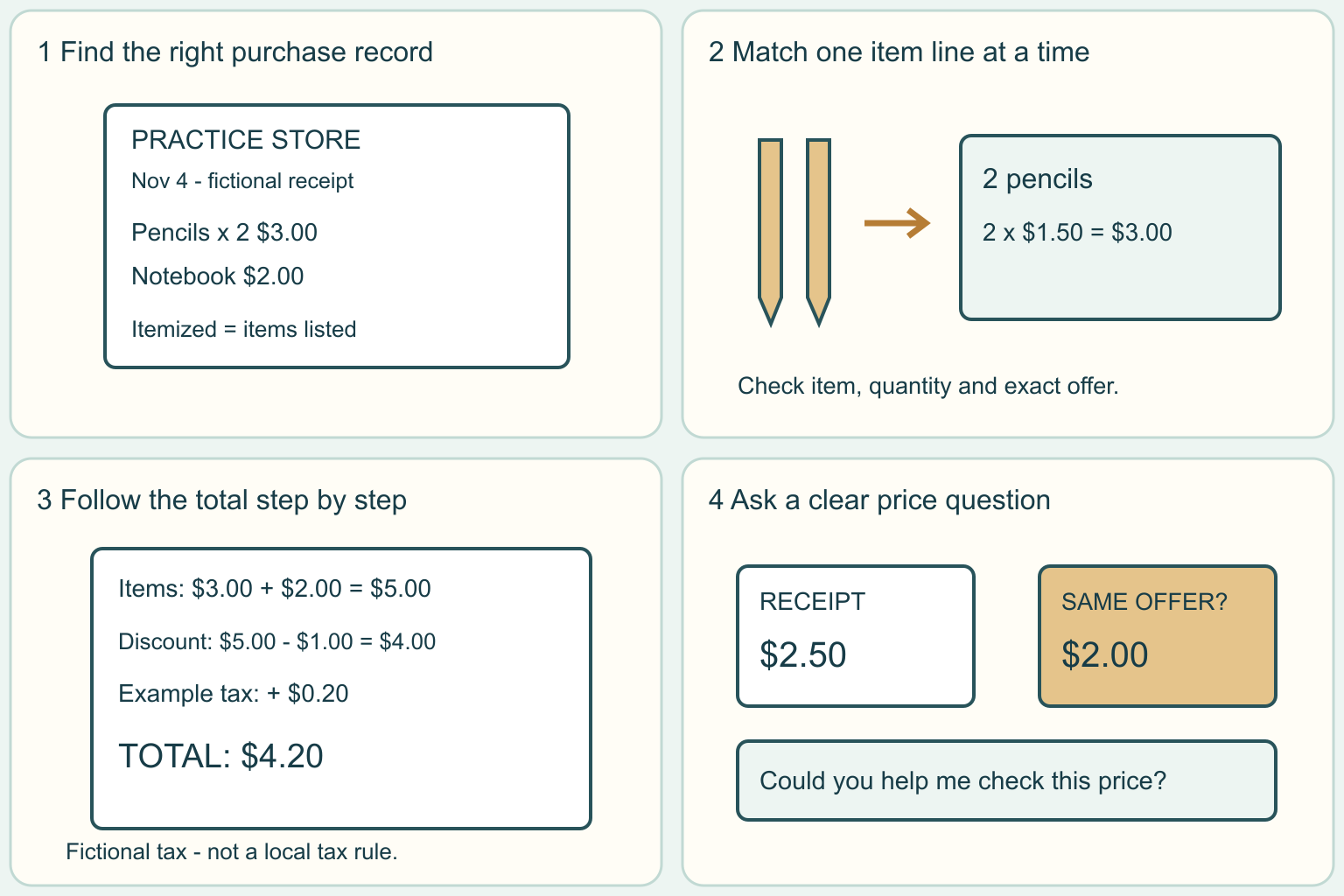
Two pencils at $1.50 each make a $3.00 line: 2 times $1.50 equals $3.00.
Check that the same item was not listed twice by mistake.
Compare with the offer for that exact size and variety.
A promotion may require a loyalty account, coupon or minimum quantity.
Keep those conditions visible instead of comparing different offers.
Weighted goods use weight and a price per weight unit; ask for help reading those lines.
Before moving to the next step
Check this specific result: I matched the item names, quantities and relevant price or offer conditions.
If that result is not true yet, leave the box unchecked. Write what is missing in your notes; use the official instructions below when the equipment or situation differs.
STEP 3 OF 4
Follow the total without subtracting a discount twice
Start here: Separate item amounts, discounts and added charges.
Illustration: Follow the total without subtracting a discount twice. Read the steps for your exact task.
Subtotal usually means an amount before some final additions; the layout decides whether discounts are already included.
Discount means money taken off.
Tax or another charge may be shown separately.
In our fictional example, pencil line $3.00 plus notebook $2.00 makes $5.00.
Subtract one $1.00 discount to get $4.00, then add the made-up $0.20 tax line to get $4.20.
The tax is an arithmetic example, not a rate or a rule for your location.
If a receipt already reduced an item price, do not subtract the same discount again.
Ask staff which items and rules explain a tax or fee you do not understand.
Before moving to the next step
Check this specific result: I can follow the displayed total or identify the specific line that needs an explanation.
If that result is not true yet, leave the box unchecked. Write what is missing in your notes; use the official instructions below when the equipment or situation differs.
STEP 4 OF 4
Ask a specific question and save the result
Start here: Show the receipt line and matching offer to customer service.
Illustration: Ask a specific question and save the result. Read the steps for your exact task.
Use a calm question such as Could you help me check this price?
This receipt line shows $2.50, and this offer for the same size shows $2.00.
Ask staff to check the conditions and explain or correct the difference.
If a correction is made, keep its receipt too and check the new amount.
If unresolved, note the item, date, quoted price, charged price and store response privately.
For U.S. price-accuracy concerns, your state weights-and-measures or consumer office may be the appropriate next contact; local rules decide.
A return for an unwanted item is a separate process from checking a charge.
Before moving to the next step
Check this specific result: I saved the receipt and any explanation or correction, with a clear next action if unresolved.
If that result is not true yet, leave the box unchecked. Write what is missing in your notes; use the official instructions below when the equipment or situation differs.
Pictures for this guide
Picture 1 of 4 · Find your receipt and check which purchase it records
A fictional receipt shows a practice store, purchase date and itemized lines without private identifiers.
For: Find your receipt and check which purchase it records
Illustrations show examples of the actions above. Follow your equipment’s instructions.
Notes about these pictures
A receipt is a record of a purchase or payment. It may be paper or a digital copy. Look for the store, date and final amount. Make sure you are reading the right shopping trip. Find the list of items, not only a card payment slip that may show just the total. If you cannot find an itemized receipt, ask staff how to get one for your purchase. Itemized means each item is listed separately. Keep the receipt while you check; do not share payment numbers or barcodes in a public worksheet.
Use a fictional receipt for shared practice. Real receipts can contain payment digits, loyalty details, names or pickup codes; keep them private. Do not post them publicly. This is a basic checking skill, not a promise of a refund or a statement of local tax law. Prices, promotions, taxes and correction rules vary. Ask store staff to explain unfamiliar lines instead of assuming fraud.
Was this step clear?
Flag “Find your receipt and check which purchase it records” for review. We save the guide and step identifiers with your account to limit duplicates, not your private notes.
A specific companion has not been selected for this new guide yet. You can search for related demonstrations; search results have not been reviewed by Life’s Checklists.
These YouTube videos belong to their respective creators. Life’s Checklists does not own them and is not affiliated with the creators. Links open on YouTube, where the videos are available independently of our membership.
How to use the video with this guide
Read “Before you begin” first. Watch the relevant part, pause, then return to the written step and its completion check. Use captions and playback speed if they help. A demonstration may cover only part of the task or show different equipment.
Your model’s instructions and current official guidance take priority. For urgent problems, follow the stop instructions without waiting to watch a video.
Finish the job and know what to do next.
For this guide, the final result is: I saved the receipt and any explanation or correction, with a clear next action if unresolved.
A concrete way to approach this task
Fictional receipt: two pencils at $1.50 each = $3.00; notebook = $2.00; discount = minus $1.00; made-up tax = $0.20; total = $4.20. If paying with a $5.00 note, example change is $0.80 because $5.00 minus $4.20 equals $0.80. Real totals and cash-rounding rules depend on the purchase and location.
What if I cannot complete a step?
If you cannot match a shortened item name, ask staff before assuming an extra charge. If you notice the problem later, use the store official customer-service contact and keep a private copy of the receipt. Never send a card PIN or password to resolve a receipt question. Do not throw away a paper original until you know whether it is needed for your situation.
Identify the exact step: “Find your receipt and check which purchase it records.” Record what you tried, what happened, and which item or model you used. Ask for help with that specific problem rather than repeating an unsafe or unsuccessful action.
Use a fictional receipt for shared practice. Real receipts can contain payment digits, loyalty details, names or pickup codes; keep them private. Do not post them publicly. This is a basic checking skill, not a promise of a refund or a statement of local tax law. Prices, promotions, taxes and correction rules vary. Ask store staff to explain unfamiliar lines instead of assuming fraud.
Connect this skill to everyday life
List actual take-home pay, essential bills, and their dates. Work with money available to you rather than gross income.
Money left in an account today may already be needed for a bill tomorrow. A credit limit is borrowed money, not income.
A useful record for this task: Record the result of “Ask a specific question and save the result”: I saved the receipt and any explanation or correction, with a clear next action if unresolved.
When finished, record the result and any next check or follow-up date. Your original step checks and notes remain on this browser.
Keep the result of your work
Finish and check every step before recording completion. You can write a draft below now.
Result: Not recorded · Next check: Not chosen
Choose a date from your own manual or situation. No email is enabled by saving this record.